Double Solid Yellow Line
Meaning, Rules, and When You Can Cross It
Double solid yellow lines are the most common centerline marking for separating opposing traffic and signaling a strict no-passing rule. This comprehensive guide covers everything you need to know.
Double solid yellow lines mean a no-passing zone. You must not cross into oncoming lanes to pass. A double solid yellow line in the middle of the road indicates that opposing traffic is on the other side and passing is prohibited in either direction.
Exceptions: Most states allow you to cross briefly to make a left turn, lawful U-turn, or driveway entry/exit, or when directed by police/flaggers or to avoid hazards, provided it is safe.
A Double Yellow Line in the Center of a Highway Means…
A double yellow line down the center of a two-way road signals opposing traffic and no passing. Opposing traffic on expressways is usually separated by solid double yellow lines to maximize safety.
What Do Solid Yellow Center Lines Mean?
- A solid yellow line on your side indicates a no-passing zone, even with good sight distance.
- Yellow lines mean traffic in opposite directions; white lines mean traffic in the same direction.
- Yellow lines separate traffic flowing in opposite directions.
Basic Concepts: Yellow Center Lines and Road Markings
Yellow lines govern opposing traffic; white lines govern same-direction lanes or right edges. Diagonal or horizontal markings guide or restrict entry. This is a concise “drivers ed traffic lines explained” guide.
Yellow Lines Show Traffic in Opposite Directions
- A yellow center line shows traffic flowing in opposite directions.
- Yellow double lines, two yellow solid lines, or a road with a double solid line all signal “no passing.”
- Road yellow lines tell you opposing traffic is on the other side—stay in your lane.
Lines Parallel to the Roadway: What They Indicate
- Parallel lines mark lane edges or separation.
- Horizontal yellow lines and diagonal yellow stripes mark gore areas, channelization, or “do not enter” zones.
- Half passing lane color: on shared climbing or passing lanes, yellow/white combinations show which side may enter.
Single Solid Yellow Line vs Double Solid Yellow Line
Both warn against crossing to pass; double solid yellow is the stronger, two-way prohibition.
Single Solid Yellow Line: Meaning and Passing Rules
Single Solid Yellow Line
A solid yellow line means your side is a no-passing zone. Crossing is generally limited to lawful exceptions (like left turns into driveways) and only when safe.
Double Solid Yellow Lines: Stronger No-Passing Message
Warning
Double solid yellow lines mean neither direction may cross to pass.
They separate lanes of traffic with a stricter no-passing rule. Only specific exceptions (left turns, lawful U-turns, driveway access, police direction, obstacle avoidance) allow brief crossing.
- Double solid yellow lines rules: no passing in either direction, stay in lane unless a listed exception applies.
- Single yellow solid line vs double / single solid yellow line and double solid yellow line: single is a warning for your side; double is a hard two-way barrier.
- Difference between solid vs double solid lines: single solid limits your side; double solid blocks both directions.
- What does double sided yellow lines mean? They are paired solid yellow lines marking a two-way no-passing zone.
Broken vs Solid Yellow Lines (Passing Zones)
Broken yellow means passing is allowed when safe; solid yellow means no passing. Combinations indicate which side may pass.
- Broken yellow line means you may pass when safe and clear of oncoming traffic.
- A single broken yellow line down the center of a two-lane road indicates passing is permitted if safe.
- Broken yellow line versus single broken line: same meaning for centerlines.
- Broken (dotted) lines mean lane changes or passing are allowed when safe.
- A broken yellow line next to your lane means you may pass if safe.
Broken Yellow Line vs Broken White Line
- Broken yellow vs broken white: yellow allows crossing into opposing lanes to pass; white allows lane changes in the same direction.
- Broken white lines (even misspellings like “broken whitw line”) allow same-direction lane changes with yielding.
- Which type of line indicates you may change lanes when safe? A dashed or broken white line.
Solid Yellow with Broken Yellow or White Line
- Solid yellow on your side plus broken on the other: your side cannot pass; the opposite side may.
- A solid yellow line on your side indicates a no-passing zone even if the other side is broken.
- Double solid yellow “breakdown” patterns (for example, some Florida medians) mark turn lanes or managed lanes—do not use them for passing or stopping.
- Double broken yellow may appear on reversible or managed lanes—follow time-of-day controls.
- A double solid yellow line with a broken white line usually marks a managed or turn lane boundary; only cross where openings or signs permit.
When May You Cross a Double Solid Yellow Line?
Tip
No, you cannot cross to pass.
However, limited exceptions exist:
- Left turns
- Lawful U-turns
- Driveway access
- Police or flagger direction
- Avoiding an obstacle (when safe)
- “Under no conditions” is incorrect—these limited exceptions exist.
- If someone tries to pass you across double yellow, maintain speed, do not race, and keep safe space.
Legal Exceptions: Emergency Vehicles, Road Work, and Obstacles
- Follow police or flagger instructions.
- Follow detours or temporary controls in work zones.
- To avoid an obstacle, you may briefly cross if no safer option exists and oncoming traffic is clear.
- Emergency vehicles may cross while on duty; regular drivers should usually yield right without crossing.
Left Turns, U-Turns, and Driveways Across Double Yellow Lines
Most states allow left turns or U-turns across double yellow when legal and safe.
Turning Left Across Double Yellow Lines
Permitted where no posted ban and sight distance is adequate—enter side streets, driveways, and business entrances only when safe. Double solid yellow line left turn rules mirror the general exceptions: signal early, yield, and turn when clear. When to turn into a driveway lines: slow early, signal, and complete the turn without blocking through traffic.
- Cross double solid yellow lines to make a left turn: legal when no sign prohibits and it is safe to do so.
- Crossing to a solid double yellow line to park at an establishment on the left: also allowed when safe, yielding to oncoming traffic.
U-Turns on Roads with Double or Broken Yellow Lines
- U-turns depend on state law and signage; if not prohibited and sight distance is sufficient, a lawful U-turn may be made when safe.
- Always yield to oncoming traffic and pedestrians.
Parking or Entering Driveways on the Left
- Crossing double yellow to park or enter a left-side lot is generally allowed when safe and lawful.
- Signal early, slow down, and check opposing and following traffic.
Special Double Yellow Configurations and Painted Medians
Painted Medians with Double Solid Yellow Lines on Both Sides
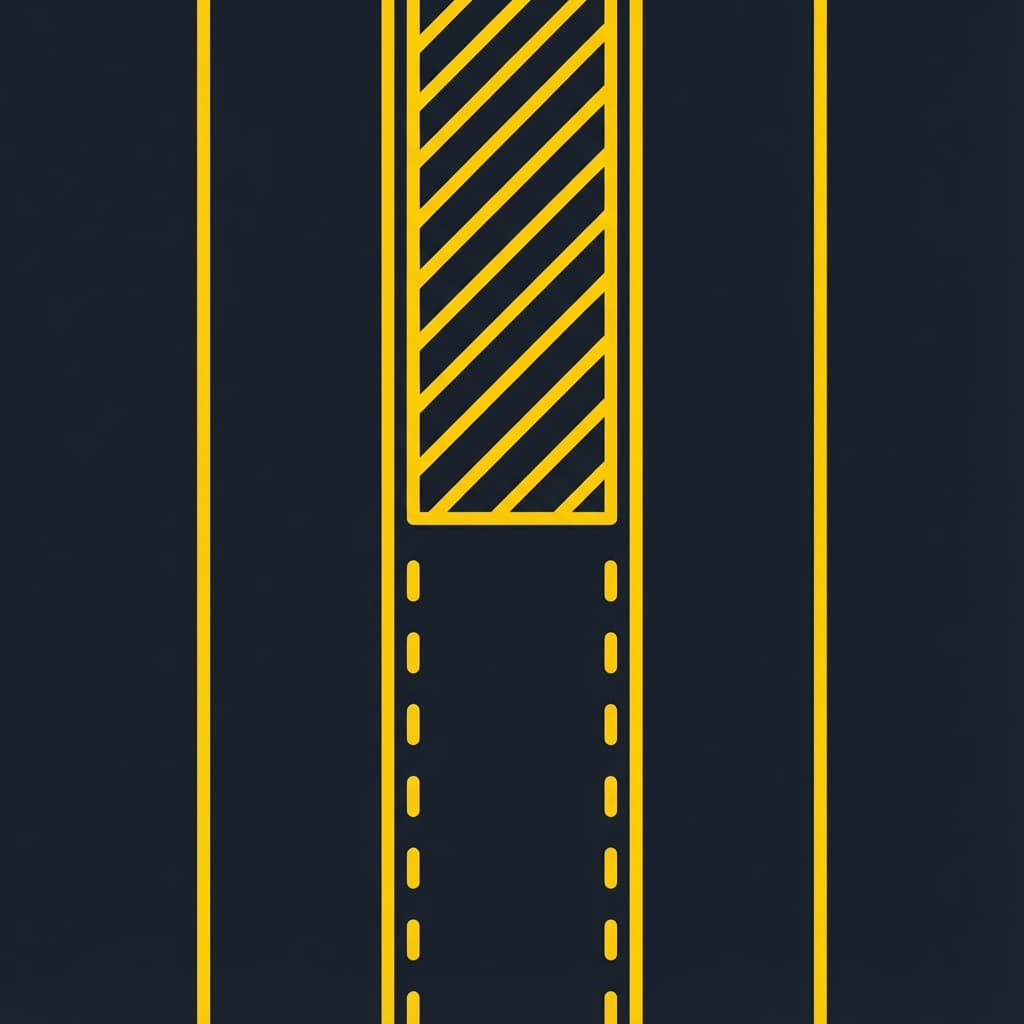
Painted medians with double yellow on both sides are non-travel buffers; do not drive or stop in them. Use openings to turn.
- Painted median with double solid yellow lines on both sides: treat it as a barrier unless a marked opening invites a turn.
“Double-Double” Yellow Lines (Two Sets of Double Solid Yellow Lines)
Warning
Two sets of double yellow lines spaced 2 or more feet apart act as a physical barrier—do not cross or enter. They are stricter than a single double yellow pair.
Double Yellow Lines on the Edge or Outer Edge of the Road
Yellow Line on the Side of the Road: What It Indicates
- Double solid yellow on the edge or outer edge often marks a left-side barrier (for example, reversible or divided configurations); do not cross. Double solid yellow line on edge of road / double solid yellow line on outer edge of road both signal “do not enter.”
- A yellow line on the side of the road marks the left edge of a divided highway; the right edge is typically a white line.
- Double solid yellow lines not in the center of road (for example, geoguessr-style median edges) still mean do not cross into the restricted side.
- What does a yellow line on the side of the road indicate? It marks the left edge or a barrier side; stay to the right of it.
Yellow vs White Lines, Single vs Double White Lines
Yellow separates opposing traffic; white separates same-direction traffic or marks the right edge. Yellow and white solid lines both discourage or restrict crossing, but context differs.
Single Solid White Line vs Dashed White Line
- Single solid white: same-direction lanes; avoid crossing unless necessary.
- A solid white line on the right edge: right-hand edge line.
- Dashed white line: lane changes allowed when safe.
Double Solid White Line vs Double Solid Yellow Line
- Double solid white: same-direction lanes—do not cross (for example, HOV or toll boundaries).
- Double solid yellow: opposing traffic—do not cross to pass.
- Single vs double white: double is stricter.
- You may cross a single solid white in limited, safe, and usually discouraged situations; double white is typically a hard “do not cross.”
- Double solid white line vs double solid yellow line: both are “do not cross,” but white applies to same-direction lanes, yellow to opposing traffic.
Distance, Spacing, and Other Marking Details
- Typical MUTCD centerline pattern: 10-foot line segments with 30-foot gaps (may vary by state or road type).
- Half passing lane color: line patterns show which side may enter a passing or climbing lane.
- International note: U.S. rules follow MUTCD; other countries (for example, Philippines) may differ—follow local standards.
- Distance between dotted yellow lines on a single road: commonly 10-foot stripes with 30-foot gaps unless a state standard varies.
- A yellow center line shows traffic flowing in opposite directions—if the center line is yellow, expect oncoming traffic.
- Double yellow lines on road / double yellow line on road: both indicate two-way separation and no passing unless exceptions apply.
State-Specific Rules and Examples (Overview)
The base meaning is consistent, but left-turn or U-turn allowances, special lanes, and penalties vary by state; see state pages for details.
🏛️State-Specific Variations
Florida
Double Solid Yellow Breakdown Lines: Florida often uses two-way left-turn lanes bordered by double yellow; stay out except to make permitted left turns or U-turns at openings, not for stopping or passing.
Oregon
Double Solid Yellow Line Rules: Oregon bans passing across double yellow but allows safe left turns into or out of driveways or lawful U-turns where not prohibited. Mountain curves may extend double yellow for safety.
Common Phrasing and Test Prompts (Coverage)
- A double yellow line down the center of a two-way street indicates a two-way, no-passing zone; a solid double yellow line down the center of a two-way street indicates the same.
- Double solid yellow lines painted down the middle of the road mean opposing traffic separation and no passing; a double solid yellow line means a two-way no-passing barrier.
- Double solid yellow line vs single solid yellow line: double is stricter; single solid yellow line and double solid yellow line both warn against passing, but double blocks both directions.
- Double solid yellow line means: no passing; only limited exceptions for turns or hazards.
- Can you pass double solid yellow line? No—passing is prohibited. When can you cross a solid yellow line? Only for specific exceptions like safe left turns where allowed.
- Double broken yellow line in the road means a reversible or managed lane; obey lane-control signals.
- Double solid yellow breakdown lines mean a painted median or turn lane; do not travel or stop inside except at marked openings.
- Two sets of solid double yellow lines two feet or more apart are considered a barrier; do not cross them.
- A double solid yellow line with a broken white line in between means you’re at the edge of a managed or turn lane—cross only where openings or signs permit.
- What do solid yellow center lines mean? They indicate opposing traffic; passing is controlled by solid vs broken patterns.
- What do solid yellow center lines mean? a common test prompt whose answer is “two-way traffic, no passing unless you have a broken line on your side.”
- What do solid yellow center lines mean? a — same answer, two-way traffic with no passing unless your side is broken.
- What does double sided yellow lines mean? They are paired solid yellow lines marking a two-way no-passing zone.
- What is it called when you cross the yellow line to pass another vehicle? Improper or unsafe passing across the centerline.
- Double solid yellow line with broken white line: treat as a boundary—no crossing except at designated openings.
- Double solid yellow lines not in the center of road geoguessr / on the outer edge of road geoguessr: still act as barriers marking no-entry zones.
- Double solid yellow lines on the outer edge of road geoguessr: same barrier rule stated plainly.
- Solid yellow road line / double yellow lines on road / double yellow line on road: center markings separating two-way traffic; no passing unless you have a broken line on your side.
- Left roadway meaning: leaving the traveled way; do so only where legal (for example, a legal left turn) and never to pass across double yellow.
- Crossing to a solid double yellow line to park at an establishment on the left: permitted when safe and legal; yield to oncoming traffic.
- Can you do a U-turn on both a double and broken yellow line? Only if local law and signage allow; broken on your side with clear sight distance is required for safe passing or turning.
- Double solid yellow lines rules: no passing; limited exceptions for turns, driveways, hazards, or official direction.
- What does a yellow line on the side of the road indicate? It marks the left edge or barrier side; stay right of it.
- Double solid yellow line on edge of road / double solid yellow line on outer edge of road: treat as a barrier, not a passing invitation.
- You may cross a double solid yellow line under no conditions meaning: that phrasing is wrong—limited exceptions do exist.
- Single yellow lines can you do a left turn? Yes, where not prohibited and safe; follow the same caution as double yellow exceptions.
- Cross double solid yellow lines to make a left turn: legal when not posted otherwise and safe.
- Can you do a u turn on both a double and broken yellow line: only where U-turns are permitted and safe; check signage and sight distance.
- A solid double yellow center line means opposing traffic separation and no passing.
- Opposing traffic on expressways is usually separated by solid, double yellow lines; stay in your lane.
- When are you allowed to cross a double solid yellow line? Only for narrow exceptions; never to pass.
- If someone tries to pass you on a double solid yellow line: hold lane and speed; do not escalate.
- Broken yellow line vs single broken line: both permit passing when safe; context (center vs lane) matters.
- Where on a divided highway does a solid yellow line appear by itself? On the left edge by the median to mark the opposing side.
- Is double solid yellow line oppostie directino? Yes—double yellow separates opposite directions; stay to the right of it unless a lawful exception applies.
Practice Questions: DMV-Style Double Yellow Line Questions
1. A double, solid yellow line in the middle of the road means:
No crossing to pass; only brief crossing for allowed moves like left turns, U-turns, or driveways when safe and legal.
2. A double yellow line in the center of a highway means:
Two-way traffic separated; passing is prohibited. Follow local rules for left turns or U-turns.
3. Double solid yellow lines painted down the middle of the road mean:
Opposing traffic separation and no passing; stay in your lane except for lawful exceptions.
4. A solid yellow line on your side indicates a no-passing zone.
True; do not cross to pass.
5. A broken yellow line in the middle of the road means:
Passing is allowed when safe and after yielding to oncoming traffic.
6. You may not cross a single broken white (or yellow) line:
Normally dashed lines may be crossed when safe, unless signs or signals prohibit or near restricted areas or intersections.
7. Is it legal to cross a double solid yellow centerline to pass?
No. Passing across double yellow is illegal; left turns, U-turns, and driveways are not “passing.”
8. When double solid yellow lines separate lanes of traffic…
Neither direction may cross to pass; stay in lane unless a lawful exception applies.
9. If there is a solid double yellow line in the center of the roadway, you:
Stay in your lane; only cross briefly for lawful left turns, U-turns, or driveways when safe.
10. What is it called when you cross the yellow line to pass another vehicle?
Improper or unsafe passing or crossing the centerline—typically ticketed with fines and points.
11. Double solid yellow line means?
It means a two-way no-passing zone; crossing to pass is prohibited, with only limited exceptions for turns or hazards.
12. . Is it legal cross a double solid yellow centerline to pass?
No. Even with the leading period seen in some test prep phrasing, the rule remains: do not cross double solid yellow to pass.
FAQ: Double Solid Yellow Line Meaning and Crossing Rules
Frequently Asked Questions
What does a double solid yellow line mean?
It separates opposing traffic and creates a no-passing zone in both directions; only limited legal exceptions allow brief crossing.
When may you cross a double solid yellow line?
Common exceptions: left turns into or out of driveways or side streets, lawful U-turns where permitted, following police or flagger directions, or carefully avoiding an obstacle when safe.
Can you pass another vehicle over a double solid yellow line?
No. Passing into oncoming lanes is prohibited; left turns, U-turns, and driveways are not “passing.”
What is the difference between a single solid yellow line and a double solid yellow line?
Single solid yellow warns one side not to pass; double solid yellow is a two-way no-passing barrier, enforced more strictly.
What do yellow and white solid lines mean?
Yellow solid lines separate opposing traffic and restrict crossing; white solid lines separate same-direction lanes or mark the right edge and discourage or prohibit lane changes depending on single versus double.