This comprehensive guide covers Ohio's essential driving laws and traffic regulations under the Ohio Revised Code (ORC). Whether you're a new driver preparing for your Ohio BMV driver's license exam, a resident needing to understand state-specific rules, or a visitor navigating Ohio roads, this guide provides clear explanations of double yellow line rules, turn regulations, school bus stop laws, OVI penalties, work zone requirements, and Ohio-specific traffic laws. All information references official Ohio BMV guidance and ORC statutes.
Advertisement
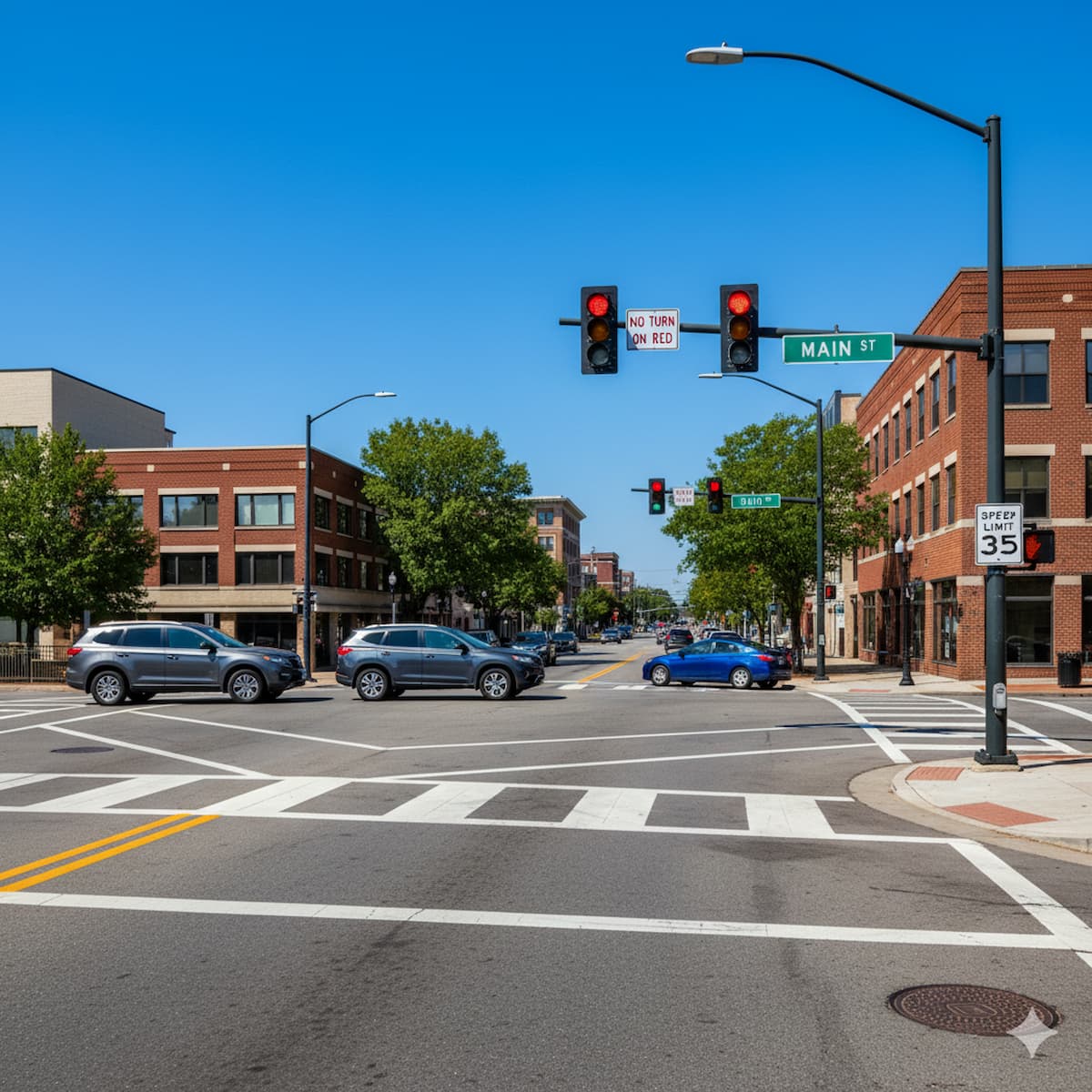
Ohio roadways require drivers to follow specific state traffic laws and road marking regulations.
Ohio Double Yellow Line Laws: No-Passing Zones & Centerline Rules
ORC §4511.31: When you can and cannot cross double yellow lines
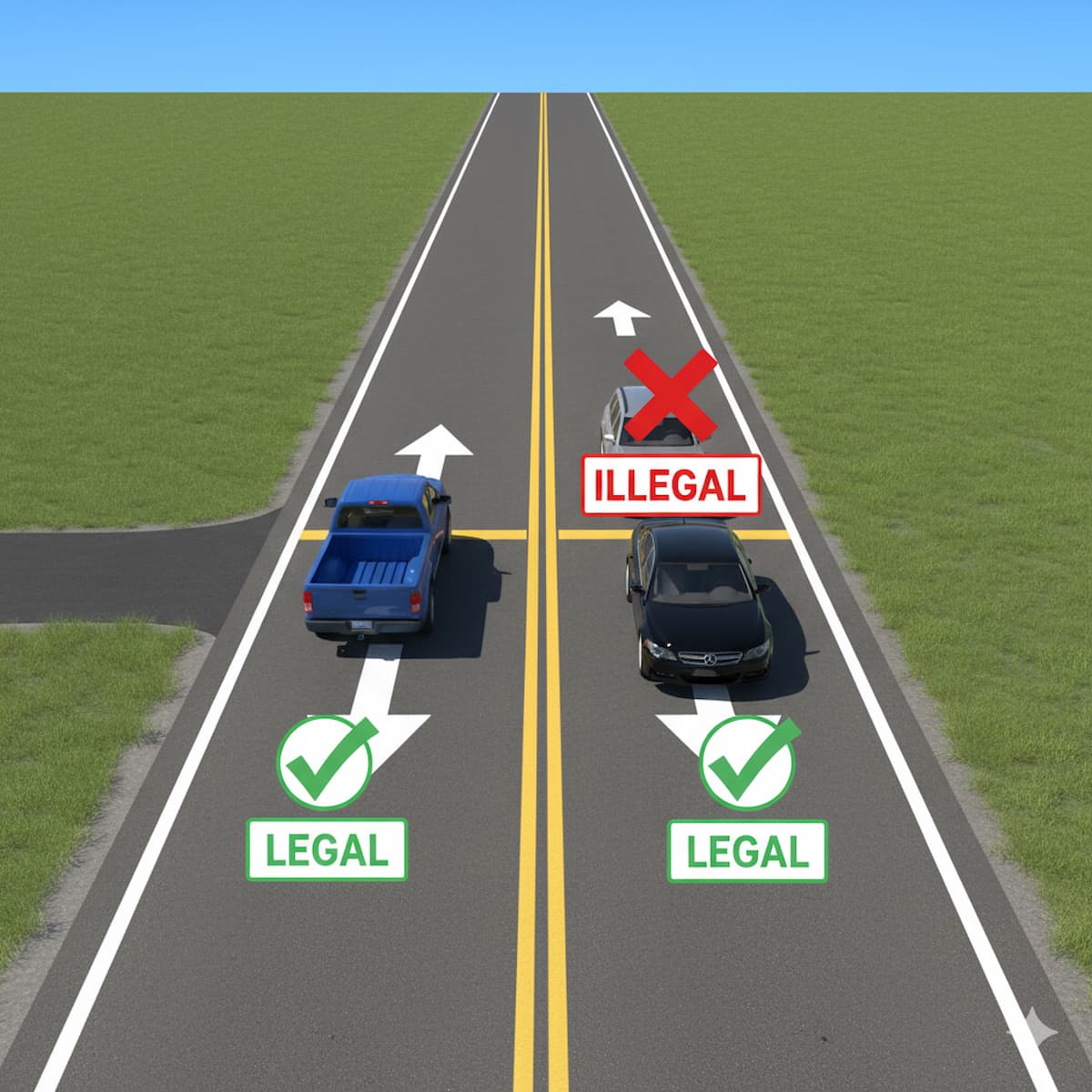
Ohio's double yellow centerline regulations are governed by Ohio Revised Code (ORC) §4511.31, which establishes no-passing zones throughout the state. In Ohio, double solid yellow lines indicate that passing is prohibited for traffic traveling in both directions. These markings typically appear on curves, hills, intersections, bridges, and other areas where passing would be dangerous due to limited sight distance, heavy traffic, or roadway conditions.
Legal exceptions: left turns into driveways and private roads in Ohio
Ohio law permits drivers to cross double yellow lines to make left turns into driveways, alleys, or private roads when it is safe to do so. This is the most common exception to the no-passing rule. When making such turns, you must yield to oncoming traffic, use your turn signal at least 100 feet in advance, and complete the maneuver safely without impeding other vehicles. Review our detailed guide on left turns across double yellow lines for step-by-step best practices and safety tips.
Crossing to avoid obstructions: roadway hazards and stopped vehicles in OH
Ohio drivers may briefly cross the centerline—even in a no-passing zone—to avoid an obstruction in the roadway, such as a disabled vehicle, fallen debris, road construction equipment, or a road hazard. The key requirement is that the maneuver must be necessary for safety and performed only when it can be done without endangering oncoming traffic. You must return to your lane as soon as it is safe. This exception does not permit passing slower-moving vehicles in no-passing zones—that remains illegal under ORC §4511.31.
Common violations and penalties for illegal passing in Ohio
Illegally passing across double yellow lines in Ohio can result in fines typically ranging from $150 to $500 depending on the jurisdiction, plus court costs. The violation carries 2 points on your Ohio driving record. Accumulating too many points (12 or more within 2 years) triggers a license suspension. Courts and law enforcement view passing in no-passing zones seriously, especially if it results in a crash, near-miss, or endangers other road users. Check our guide on when you may cross double yellow lines for complete rules and exceptions.
Two sets of double yellow lines: Ohio painted median regulations
In Ohio, when you encounter two sets of double yellow lines placed close together (often called a "painted median," "flush median," or "double-double yellow"), you must treat this area as a physical barrier. Under ORC §4511.35, you may not drive on, across, or within this painted median except at designated openings marked for left turns. These markings are commonly found on busy state routes and urban arterial roads in Ohio cities like Columbus, Cleveland, Cincinnati, and Toledo. Learn more about two sets of double yellow lines and how they function as median barriers.
Center left-turn lanes (TWLTL) vs painted medians in Ohio roadways
Ohio also uses center left-turn lanes (two-way left-turn lanes or TWLTL), which have a different marking pattern. These lanes feature broken yellow lines on both sides with yellow arrows pointing left, and they are shared by traffic traveling in both directions to make left turns. Do not confuse these with painted medians—center turn lanes are designed for shared use and may be entered for up to 200 feet before your turn, while painted medians are barriers that must not be crossed or occupied except at designated openings.
Ohio allows crossing double yellow lines for left turns but prohibits passing in no-passing zones.
Advertisement
Right Turn on Red in Ohio: ORC §4511.13 Requirements
Complete stop requirement before turning right on red in Ohio
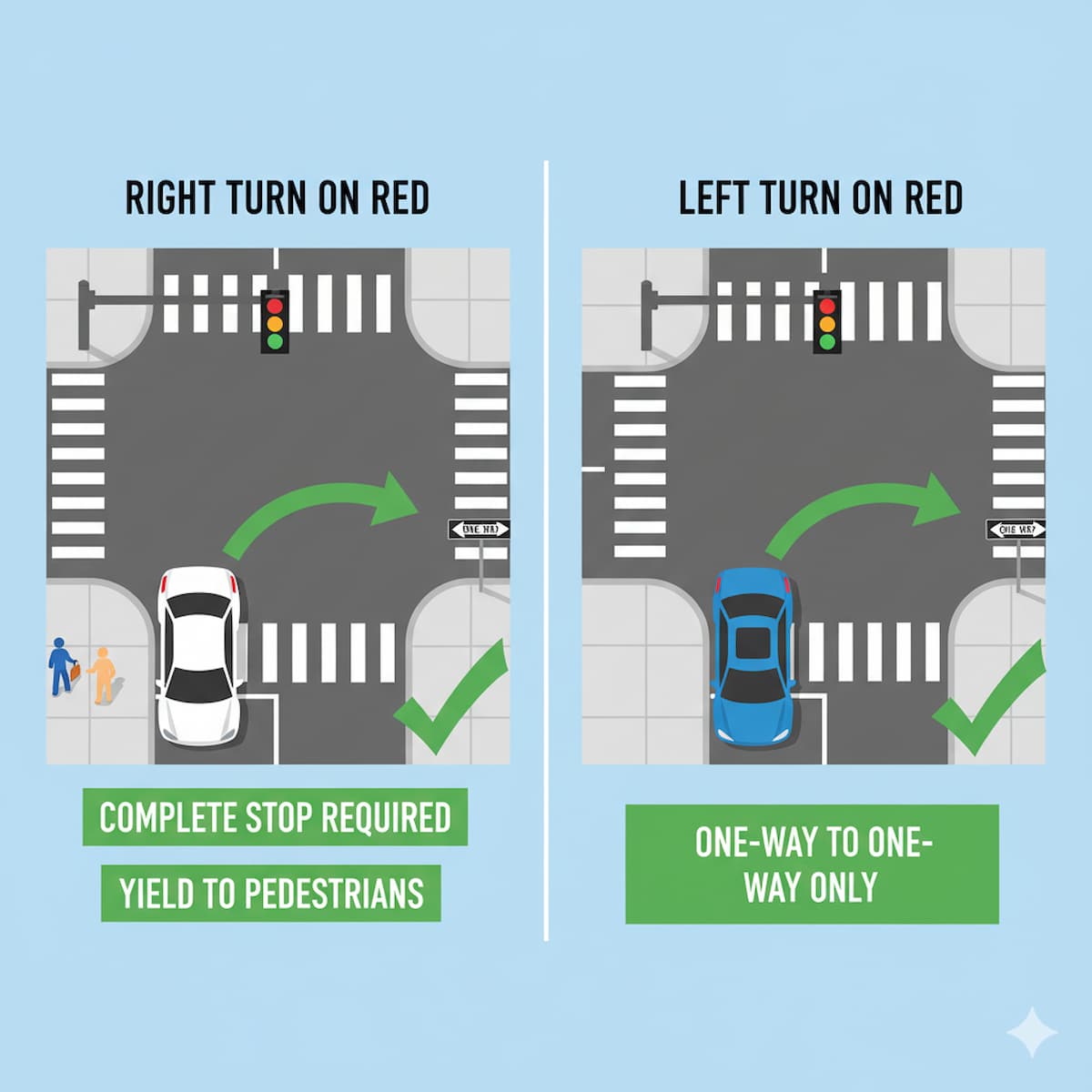
Ohio law allows right turns on red after coming to a complete stop at the stop line, crosswalk, or point where you have a clear view of approaching traffic. Under ORC §4511.13, you must yield the right-of-way to pedestrians and vehicles lawfully proceeding through the intersection before making your turn. This is one of the most commonly tested rules on the Ohio BMV driver's license exam. The complete stop must be made before the marked stop line or crosswalk—rolling through without stopping is a violation that carries a fine and 2 points.
"NO TURN ON RED" signs and posted restrictions in Ohio cities
Ohio municipalities can prohibit right turns on red at specific intersections by posting "NO TURN ON RED" signs. These restrictions are common in busy urban areas like downtown Cleveland, Columbus Short North district, Cincinnati's Over-the-Rhine neighborhood, and Dayton's downtown core—particularly at intersections with heavy pedestrian traffic, complex signal phasing, or accident history. Time-based restrictions (e.g., "No Turn on Red 7-9 AM, 4-6 PM") apply only during posted hours. Always scan for signage before attempting to turn, as these signs override the default permission to turn right on red.
Pedestrian right-of-way and crosswalk safety when turning in Ohio
Before executing a right turn on red, you must scan the crosswalk for pedestrians who have started crossing, are about to enter, or are within the crosswalk. Ohio law under ORC §4511.46 requires drivers to yield to pedestrians in marked and unmarked crosswalks at all times. Failing to yield can result in fines ranging from $150-$500 and 2 points on your license, with significantly increased penalties and possible criminal charges if a pedestrian is struck.
Red light camera enforcement in Ohio cities and suburbs
Several Ohio communities use automated red light cameras to enforce traffic signal violations, though their use is regulated and restricted under Ohio law. These cameras capture vehicles that fail to stop before the stop line or enter an intersection after the signal turns red. Violations typically result in a civil citation sent to the vehicle's registered owner, with fines that vary by jurisdiction. Even when making a legal right turn on red, you must come to a complete stop first—before the stop line or crosswalk—to avoid triggering the camera and receiving a citation in the mail.
Left Turn on Red in Ohio: One-Way Street Regulations
When left on red is legal: ORC §4511.13 one-way exceptions explained
Ohio permits left turns on red from a one-way street onto another one-way street after coming to a complete stop, unless prohibited by posted signage. This rule is less well-known but equally important for drivers navigating downtown areas and urban grid systems in cities like Cincinnati, Cleveland, and Columbus. You must yield to all pedestrians and vehicles with the right-of-way before proceeding. Check our comprehensive guide on left on red from one-way to one-way for detailed scenarios, diagrams, and real-world examples.
Signal compliance and yielding requirements for left on red in Ohio
Just like right on red, you must make a complete stop at the stop line or crosswalk before turning left on red from one one-way street to another. Scan for oncoming traffic from all directions, watch carefully for pedestrians crossing both streets, and only proceed when the intersection is completely clear and safe. Protected-turn signals (green arrows) and "No Turn on Red" or "No Left Turn" signs override the default permission to turn left on red. When in doubt, wait for a green signal or green arrow to avoid violations.
Downtown Columbus, Cincinnati, and Cleveland restrictions on left turns
Major Ohio cities may restrict left turns on red in downtown business districts, high-traffic areas, or at intersections with complex geometry or poor sight lines. Always look for posted signs, especially in: downtown Columbus near the Capitol and Convention Center, downtown Cincinnati's Fountain Square area, downtown Cleveland's Public Square district, and downtown Toledo's entertainment district. These areas often have additional signage due to high pedestrian volumes and complex traffic patterns.
Both right and left turns on red in Ohio require a complete stop and yielding to all traffic and pedestrians.
Advertisement
Ohio U-Turn Laws: When and Where U-Turns Are Legal
ORC §4511.37: U-turn prohibitions and restrictions in Ohio
U-turns are generally legal in Ohio when they can be made safely and do not interfere with other traffic. However, Ohio law prohibits U-turns in certain locations under ORC §4511.37 and §4511.12. You may not make a U-turn in a business district unless at an intersection where traffic is controlled by a traffic signal or where permitted by posted signs. U-turns are also prohibited on curves, near the crest of a hill where your vehicle cannot be seen by other drivers within 500 feet, and between intersections in business districts. For complete details and diagrams, see our guide on U-turns across double yellow lines.
Safe U-turn execution: sight distance and gap selection in Ohio
When making a legal U-turn in Ohio, ensure you have adequate sight distance in both directions—typically at least 500 feet. Signal your intention using your left turn signal, check mirrors and blind spots thoroughly, and yield to all approaching vehicles, bicycles, and pedestrians. Execute the turn in a single, smooth motion without stopping in the opposing lane or blocking traffic. Choose wide intersections, areas with center turn lanes, or roads with light traffic when possible. Ohio's U-turn law emphasizes safety: if you cannot complete the turn without interfering with other traffic, you must wait or find an alternative route.
Posted "No U-Turn" signs and business district restrictions in Ohio cities
Ohio municipalities and ODOT (Ohio Department of Transportation) can post "No U-Turn" signs at specific locations, typically in business districts, school zones, high-traffic areas, and locations with restricted sight distance. These restrictions are enforceable by law under ORC §4511.12, and violations can result in fines of $150-$250 plus court costs and 2 points on your license. Always scan for signage and pavement markings before attempting a U-turn. In business districts, U-turns are generally prohibited except at signalized intersections unless otherwise posted.
U-turn citations and defensive driving best practices in Ohio
Illegal U-turns in Ohio can result in fines and 2 points on your license if deemed an improper turn or unsafe movement. Citations increase significantly if your U-turn causes a collision or near-miss. To avoid tickets and ensure safety, only make U-turns where visibility is excellent in both directions, traffic is light, no signs prohibit the maneuver, and you can complete the turn without impeding any other traffic. When in doubt, continue to the next legal turning opportunity such as a parking lot entrance, side street, or signalized intersection with adequate turning space.
Advertisement
Ohio School Bus Stop Laws: ORC §4511.75 Requirements
When you must stop for school buses with flashing red lights in Ohio
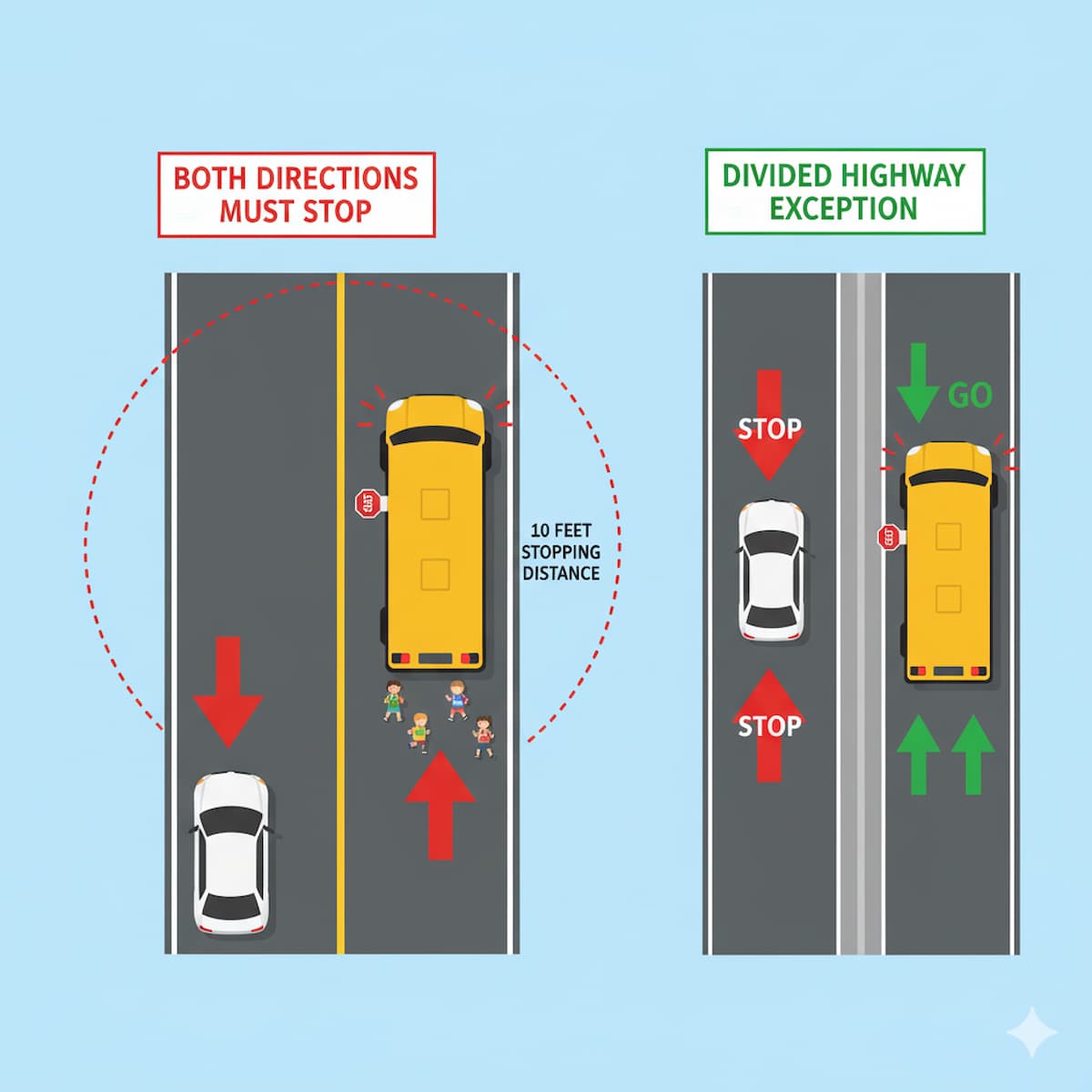
Ohio has strict school bus stop laws designed to protect children entering and exiting buses. Under ORC §4511.75, when a school bus displays flashing red lights and extends its stop arm, all traffic traveling in both directions must stop at least 10 feet away from the bus. You may not proceed until the red lights stop flashing, the stop arm is retracted, the bus begins moving again, or the bus driver signals you to proceed. This law applies on all roadways in Ohio except divided highways with a physical barrier separating opposing traffic.
Both-direction stopping rule on undivided Ohio roads and highways
On two-lane roads, multi-lane undivided highways, and roads with only a painted median or center turn lane, traffic in both directions must stop for a school bus with activated red flashing lights and stop arm. This includes major state routes like US-30, US-40, and US-35 where they are undivided, as well as county roads and city streets. The only exception is when you are traveling in the opposite direction on a divided highway with a physical barrier such as a concrete median wall, cable barrier, guardrail, or grassy median strip at least four feet wide separating opposing lanes.
Divided highway exception: physical barriers and median separations in Ohio
On physically divided highways with a barrier separating opposing traffic, drivers traveling in the opposite direction of the school bus are not required to stop. Examples include I-70, I-71, I-75, I-77, and I-90 with their concrete or cable median barriers. However, if you are traveling in the same direction as the bus—even on a divided highway—you must stop. Also, roads divided only by painted lines, painted medians (double-double yellow), or center turn lanes do not qualify as divided highways for this exception; all traffic must stop.
Penalties for illegal school bus passing in Ohio: severe consequences
Illegally passing a stopped school bus in Ohio is one of the most serious traffic violations with severe penalties. Under ORC §4511.75, violations can result in:
Fine up to $500 for a first offense
License suspension for up to 1 year
Mandatory appearance in court
Potential jail time for repeat offenses or if injury occurs
5 points on your Ohio driving record
If a violation results in serious injury or death, criminal charges including vehicular assault or manslaughter may apply with penalties including prison time. Ohio law enforcement and school districts increasingly use bus-mounted cameras and traffic enforcement cameras to catch violators, and citations are aggressively prosecuted due to the serious safety risk to children.
On undivided Ohio roads, all traffic in both directions must stop at least 10 feet from school buses with flashing red lights.
Advertisement
Ohio Work Zone Safety Laws & Move Over Law Requirements
ORC §4511.213: Ohio Move Over Law for emergency and service vehicles
Ohio's Move Over Law requires drivers to move over one lane (when safe) or reduce speed when approaching stationary emergency vehicles, Ohio Department of Transportation (ODOT) vehicles, tow trucks, waste collection vehicles, or other service vehicles stopped with flashing, oscillating, or rotating lights. If changing lanes is not possible or safe, drivers must slow down below the posted speed limit and be prepared to stop. Violating Ohio's Move Over Law can result in fines up to $500, 2 points on your license, and potential criminal charges if the violation results in injury or death to a worker or first responder.
Work zone speed limits and doubled fines in active Ohio construction zones
Ohio law requires drivers to obey posted work zone speed limits and doubles fines for speeding and other moving violations when workers are present in the work zone. Work zone speed limits are clearly posted on orange signs and must be obeyed whether or not workers are immediately visible, as they may be present nearby, behind barriers, or returning to the work area. Speed limits in Ohio work zones typically range from 35-55 mph depending on roadway type and work activity. Speeding in a work zone where workers are present can result in doubled fines of $300-$1,000 or more, plus court costs and points.
Following flaggers and temporary traffic control devices in Ohio
In Ohio work zones, flagger instructions override all other traffic control devices, including permanent signs and traffic signals, under ORC §4511.131. You must obey flaggers' hand signals and STOP/SLOW paddles immediately and completely. Flaggers control traffic flow for worker and driver safety—disregarding their signals can result in citations and serious crashes. Temporary traffic control devices such as traffic cones, barrels, vertical panels, and arrow boards provide critical guidance through work zones. Follow them carefully, stay alert, reduce speed, and maintain a safe following distance of at least 3-4 seconds or more.
Worker safety zones and prohibited actions in Ohio construction areas
Ohio law prohibits specific dangerous behaviors in work zones that endanger workers and other drivers. These include using a handheld mobile device while driving through a work zone (strictly enforced), failing to merge when lanes close ahead, tailgating or following too closely, sudden lane changes without signaling, and driving through marked buffer spaces or channelizing devices. Always stay alert, minimize distractions, avoid using your phone, watch for workers and equipment entering the roadway, and be prepared for sudden stops or unexpected lane shifts. Work zones are unpredictable environments—slow down and focus completely on driving safely through the zone.
Advertisement
Ohio OVI Laws, Speed Limits & Point System Overview
Ohio OVI laws: BAC limits and penalties for impaired driving
Ohio enforces strict OVI (Operating a Vehicle while Impaired) laws under ORC §4511.19. The legal blood alcohol concentration (BAC) limit is 0.08% for drivers 21 and over, 0.02% for drivers under 21(zero-tolerance policy), and 0.04% for commercial drivers. Penalties for OVI convictions increase significantly with BAC level and number of offenses, ranging from fines starting at $375, mandatory jail time (3 days minimum to 6 months for first offense with high BAC), license suspension (typically 1-3 years for first offense), mandatory alcohol and drug assessment and treatment, vehicle immobilization or forfeiture, and ignition interlock device requirements. Ohio is an "implied consent" state under ORC §4511.191, meaning refusal to submit to chemical testing (breath, blood, or urine) results in automatic administrative license suspension of 1 year for a first refusal, with longer suspensions for subsequent refusals. Refusing the test does not prevent OVI charges and often strengthens the prosecution's case.
Ohio speed limits: urban, rural, interstate, and school zone regulations
Ohio speed limits vary by road type and area under ORC §4511.21. Unless otherwise posted, statutory speed limits in Ohio are:
25 mph in residential and business districts
35 mph in urban areas
50 mph on most county and township roads
55 mph on most state highways and rural roads
65 mph on some designated rural interstate highways
70 mph on most urban interstate highways (I-70, I-71, I-75, I-77, I-80, I-90)
School zones have reduced speed limits (typically 20 mph) when children are present or during posted hours, indicated by flashing beacons or posted time restrictions. Ohio follows the "Basic Speed Law" principle under ORC §4511.21— drivers must always travel at speeds reasonable and proper for existing conditions, even if that speed is below the posted limit. Factors include weather, visibility, traffic volume, road surface, and roadway conditions.
Ohio point system: accumulation, penalties, and license suspension
Ohio uses a point system to track traffic violations and identify high-risk drivers under ORC §4510.036. Points range from 2 to 6 depending on the severity of the offense:
2 points: Most minor violations (speeding up to 10 mph over, failing to yield, improper turn)
4 points: More serious violations (speeding 11-30 mph over, reckless operation, running red light)
6 points: Most serious violations (speeding 31+ mph over, willful/wanton disregard, street racing)
If you accumulate 12 or more points within 2 years, your Ohio driver's license will be suspended for 6 months. Points remain on your record for 2 years from the date of conviction. You can remove up to 2 points by completing an Ohio BMV-approved Remedial Driving Instruction Course, but this can only be done once every 3 years and does not prevent suspensions based on total point accumulation.
High-risk violations: reckless operation and street racing in Ohio
Ohio treats certain violations as high-risk offenses with severe penalties. Reckless operation under ORC §4511.20 involves operating a vehicle in willful or wanton disregard for the safety of persons or property. It is a minor misdemeanor for a first offense, with potential jail time up to 30 days, fines up to $150 plus court costs, 4 points on your license, and significant insurance rate increases. Street racing under ORC §4511.251 carries enhanced penalties including 6 points, license suspension, vehicle impoundment, and potential jail time. Both offenses can lead to license suspension and create serious long-term consequences for insurance rates and driving records.
This guide summarizes Ohio driving laws for educational purposes only and is not legal advice. Always consult the official Ohio Revised Code, Ohio BMV guidance, and posted traffic signs for authoritative information. Traffic laws are subject to change—verify current regulations with official sources before relying on this information.