This comprehensive guide covers Tennessee's essential driving laws and traffic regulations under the Tennessee Code Annotated (TCA) Title 55. Whether you're a new driver preparing for your Tennessee driver's license exam, a Nashville or Memphis resident navigating city traffic, or a visitor exploring the Great Smoky Mountains, this guide provides clear explanations of double yellow line rules, turn regulations, school bus stop laws, hands-free cell phone requirements, DUI penalties, mountain driving safety, and work zone regulations. All information references official TDOT (Tennessee Department of Transportation) guidance and Tennessee statutes.
Tennessee's scenic highways, from the Smokies to Memphis, require drivers to follow specific state traffic laws and road marking regulations.
Tennessee Double Yellow Line Laws: No-Passing Zones & Legal Crossing Rules
TCA §55-8-121: When you can and cannot cross double yellow centerlines in Tennessee
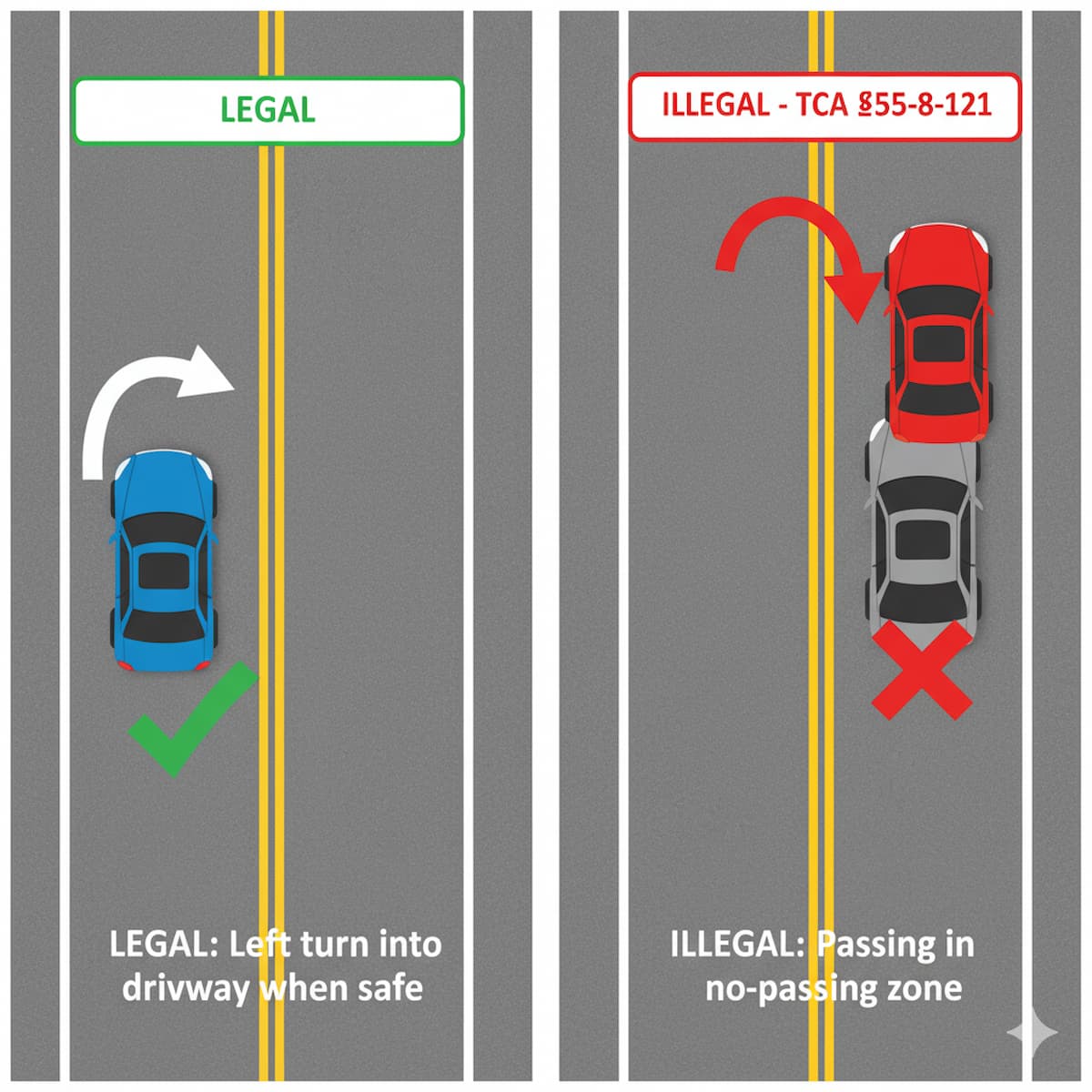
Tennessee's double yellow centerline regulations are governed by TCA §55-8-121, which establishes no-passing zones throughout the state. In Tennessee, double solid yellow lines indicate that passing is prohibited for traffic traveling in both directions. These markings typically appear on Tennessee's winding mountain roads through the Great Smoky Mountains, curves on rural highways, hills throughout East Tennessee, and other areas where passing would be dangerous due to limited sight distance or high traffic volume. Tennessee's varied terrain—from the mountainous east to the rolling hills of Middle Tennessee and the Mississippi Delta flatlands—makes these restrictions critical for safety across different driving conditions.
Legal exceptions for left turns in Tennessee: driveways, private roads, and parking lots
Tennessee law permits drivers to cross double yellow lines to make left turns into driveways, alleys, private roads, and parking lots when it is safe to do so. This is one of the most common exceptions to the no-passing rule and is particularly important for accessing Tennessee's many rural properties, Nashville's busy commercial areas, Memphis's Beale Street district parking, and Great Smoky Mountains National Park entrances. When making such turns, you must yield to oncoming traffic, use your turn signal at least 50 feet in advance (100 feet on highways), and complete the maneuver safely without impeding other vehicles. Review our detailed guide on left turns across double yellow lines for best practices and Tennessee-specific considerations.
Crossing double yellow to avoid obstructions: cyclists, debris, and road hazards in Tennessee
Tennessee drivers may briefly cross the centerline—even in a no-passing zone—to avoid an obstruction in the roadway, such as a disabled vehicle, fallen tree branches (especially common in rural areas and during storm season), construction debris, or a road hazard. Under TCA §55-8-116, the key requirement is that the maneuver must be necessary for safety and performed only when it can be done without endangering oncoming traffic. You must return to your lane as soon as it is safe. This exception does not permit passing slower-moving vehicles in no-passing zones. Tennessee also has a 3-foot passing law for bicycles under TCA §55-8-175, requiring drivers to maintain at least 3 feet of clearance when passing cyclists, which may require briefly crossing the centerline when safe.
Common violations and penalties for illegal passing on Tennessee highways
Illegally passing across double yellow lines in Tennessee can result in a Class C misdemeanor with fines ranging from $50 to $500 plus court costs. Courts view passing in no-passing zones seriously, especially on dangerous mountain highways like US-441 through the Smokies, US-129 ("Tail of the Dragon"), Highway 111 through the Cumberland Plateau, or the Natchez Trace Parkway. Tennessee uses a point system where illegal passing adds 4 pointsto your driving record. Accumulating 12 points in 12 months triggers license suspension. If the violation results in a crash or near-miss, penalties increase significantly and may include longer license suspension and higher fines.
Two sets of double yellow lines: Tennessee painted median barrier regulations
In Tennessee, when you encounter two sets of double yellow lines close together (often called a "painted median" or "flush median"), you must treat this area as a physical barrier under TCA §55-8-120. You may not drive on, across, or within this painted median except at designated openings marked for left turns. These painted medians are common on Tennessee's urban arterials like West End Avenue in Nashville, Poplar Avenue in Memphis, Kingston Pike in Knoxville, and other high-traffic corridors throughout the state. Learn more about two sets of double yellow lines and how they function as barriers to prevent head-on collisions.
Center left-turn lanes (TWLTL) vs painted medians in Tennessee cities
Tennessee also uses center left-turn lanes (two-way left-turn lanes), which have a different marking pattern. These lanes feature broken yellow lines on both sides with yellow diagonal markings inside, and are shared by traffic traveling in both directions to make left turns. Do not confuse these with painted medians—center turn lanes are designed for shared use (enter the lane no more than 200 feet before your turn), while painted medians are barriers that cannot be crossed except at designated openings. Nashville, Memphis, and Knoxville feature extensive center turn lanes on commercial corridors.
Tennessee allows crossing double yellow lines for left turns but prohibits passing in no-passing zones on mountain highways.
Right Turn on Red in Tennessee: TCA §55-8-110 Requirements & Restrictions
Complete stop requirement before turning right on red at Tennessee intersections
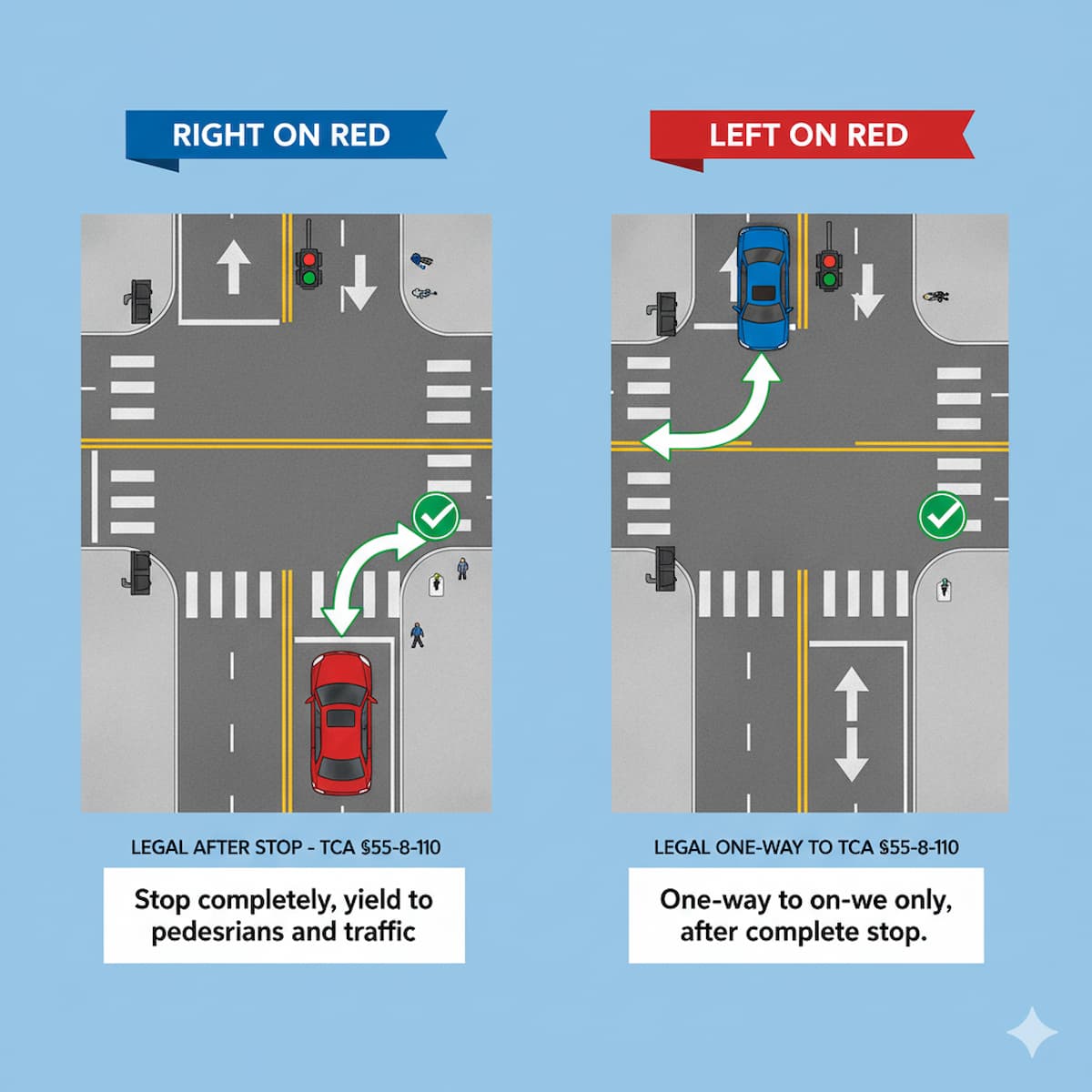
Tennessee law allows right turns on red after coming to a complete stop at the limit line, crosswalk, or point where you have a clear view of approaching traffic. Under TCA §55-8-110(c)(3)(A), you must yield the right-of-way to pedestrians and vehicles lawfully proceeding through the intersection before making your turn. This is one of the most tested rules on the Tennessee driver's exam. Tennessee's law is consistent with most states and applies statewide unless specifically prohibited by posted signage. The complete stop must occur before the marked stop line, crosswalk, or intersection—rolling stops are violations subject to citations.
"NO TURN ON RED" signs and posted restrictions in Nashville, Memphis, and Knoxville
Tennessee municipalities can prohibit right turns on red at specific intersections by posting "NO TURN ON RED" signs. These restrictions are particularly common in busy areas like downtown Nashville (especially near Broadway and the gulch), Beale Street in Memphis, Market Square in Knoxville, and Chattanooga's downtown pedestrian zones. Time-based restrictions (e.g., "No Turn on Red 7-9 AM, 4-6 PM") apply only during posted hours and are often used near schools, universities (Vanderbilt, University of Tennessee), and high-traffic commercial areas. Always check for signage before turning, as violating posted restrictions carries the same penalties as running a red light.
Pedestrian right-of-way and crosswalk safety in Tennessee urban areas
Before executing a right turn on red, you must scan the crosswalk for pedestrians who have started crossing or are about to enter. Tennessee law requires drivers to yield to pedestrians in crosswalks at all times under TCA §55-8-134. Downtown Nashville, Memphis's Beale Street district, and Knoxville's Market Square area have particularly strict enforcement due to high pedestrian traffic and tourist activity. Failing to yield to pedestrians can result in fines up to $200, 6 points on your license, and potential liability in injury accidents. Tennessee pedestrian fatality rates have increased in recent years, making enforcement a priority.
Red light camera enforcement at Tennessee intersections
Tennessee previously allowed red light cameras, but state legislation in recent years has restricted their use. As of 2025, many cities have removed red light cameras, though some municipalities may still have active enforcement under grandfathered agreements. However, law enforcement actively patrols high-traffic intersections, particularly in Nashville's Davidson County, Shelby County (Memphis), Knox County (Knoxville), and Hamilton County (Chattanooga). Even without cameras, you must come to a complete stop before the stop line when making a legal right turn on red to avoid citations from police officers. Violations carry fines ranging from $50 to $200 depending on jurisdiction.
Left Turn on Red in Tennessee: One-Way Street Rules & Intersection Requirements
When left on red is legal in Tennessee: TCA §55-8-110 one-way to one-way explained
Tennessee permits left turns on red from a one-way street onto another one-way street after coming to a complete stop, unless prohibited by signage, under TCA §55-8-110(c)(3)(B). This rule is less well-known but equally important and is particularly useful in downtown Nashville's grid system (especially near Broadway, 2nd Avenue, and the Gulch), Memphis's downtown area, and Knoxville's central business district, all of which feature several one-way streets. You must yield to all pedestrians and vehicles with the right-of-way before proceeding. Check our guide on left on red from one-way to one-way for detailed scenarios specific to Tennessee cities.
Signal compliance and yielding requirements for left turns on red signals in Tennessee
Just like right on red, you must make a complete stop at the stop line or crosswalk before turning left on red from one-way to one-way. Scan for oncoming traffic from all directions, watch for pedestrians (especially during Nashville's tourism season when foot traffic is heavy on Broadway and in the Gulch), and only proceed when the intersection is clear. Protected-turn signals (green arrows) and "No Turn on Red" signs override the default permission. The violation penalty is the same as running a red light—up to $200 fine and 6 points on your Tennessee driving record.
Downtown Nashville and Memphis one-way street navigation tips
Nashville's downtown features a complex grid system with one-way streets including portions of Broadway (eastbound), 2nd Avenue, 3rd Avenue, 4th Avenue, Church Street, Commerce Street, and others. Memphis's downtown one-way streets include portions of Main Street, Front Street, 2nd Street, Union Avenue, and Madison Avenue. Understanding the left-on-red rule helps you navigate efficiently during peak hours and special events at Bridgestone Arena, Nissan Stadium, FedExForum, or Beale Street. Always look for posted signs, especially during major events like CMA Fest, Nashville Sounds games, Memphis in May, or Grizzlies games.
Both right and left turns on red in Tennessee require a complete stop and yielding to all traffic and pedestrians.
Tennessee U-Turn Laws: When and Where U-Turns Are Legal Under TCA §55-8-115
TCA §55-8-115: U-turn prohibitions at traffic signals and business districts in Tennessee
U-turns are generally legal in Tennessee when they can be made safely without interfering with other traffic under TCA §55-8-115. However, Tennessee law specifically prohibits U-turns in several situations: (1) where your vehicle cannot be seen by approaching drivers within 500 feet in either direction, (2) at any location where official signs prohibit them, (3) on curves or near the crest of a hill where visibility is limited, and (4) in some municipalities within business districts unless made at an intersection. For more details on safely executing U-turns, see our guide on U-turns across double yellow lines.
Safe U-turn execution on Tennessee mountain highways: visibility and gap selection
When making a legal U-turn in Tennessee, especially on mountain highways through the Smokies or Cumberland Plateau, ensure you have adequate sight distance in both directions—typically at least 500 feet as required by statute. Signal your intention, check mirrors and blind spots, and yield to all approaching vehicles and pedestrians. Execute the turn in a single, smooth motion without stopping in the opposing lane. On narrow mountain roads like US-441, US-129 ("Tail of the Dragon"), or Highway 111, choose wide areas with good visibility or designated turnaround points. Never attempt U-turns on blind curves or near the crest of hills on dangerous mountain routes.
Posted "No U-Turn" signs at Tennessee tourist areas and urban intersections
Tennessee municipalities and TDOT post "No U-Turn" signs at specific locations where U-turns would create hazards. These restrictions are common at tourist-heavy areas (Gatlinburg, Pigeon Forge, Great Smoky Mountains entrances), busy urban intersections in Nashville (West End Avenue, Broadway, Charlotte Pike), Memphis (Poplar Avenue, Union Avenue), and Knoxville (Kingston Pike, Cumberland Avenue). These restrictions are enforceable by law, and violations can result in fines starting at $50 and 4 points on your Tennessee driving record. During tourist season in the Smokies (especially fall foliage and summer vacation periods), enforcement is particularly strict due to heavy traffic.
U-turn citations and defensive driving in Tennessee traffic conditions
Illegal U-turns in Tennessee can result in fines and points on your license if deemed an unsafe movement or if they violate posted restrictions. During peak tourist season in East Tennessee and special events in Nashville and Memphis, traffic increases dramatically, and illegal U-turns can cause serious accidents. To avoid citations, only make U-turns where visibility is excellent (500+ feet), traffic is light, and no signs prohibit the maneuver. When in doubt, continue to the next legal turning opportunity, designated turnaround area, or parking lot to reverse direction safely.
Tennessee School Bus Stop Laws: TCA §55-8-154 Requirements & Penalties
When you must stop for school buses with flashing red lights in Tennessee: 20-foot rule
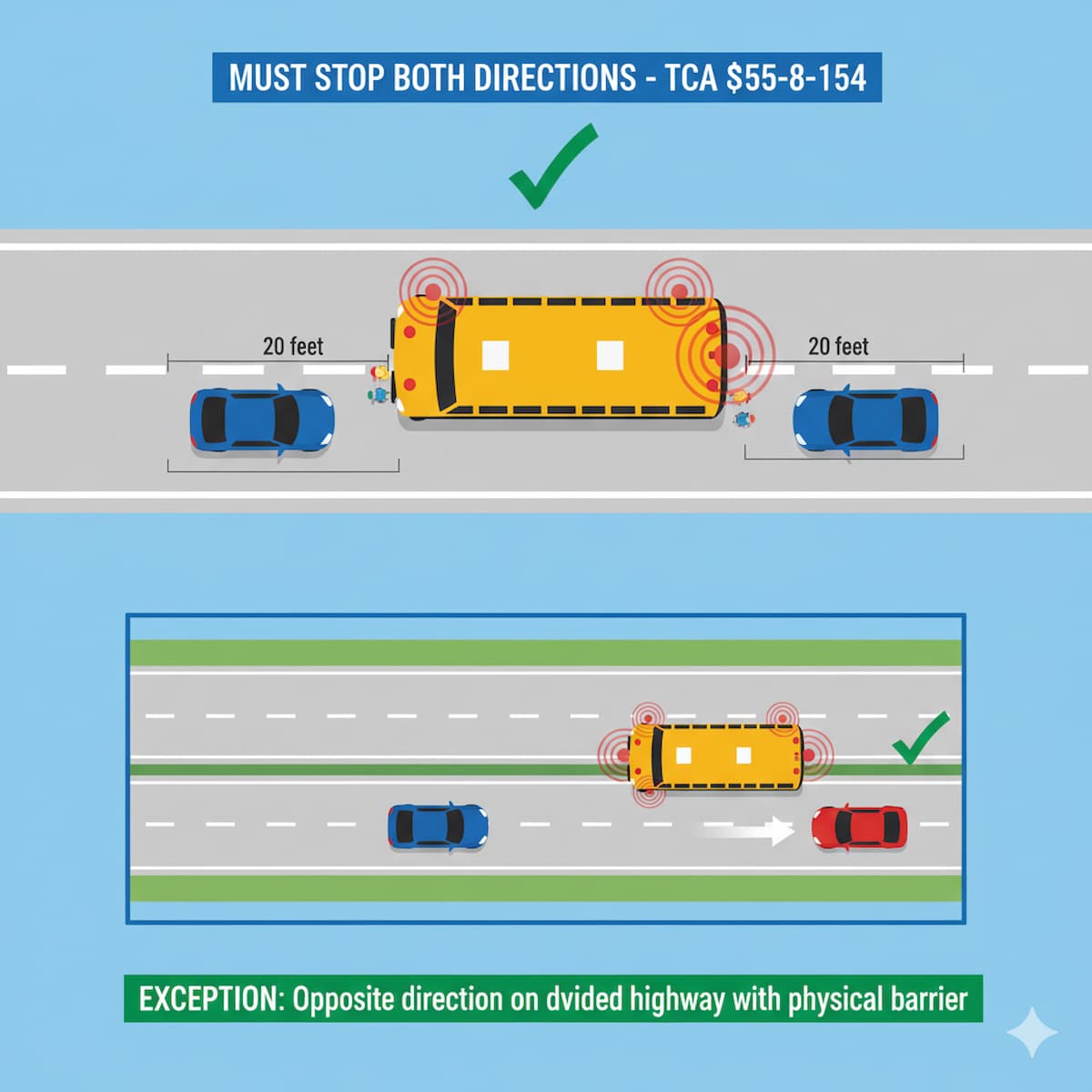
Tennessee has strict school bus stop laws designed to protect children. UnderTCA §55-8-154, when a school bus displays flashing red lights and extends its stop arm, all traffic traveling in both directions must stop at least 20 feet from the bus. You may not proceed until the red lights stop flashing, the stop arm is retracted, and the bus begins moving—or until the bus driver signals you to proceed. The 20-foot minimum distance is strictly enforced, and getting too close can result in additional violations even if you technically stopped.
Both-direction stopping rule on undivided Tennessee roads and highways
On two-lane roads and multi-lane undivided highways throughout Tennessee, traffic in both directionsmust stop for a school bus with activated signals. This includes highways with center turn lanes or painted medians that are not physically divided. The only exception is when you are traveling in the opposite direction on a divided highway with a physical barrier such as a concrete median, metal guardrail, cable barrier, or grassy divider. On rural Tennessee roads, two-lane highways through small towns, and most state routes, both directions must stop.
Divided highway exception: physical barriers and median requirements in Tennessee
On physically divided highways with a barrier separating opposing traffic (such as I-40, I-24, I-75, I-65, I-81, or portions of US-70), drivers traveling in the opposite direction of the school bus are not required to stop. However, if you are traveling in the same direction as the bus or on a road divided only by pavement markings (painted median), you must stop at least 20 feet away. When in doubt on Tennessee highways, always stop—enforcement is strict, and school bus violations carry severe penalties that can affect your driving record and insurance rates.
Penalties for illegal school bus passing in Tennessee: fines, jail time, and license suspension
Illegally passing a stopped school bus in Tennessee is a serious offense with escalating penalties. First-time offenders face fines ranging from $250 to $1,000 and potential jail time up to 30 days. The Tennessee Department of Safety adds 8 points to your driving record (remember, 12 points in 12 months triggers suspension). Your driver's license can be suspended for up to 1 year for a first offense, and repeat violations carry longer suspensions and mandatory jail time. If you cause injury while illegally passing a school bus, charges can escalate to vehicular assault or worse. Tennessee school districts and law enforcement increasingly use bus-mounted cameras to identify violators, and citations from camera evidence are prosecuted aggressively.
On undivided Tennessee roads, all traffic in both directions must stop at least 20 feet from school buses with flashing red lights.
Tennessee Hands-Free Driving Law & Distracted Driving Penalties
TCA §55-8-199: Tennessee's hands-free cell phone law requirements and exceptions
Tennessee enacted a comprehensive hands-free driving law under TCA §55-8-199, which took effect July 1, 2019. The law prohibits drivers from holding a cell phone or mobile device while operating a vehicle. You may use your phone only with hands-free technology such as Bluetooth headsets, dashboard mounts with voice commands, or built-in vehicle systems. The law applies to all drivers, regardless of age or license type. Texting while driving, watching videos, taking photos, and manual phone use are all prohibited and subject to primary enforcement—meaning officers can pull you over solely for this violation without observing another traffic offense.
Hands-free penalties: fines for first and subsequent violations in Tennessee
First-time hands-free law violations carry a fine of $50 (plus court costs). Second and subsequent violations within a specified period increase to $100 fines. If you violate the hands-free law in awork zone or school zone, the fine increases to $200. Additionally, violations add3 points to your Tennessee driving record. Insurance companies view distracted driving violations seriously and may increase your premiums. Tennessee law enforcement conducts regular distracted driving enforcement campaigns, particularly during high-traffic periods and in school zones throughout Nashville, Memphis, Knoxville, and Chattanooga.
Emergency exceptions and permitted hands-free technology in Tennessee
Tennessee's hands-free law includes limited exceptions. You may hold and use your phone to report an emergency to 911, law enforcement, fire department, or ambulance service. GPS navigation is permitted if your phone is mounted and you use voice commands—you cannot hold the phone to view or interact with maps. Commercial drivers, first responders, and utility workers performing official duties may have additional exceptions. The safest practice is to set up your navigation, music, and calls before you begin driving, or pull over to a safe location if you need to interact with your phone manually.
Texting while driving enforcement and Tennessee's distracted driving awareness campaigns
Tennessee participates in national distracted driving awareness campaigns and conducts enhanced enforcement periods throughout the year. Law enforcement agencies in all major Tennessee cities use both marked and unmarked vehicles to spot distracted drivers. Some agencies use elevated vantage points (like semi-trucks or overpasses) to observe drivers from above, making it easier to spot phone use. If you're involved in an accident while using your phone in violation of the hands-free law, you may face additional charges, civil liability, and your violation can be used as evidence of negligence in injury lawsuits. The state's "It Can Wait" campaign emphasizes that no text, call, or notification is worth a life.
Tennessee DUI Laws, Speed Limits, Point System & Work Zone Safety
Tennessee DUI laws: 0.08% BAC limit and strict penalties for impaired driving
Tennessee has strict DUI (Driving Under the Influence) laws with a legal blood alcohol concentration (BAC) limit of0.08% for drivers 21 and over. The limit is 0.02% for drivers under 21 (zero tolerance policy), and 0.04% for commercial drivers. First-time DUI convictions under TCA §55-10-401carry mandatory minimum jail time of 48 hours (up to 11 months, 29 days maximum), fines ranging from$350 to $1,500, license suspension for 1 year, mandatory participation in an alcohol and drug treatment program, and installation of an ignition interlock device for at least 6 months after license reinstatement. Tennessee's implied consent law means refusing a breath or blood test results in automatic 1-year license suspension, even if you're not ultimately convicted of DUI.
Tennessee speed limits: urban, rural, interstate, and posted school zone regulations
Tennessee speed limits vary by road type and area. Unless otherwise posted, statutory speed limits under TCA §55-8-152 are: 30 mph in urban districts, 35 mph in suburban districts,45 mph on state highways in rural areas, and 55 mph on other rural roads. Interstate speed limits are 65-70 mph depending on the specific segment—I-40, I-24, I-65, I-75, and I-81 have posted limits of 65 mph in most areas and 70 mph in rural sections. School zones have reduced speed limits of 15-25 mph when children are present or during posted hours (typically 7-9 AM and 2-4 PM on school days). Tennessee enforces the "Basic Rule"—drivers must travel at speeds safe for current conditions, which is particularly important during winter weather, fog in rural areas, and heavy rain.
Tennessee point system: accumulation thresholds and license suspension rules
Tennessee uses a point system to track traffic violations. Points range from 1 point (minor violations like improper registration display) to 8 points (school bus passing, reckless driving). Accumulating certain point thresholds within 12 months results in license suspension: 12 points = suspension for drivers of any age. Point suspensions last from 30 days to 1 year depending on your age and point total. You can attend a state-approved defensive driving course once every 5 years to reduce your point total by up to 3 points. Common point values: speeding 1-5 mph over (1 point), 6-15 mph over (3 points), 16-25 mph over (4 points), 26+ mph over (5 points), running red light (6 points), illegal passing (4 points), school bus violation (8 points), reckless driving (6 points).
Tennessee work zone safety: Move Over Law and double fine penalties
Tennessee's Move Over Law under TCA §55-8-132 requires drivers to move over one lane (when safe) or slow down when approaching stopped emergency vehicles, maintenance vehicles, tow trucks, or TDOT vehicles with flashing lights. If you cannot safely move over, you must slow down below the posted speed limit and be prepared to stop. Work zones on Tennessee highways and interstates have double fines for all traffic violations when workers are present. Speeding in a work zone carries fines up to $500, and causing injury to a worker can result in felony charges with prison time. Tennessee has unfortunately experienced multiple work zone fatalities in recent years, leading to increased enforcement. TDOT's "Nobody Trues Harder Than You" campaign reminds drivers that real people—someone's family members—work in these zones.
This guide summarizes Tennessee driving laws for educational purposes only and is not legal advice. Always consult the official Tennessee Code Annotated, TDOT guidance, and posted traffic signs for authoritative information. Traffic laws are subject to change—verify current regulations with official sources. When driving in Tennessee's diverse terrain from the Mississippi Delta to the Great Smoky Mountains, always prioritize safety and adjust your driving to current conditions.