This comprehensive guide covers Virginia's essential driving laws and traffic regulations under the Virginia Code. Whether you're navigating Northern Virginia's HOV lanes, driving through Richmond's downtown corridors, or traveling the scenic Blue Ridge Parkway, understanding state-specific traffic rules is crucial. Virginia is known for its strict enforcement of reckless driving laws, extensive HOV lane network, and significant penalties for traffic violations. This guide provides clear explanations of double yellow line rules, turn regulations, school bus stop laws, HOV requirements, speed limits, work zone safety, and DUI penalties. All information references official Virginia DMV guidance and Virginia Code statutes to ensure accuracy for residents, new drivers, and visitors alike.
Advertisement
Virginia's highways require strict adherence to traffic laws, especially on routes through the Blue Ridge Mountains and Northern Virginia corridors.
Virginia Double Yellow Line Laws: No-Passing Zones and Legal Crossings (VA Code § 46.2-804)
Understanding Virginia no-passing zones and centerline markings
Virginia's no-passing regulations are governed by Virginia Code § 46.2-804, which establishes clear rules for double solid yellow centerlines. In Virginia, double solid yellow lines indicate that passing is prohibited for traffic traveling in both directions. These markings typically appear on curves, hills, narrow bridges, and other locations where passing would create a safety hazard due to limited sight distance or oncoming traffic visibility. Virginia law enforcement actively patrols no-passing zones, particularly on scenic routes like Skyline Drive and the Blue Ridge Parkway where violations can lead to serious accidents.
When you may legally cross double yellow lines in Virginia
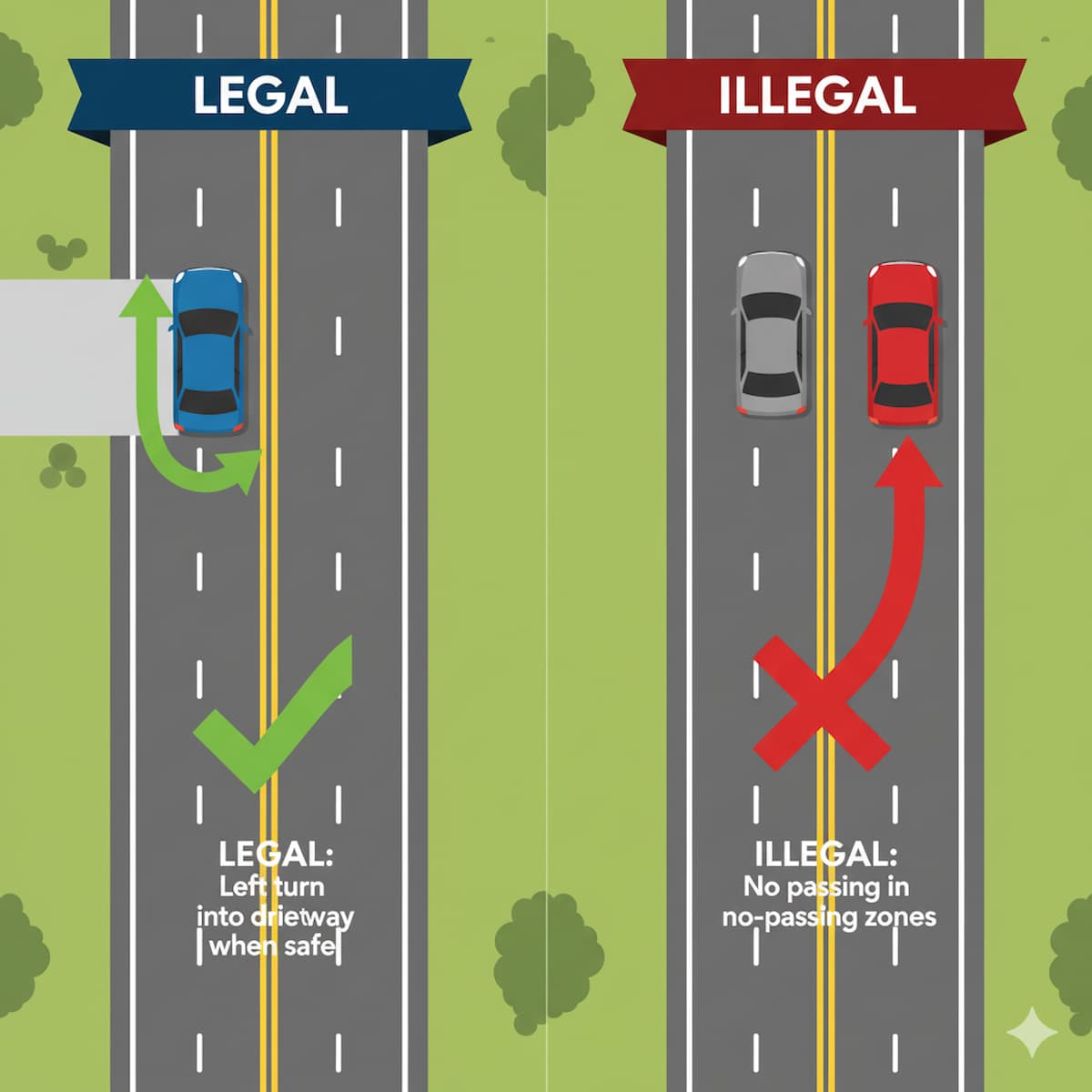
Virginia law permits drivers to cross double yellow lines in specific situations when it can be done safely and does not endanger other road users. The primary legal exceptions include: (1) making a left turn into a driveway, alley, or private road when safe and no signs prohibit the movement; (2) executing aU-turn where legal and sight distance requirements are met; and (3) briefly avoiding an obstruction in the roadway such as debris, a disabled vehicle, or road damage when necessary for safety. These exceptions apply throughout the Commonwealth, from rural counties to urban centers like Alexandria, Arlington, Norfolk, and Virginia Beach.
Left turns across double yellow into driveways and side streets
Making a left turn across double yellow lines is one of the most common legal exceptions in Virginia. When executing this maneuver, drivers must signal their intention at least 50 feet in advance (100 feet on highways), yield to all oncoming traffic and pedestrians, and complete the turn in a single, continuous movement without lingering in the opposing lane. This exception is particularly important in Northern Virginia where heavy traffic and frequent commercial driveways make left turns a daily necessity on routes like Route 7, Route 50, and Lee Highway.
Avoiding obstructions: roadway hazards and emergency situations in Virginia
Virginia's diverse geography presents unique hazards including wildlife crossings in rural areas, construction zones in urban corridors, and weather-related debris during winter storms. State law permits drivers to briefly cross the centerline to avoid these obstructions when it can be done safely and no oncoming traffic is present. However, this exception does not permit passing slower-moving vehicles in no-passing zones. On scenic mountain routes like Route 58 through the Blue Ridge or Route 211 through Shenandoah National Park, drivers should exercise extreme caution when considering any centerline crossing due to limited sight distances and steep drop-offs.
Penalties for illegal passing across double yellow lines in Virginia
Illegally passing across double yellow lines in Virginia can result in significant penalties. Violations typically carry fines ranging from $100 to $250 plus court costs, and 3 demerit points added to your driving recordunder Virginia's point system. Accumulating too many points can lead to license suspension, mandatory driver improvement courses, and increased insurance premiums. Virginia courts treat passing violations seriously, particularly if they result in a collision, near-miss with oncoming traffic, or occur in a construction zone where penalties are doubled.
Common violations on Virginia scenic highways and rural roads
Law enforcement in Virginia actively patrols popular scenic routes where illegal passing is common, including Skyline Drive, the Blue Ridge Parkway, Colonial Parkway, and George Washington Memorial Parkway. These winding roads feature numerous curves and hills with limited sight distance, making passing extremely dangerous. Drivers should exercise patience and wait for designated legal passing zones marked by dashed yellow lines before attempting to overtake slower vehicles. Virginia State Police use both marked and unmarked vehicles to enforce traffic laws on these routes.
Virginia permits crossing double yellow lines for left turns into driveways but prohibits passing in no-passing zones.
Advertisement
Right Turn on Red Rules in Virginia: Complete Stop Requirements (VA Code § 46.2-833)
Virginia right on red law: stop, yield, and proceed when clear
Virginia law allows right turns on red after coming to a complete stop at the clearly marked stop line, crosswalk, or point where you have a clear view of approaching traffic. Under Virginia Code § 46.2-833, drivers must yield the right-of-way to pedestrians and vehicles lawfully proceeding through the intersection before making their turn. This rule is tested frequently on the Virginia DMV driver's license exam and is a fundamental skill all drivers must master. Northern Virginia municipalities like Arlington, Alexandria, and Fairfax have numerous intersections with specific right-on-red restrictions due to heavy pedestrian traffic.
Complete stop requirement: no rolling stops allowed
A complete stop means bringing your vehicle to a full halt with wheels motionless. "Rolling stops"—where the vehicle slows but never completely stops—are illegal and frequently cited by law enforcement, especially at intersections with heavy pedestrian traffic or automated enforcement cameras. In Northern Virginia cities and college towns like Blacksburg (Virginia Tech) and Charlottesville (UVA), officers often monitor busy intersections for rolling stop violations during right turns on red. The fine for a rolling stop can reach $250 plus court costs.
NO TURN ON RED signs and posted restrictions in Virginia cities
Virginia municipalities can prohibit right turns on red at specific intersections by posting "NO TURN ON RED"signs. These restrictions are common in downtown areas, near Metro stations in Northern Virginia, school zones, and intersections with complex signal phasing or heavy pedestrian traffic. Some intersections may have time-based restrictions (e.g., "No Turn on Red 7-9 AM, 4-7 PM") that apply only during posted hours. Richmond, Norfolk, and Arlington have extensive networks of restricted intersections—always check for signage before turning.
Pedestrian right-of-way and crosswalk safety when making right turns
Before executing a right turn on red, drivers must scan the crosswalk for pedestrians who have started crossing or are about to enter. Virginia law requires drivers to yield to pedestrians in crosswalks at all times under Virginia Code § 46.2-924. Failing to yield can result in fines up to $500, points on your license, and significantly increased penalties if a pedestrian is struck. This is especially critical near Metrorail stations, university campuses, and downtown shopping districts where pedestrian volumes are high.
Left Turn on Red in Virginia: One-Way Street Exception (VA Code § 46.2-833)
When left on red is permitted: one-way to one-way street rules
Virginia permits left turns on red from a one-way street onto another one-way street after coming to a complete stop, unless prohibited by signage. This lesser-known rule can improve traffic flow in urban grid systems like downtown Richmond, Norfolk's Granby Street corridor, and parts of Old Town Alexandria. Drivers must yield to all pedestrians and vehicles with the right-of-way before proceeding. Check our detailed guide on left on red from one-way to one-way for specific scenarios and best practices.
Signal compliance and safe execution of left turns on red
Just like right on red, you must make a complete stop at the stop line or crosswalk before turning left on red. Scan for oncoming traffic from all directions, watch for pedestrians in the crosswalk, and only proceed when the intersection is completely clear. Protected-turn signals (green arrows) and "No Turn on Red" signs override the default permission to turn left on red. In downtown areas with complex one-way street grids, exercise extra caution and verify street directions before attempting this maneuver.
Urban area restrictions and downtown signage
In downtown Richmond, Norfolk, Alexandria, and other urban centers, be especially alert for posted restrictions on left turns on red. High-traffic intersections and areas with heavy pedestrian activity may prohibit the maneuver entirely. When in doubt, wait for a green signal or green arrow before proceeding. Virginia's increasing use of automated red-light cameras means violations are more likely to be captured and prosecuted.
Both right and left turns on red in Virginia require a complete stop and yielding to all traffic and pedestrians.
Advertisement
Virginia U-Turn Laws: When and Where U-Turns Are Legal (VA Code § 46.2-846)
Legal U-turns in Virginia: safety requirements and restrictions
U-turns are generally legal in Virginia when they can be made safely and do not interfere with other traffic. However, Virginia law prohibits U-turns in certain locations under Virginia Code § 46.2-846. You may not make a U-turn where your vehicle cannot be seen by other drivers approaching from either direction within 500 feet, such as on curves or near the crest of a hill. U-turns are also prohibited in business districts unless made at an intersection or where traffic control devices permit them. For comprehensive guidance, see our article on U-turns across double yellow lines.
Sight distance requirements for safe U-turn execution
When making a legal U-turn in Virginia, ensure you have adequate sight distance in both directions—typically at least 500 feet on rural highways and more on high-speed roads. Signal your intention, check mirrors and blind spots, yield to all approaching vehicles and pedestrians, and execute the turn in a single, smooth motion without stopping in the opposing lane. Choose wide intersections, areas with center turn lanes, or designated U-turn locations when possible. On busy Northern Virginia corridors like Route 50, Route 7, and Braddock Road, U-turns should only be attempted at signalized intersections with dedicated U-turn phases.
Posted NO U-TURN signs and business district restrictions
Virginia municipalities can post "NO U-TURN" signs at specific locations, typically in business districts, school zones, and high-traffic areas. These restrictions are enforceable by law, and violations can result in fines up to $250 and points on your license. In downtown areas like King Street in Alexandria, Main Street in Richmond, or Granby Street in Norfolk, watch carefully for U-turn prohibitions before attempting the maneuver. Northern Virginia's congested corridors have extensive U-turn restrictions to maintain traffic flow during peak hours.
U-turn citations and defensive driving best practices
Illegal or unsafe U-turns in Virginia can result in fines and 3 demerit points on your license. To avoid citations, only make U-turns where visibility is excellent, traffic is light, and no signs prohibit the maneuver. On highways through the Blue Ridge Mountains or Shenandoah Valley, where sight distance may be limited by terrain, it's often safer to continue to the next legal turning opportunity rather than risk an illegal U-turn. Virginia State Police actively enforce U-turn violations on scenic parkways and high-traffic urban corridors.
Virginia School Bus Stop Laws: Protecting Children (VA Code § 46.2-844)
When you must stop for school buses with flashing red lights
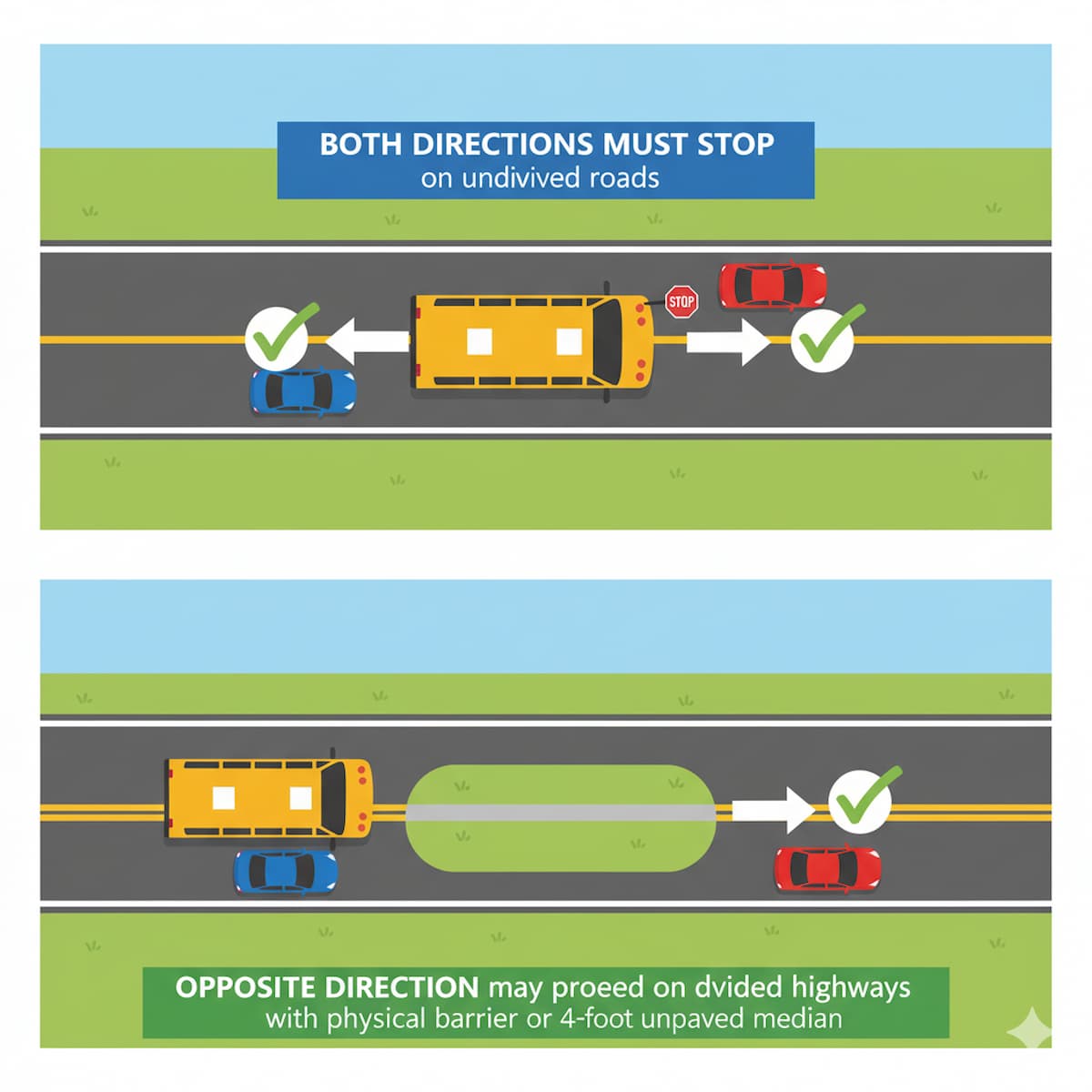
Virginia has strict school bus stop laws designed to protect children boarding and exiting buses. Under Virginia Code § 46.2-844, when a school bus displays flashing red lights and extends its stop arm, all traffic traveling in both directions must stop. You may not proceed until the red lights stop flashing, the stop arm is retracted, and the bus begins moving—or until the bus driver signals you to proceed. Virginia law imposes severe penalties for violations, including mandatory license suspension and potential criminal charges if a child is injured.
Both-direction stopping rule on undivided Virginia roads
On two-lane roads and multi-lane undivided highways, traffic in both directions must stop for a school bus with activated signals. This includes highways with center turn lanes or painted medians that are not physically divided. The requirement applies throughout Virginia's rural counties, small towns like Harrisonburg and Staunton, and suburban communities. Virginia school districts increasingly use bus-mounted cameras to identify and cite violators, and law enforcement conducts regular enforcement campaigns at the start of each school year.
Divided highway exception: physical barriers and wide medians
The only exception to the both-direction stopping rule is when you are traveling in the opposite direction on adivided highway with a physical barrier or unpaved median at least 4 feet wide. This includes highways with concrete medians, guardrails, or wide grassy dividers. Interstates and major divided highways like I-95, I-64, Route 288, and the Dulles Toll Road fall under this exception for opposite-direction traffic. However, if you are traveling in the same direction as the bus or on a road divided only by pavement markings (painted median), you must stop regardless of the number of lanes.
Penalties for illegally passing a stopped school bus in Virginia
Illegally passing a stopped school bus in Virginia is a serious traffic violation with severe consequences. First offense penalties include a fine of up to $2,500, 6 demerit points on your driving record, and potential license suspension. Subsequent violations within 10 years can result in mandatory 10-day jail sentences and one-year license suspensions. If a violation results in injury or death to a child, the driver may face felony charges including vehicular manslaughter. Virginia takes school bus safety extremely seriously, and judges rarely dismiss these citations even for first-time offenders.
On undivided Virginia roads, all traffic in both directions must stop for school buses with flashing red lights and extended stop arms.
Advertisement
Virginia HOV Lane Rules: High Occupancy Vehicle Requirements and Enforcement
Understanding Virginia HOV lanes: I-66, I-95, I-395 Express Lanes
Virginia has one of the most extensive HOV (High Occupancy Vehicle) lane networks in the United States, particularly in Northern Virginia where chronic traffic congestion affects commuters daily. HOV lanes require a minimum of 2 or 3 occupants (depending on the route) during posted hours, typically weekday morning and evening rush hours. Major HOV facilities include I-66 inside the Beltway (2+ occupants), I-95/I-395 Express Lanes (3+ occupants during peak hours when tolled), and Route 95 HOV lanes south of Fredericksburg. Violating HOV restrictions results in fines starting at $125 plus processing fees, and repeat violations carry escalating penalties.
I-66 inside the Beltway: HOV-2 and dynamic tolling rules
I-66 inside the Capital Beltway operates under unique rules that have evolved significantly. During weekday rush hours (eastbound 6:30-9 AM, westbound 4-6:30 PM), the highway is restricted to vehicles with 2 or more occupants (HOV-2) and motorcycles. Single-occupant vehicles can use the highway outside these hours or by paying dynamic tolls when tolling is in effect. The toll rates vary based on congestion levels and can reach $40 or more during severe traffic conditions. Exemptions exist for certain clean fuel vehicles with valid E-ZPass Flex transponders and HOV decals issued by Virginia DMV.
I-95/I-395 Express Lanes: HOV-3 requirements and toll options
The I-95/I-395 Express Lanes operate as HOV-3 facilities during peak hours, requiring 3 or more occupants to travel toll-free with an E-ZPass Flex transponder set to HOV mode. Single and two-occupant vehicles can use the Express Lanes by paying variable tolls. The system extends from Edsall Road in Alexandria south to Garrisonville Road in Stafford County, providing a faster alternative to the congested general-purpose lanes. Violating HOV-3 requirements or transponder rules results in fines and potential toll violations. Virginia State Police conduct regular HOV enforcement operations using both marked cruisers and unmarked vehicles positioned at strategic merge points.
HOV enforcement, exemptions, and E-ZPass Flex transponder requirements
Virginia actively enforces HOV regulations using State Police officers stationed at entry points and along HOV corridors. Violations are detected through visual inspection, and officers can pull over violators at designated enforcement areas. To legally use HOV lanes with the required occupancy, drivers must have an E-ZPass Flex transponder that can be switched to HOV mode to avoid tolls. Clean fuel vehicles (hybrid/electric) that previously enjoyed HOV exemptions now face restricted or eliminated exemptions on many corridors—check current regulations before assuming exemption eligibility. Motorcycles are always permitted in HOV lanes regardless of occupancy requirements.
Virginia Reckless Driving Laws: 20 Over or 85 MPH Rule (VA Code § 46.2-862)
Virginia is nationally known for having one of the strictest reckless driving laws in the United States. UnderVirginia Code § 46.2-862, driving 20 mph or more over the posted speed limit OR driving over 85 mph regardless of the limit is automatically classified as reckless driving—not just a speeding ticket. This is a Class 1 misdemeanor criminal offense, carrying potential penalties of up to 12 months in jail, fines up to $2,500, 6 demerit points, license suspension up to 6 months, and a permanent criminal record. Unlike most states where speeding is a civil infraction, Virginia treats excessive speeding as a crime.
The 85 mph threshold: automatic reckless driving on Virginia highways
Many Virginia highways have speed limits of 70 mph, meaning drivers traveling 85 mph face automatic reckless driving charges even though they're only 15 mph over the limit. This catches many out-of-state drivers by surprise, particularly on I-95, I-81, and I-64 where traffic often flows at speeds exceeding the limit. Virginia State Police actively enforce this threshold using radar, laser, and pacing techniques. Even first-time offenders should consider hiring an attorney, as a reckless driving conviction has serious long-term consequences including employment background checks, insurance rate increases exceeding 40%, and potential security clearance issues for federal employees and contractors.
Court appearances, penalties, and legal defense strategies
Reckless driving charges in Virginia require a court appearance—you cannot prepay the ticket like a simple speeding violation. Judges have wide discretion in sentencing, considering factors like actual speed, traffic conditions, driving record, and defendant attitude. Common defense strategies include providing speedometer calibration records, completing voluntary driver improvement courses before the court date, obtaining a clean driving record transcript, and negotiating reductions to improper driving (a lesser offense) when circumstances warrant. Legal representation is strongly recommended, especially for speeds above 90 mph or cases involving accidents.
Virginia Code defines numerous other reckless driving scenarios beyond speed-based violations, including racing, passing a stopped school bus, driving with faulty brakes, passing at a railroad crossing, passing on a curve or crest of a hill, driving too fast for conditions, and aggressive driving behaviors. Virginia Code § 46.2-852 through § 46.2-869 outline these various reckless driving offenses. Each carries the same Class 1 misdemeanor classification with potential jail time, fines, and criminal record consequences.
Virginia Speed Limits, Work Zones, and Move Over Law
Virginia speed limits: interstate, highway, and urban regulations
Virginia speed limits vary by road type and location. Unless otherwise posted, speed limits are 25 mph in residential districts and business districts, 25 mph in school zones (when children are present or during posted hours), 55 mph on most rural highways, and 70 mph on Interstate highways in rural areas. Some sections of I-95, I-81, and I-64 have 70 mph limits, while urban interstates like I-395, I-495 (Capital Beltway), and parts of I-64 through Hampton Roads may be posted at 55-65 mph. Virginia strictly enforces speed limits, and exceeding them by significant margins triggers reckless driving charges as discussed above.
Work zone safety and doubled fines for violations
Virginia takes work zone safety seriously under Virginia Code § 46.2-878.1. Fines for speeding and other moving violations in active work zones are doubled when workers are present. Active work zones are marked by signs indicating "Work Zone" and reduced speed limits, often dropping to 25-45 mph in construction areas. Major projects on I-495, I-66, I-95, and regional routes frequently create work zones with heavy enforcement. Virginia also employs automated work zone speed enforcement systems that issue citations by mail when vehicles exceed posted work zone speed limits. Repeat violations or reckless driving in work zones can result in jail time, especially if a worker is endangered or injured.
Move Over Law: yielding to emergency vehicles and service vehicles
Virginia's Move Over Law requires drivers to change lanes away from stopped emergency vehicles, VDOT vehicles, and tow trucks displaying flashing lights when safe to do so. If lane change is not possible due to traffic or road configuration, drivers must slow down and proceed with caution. Emergency vehicles include police, fire, ambulance, and any vehicle with activated emergency lights. The law was expanded to include tow trucks, VDOT maintenance vehicles, and other service vehicles. Violations result in fines up to $250, and causing injury to an emergency worker significantly increases penalties including potential felony charges.
Advertisement
Virginia DUI Laws: BAC Limits and Penalties (VA Code § 18.2-266)
Virginia DUI/DWI laws: blood alcohol concentration limits
Virginia enforces strict DUI (Driving Under the Influence) and DWI (Driving While Intoxicated) laws under Virginia Code § 18.2-266. The legal blood alcohol concentration (BAC) limit is 0.08% for drivers 21 and over,0.02% for drivers under 21 (Virginia's Zero Tolerance law), and 0.04% for commercial drivers. Virginia is an implied consent state, meaning refusing a breath or blood test results in automatic license suspension for 12 months (first offense) or longer for subsequent refusals. Unlike some states, Virginia prosecutes DUI cases aggressively with high conviction rates and mandatory minimum penalties.
First offense DUI penalties: fines, jail, license suspension, and ASAP
First-offense DUI penalties in Virginia include fines up to $2,500, possible jail time (mandatory minimums apply for BAC over 0.15%), license suspension for 12 months (with restricted license eligibility after mandatory suspension periods), completion of the Virginia Alcohol Safety Action Program (ASAP), and potential ignition interlock device installation. BAC levels of 0.15-0.20% trigger mandatory minimum 5-day jail sentences, while BAC over 0.20% requires mandatory 10-day jail time. Court costs and fees can exceed $1,000 beyond the fine itself, making total DUI costs reach $5,000-$10,000 for first offenses when including insurance increases and legal fees.
Repeat DUI offenses and felony DUI in Virginia
Second DUI convictions within 5-10 years result in mandatory minimum jail sentences (20 days if within 5 years, 10 days if 5-10 years), longer license suspensions, required ignition interlock for at least 6 months, and significantly higher fines. Third or subsequent DUI offenses within 10 years are charged as Class 6 feloniescarrying 1-5 years in prison (with mandatory minimum sentences), indefinite license revocation, vehicle forfeiture provisions, and permanent felony records. Virginia also prosecutes DUI causing injury or death as separate felony offenses with severe prison sentences.
Ignition interlock requirements and restricted license procedures
Virginia requires ignition interlock devices for certain DUI offenders, including all second or subsequent offenses, first offenses with high BAC, and as a condition for restricted license privileges. The device prevents vehicle operation if alcohol is detected on the driver's breath. Installation and monthly monitoring costs are paid by the offender, typically running $70-100 per month. To obtain a restricted license during suspension, offenders must enroll in ASAP, install an interlock device (if required), maintain SR-22 insurance, and petition the court for restricted driving privileges specifying routes and times for work, medical, ASAP, and other authorized purposes.
This guide summarizes Virginia driving laws for educational purposes only and is not legal advice. Always consult the official Virginia Code, Virginia DMV guidance, and posted traffic signs for authoritative information. Traffic laws are subject to change—verify current regulations with official sources. For reckless driving or DUI charges, consult with a qualified Virginia traffic attorney.
Advertisement
Advertisement
Virginia Driving Laws & Traffic Rules 2025: Complete DMV Guide