This comprehensive guide covers Vermont's essential driving laws and traffic regulations under the Vermont Statutes Annotated (VSA) Title 23. Whether you're a new driver preparing for your Vermont driver's license exam, a resident needing to understand state-specific rules, or a visitor navigating Vermont's scenic mountain roads and fall foliage routes, this guide provides clear explanations of double yellow line rules, turn regulations, school bus stop laws, moose crossing safety, covered bridge navigation, DUI penalties, and winter driving requirements. All information references official VTrans guidance and Vermont statutes.
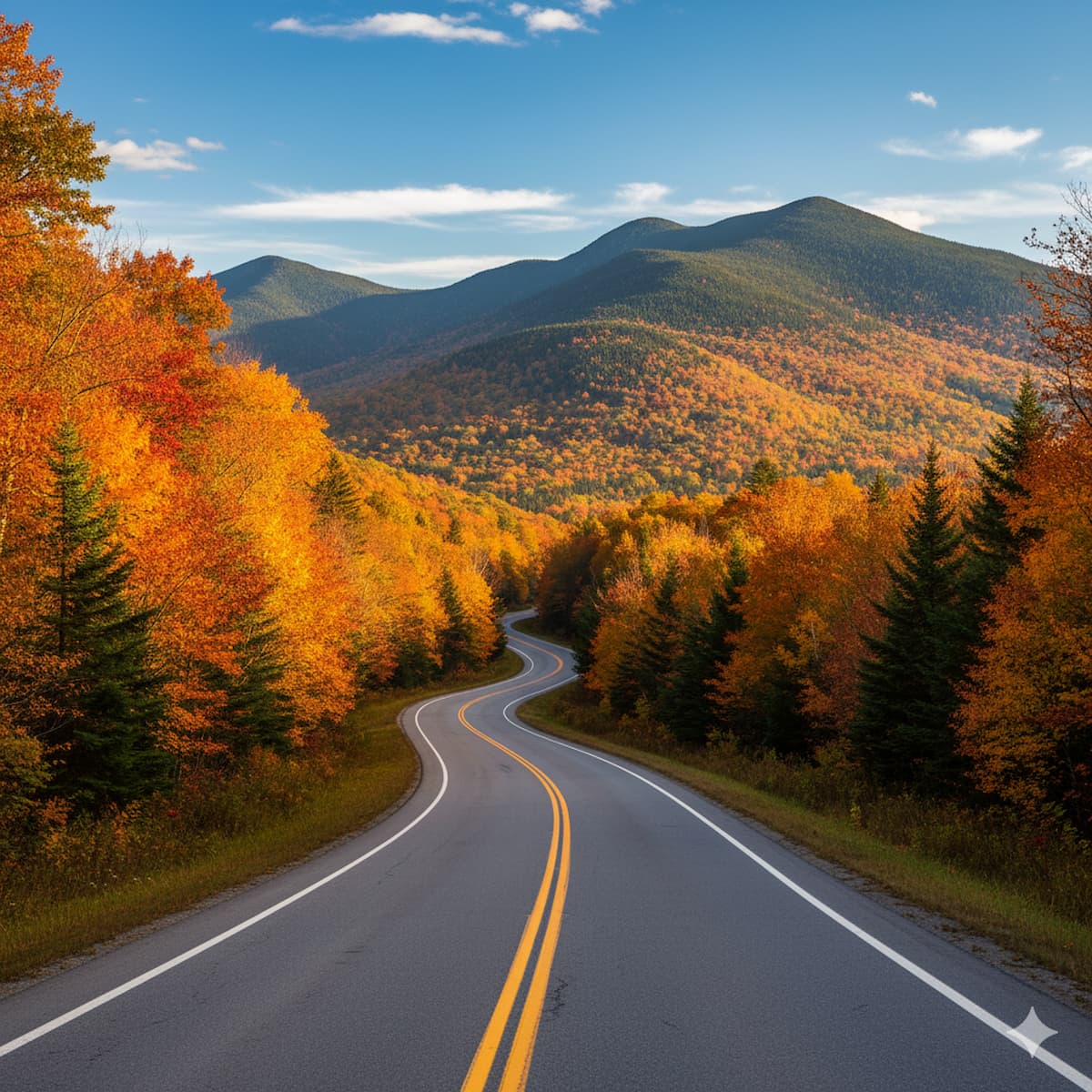
Vermont's scenic mountain highways and rural roads require drivers to follow specific state traffic laws and road marking regulations.
Vermont Double Yellow Line Laws: No-Passing Zones & Legal Crossing Rules
23 VSA §1033: When you can and cannot cross double yellow centerlines in Vermont
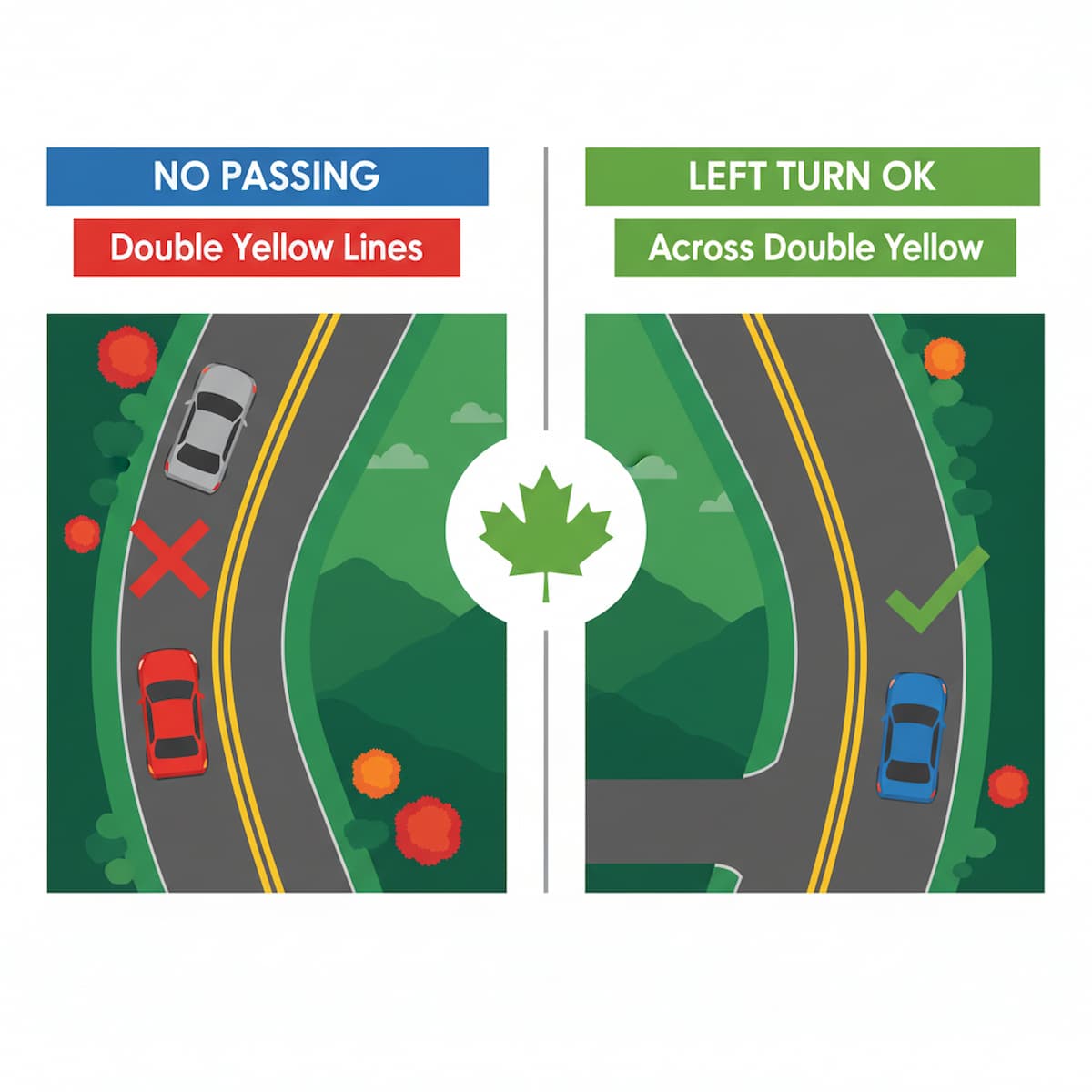
Vermont's double yellow centerline regulations are governed by 23 VSA §1033, which establishes no-passing zones throughout the state. In Vermont, double solid yellow lines indicate that passing is prohibited for traffic traveling in both directions. These markings typically appear on Vermont's winding mountain roads, narrow rural highways, curves, hills, and other areas where passing would be dangerous due to limited sight distance or high traffic volume. Vermont's mountainous terrain, particularly in the Green Mountains, makes these restrictions especially critical for safety during peak fall foliage season when tourist traffic significantly increases.
Legal exceptions for left turns: driveways, covered bridges, and maple sugarhouse access roads
Vermont law permits drivers to cross double yellow lines to make left turns into driveways, alleys, private roads, and parking lots when it is safe to do so under 23 VSA §1033(b). This is one of the most common exceptions to the no-passing rule and is particularly important for accessing Vermont's many maple sugar operations, ski resort access roads, covered bridge routes, and mountain properties. When making such turns, you must yield to oncoming traffic, use your turn signal at least 100 feet in advance, and complete the maneuver safely without impeding other vehicles. Review our detailed guide on left turns across double yellow lines for best practices when navigating Vermont's scenic byways.
Crossing double yellow to avoid obstructions: farm equipment, wildlife, and road hazards
Vermont drivers may briefly cross the centerline—even in a no-passing zone—to avoid an obstruction in the roadway, such as a disabled vehicle, farm equipment (common on rural routes), fallen trees or branches (especially during storms), or a road hazard. The key requirement is that the maneuver must be necessary for safety and performed only when it can be done without endangering oncoming traffic. You must return to your lane as soon as it is safe. This exception does not permit passing slower-moving vehicles in no-passing zones, though Vermont law does allow crossing to pass farm tractors and bicycles when safe and visibility permits. Vermont's rural character means encounters with slow-moving agricultural equipment are common, especially during spring planting and fall harvest seasons.
Common violations and penalties for illegal passing on Vermont mountain highways
Illegally passing across double yellow lines in Vermont can result in fines up to $600 plus court costs and 5 points on your license. Courts view passing in no-passing zones seriously, especially on dangerous mountain highways like Route 100 (Vermont's scenic spine), Route 9 (Molly Stark Byway), Route 17 (Appalachian Gap), and Route 108 (Smugglers' Notch—closed in winter). If the violation results in a crash or near-miss, penalties increase significantly and may include license suspension of 30-90 days. Vermont State Police actively patrol popular tourist routes during peak fall foliage season (late September through mid-October) when traffic violations increase.
Two sets of double yellow lines: Vermont painted median barrier regulations
In Vermont, when you encounter two sets of double yellow lines close together (often called a "painted median" or "flush median"), you must treat this area as a physical barrier. You may not drive on, across, or within this painted median except at designated openings marked for left turns. These painted medians are less common in Vermont than in more urbanized states but do appear on busy commercial corridors in Burlington (Williston Road/Route 2), South Burlington (Shelburne Road/Route 7), and Rutland. Learn more about two sets of double yellow lines and how they function as barriers on Vermont highways.
Center left-turn lanes (TWLTL) vs painted medians on Vermont commercial strips
Vermont also uses center left-turn lanes (two-way left-turn lanes), which have a different marking pattern. These lanes feature broken yellow lines on both sides with yellow diagonal markings inside, and are shared by traffic traveling in both directions to make left turns. Do not confuse these with painted medians—center turn lanes are designed for shared use (maximum 300 feet before your turn), while painted medians are barriers. Center turn lanes are common on Route 7 through Shelburne and Route 2A in Colchester.
Vermont allows crossing double yellow lines for left turns but prohibits passing in no-passing zones on mountain highways.
Right Turn on Red in Vermont: 23 VSA §1072 Requirements & Restrictions
Complete stop requirement before turning right on red at Vermont intersections
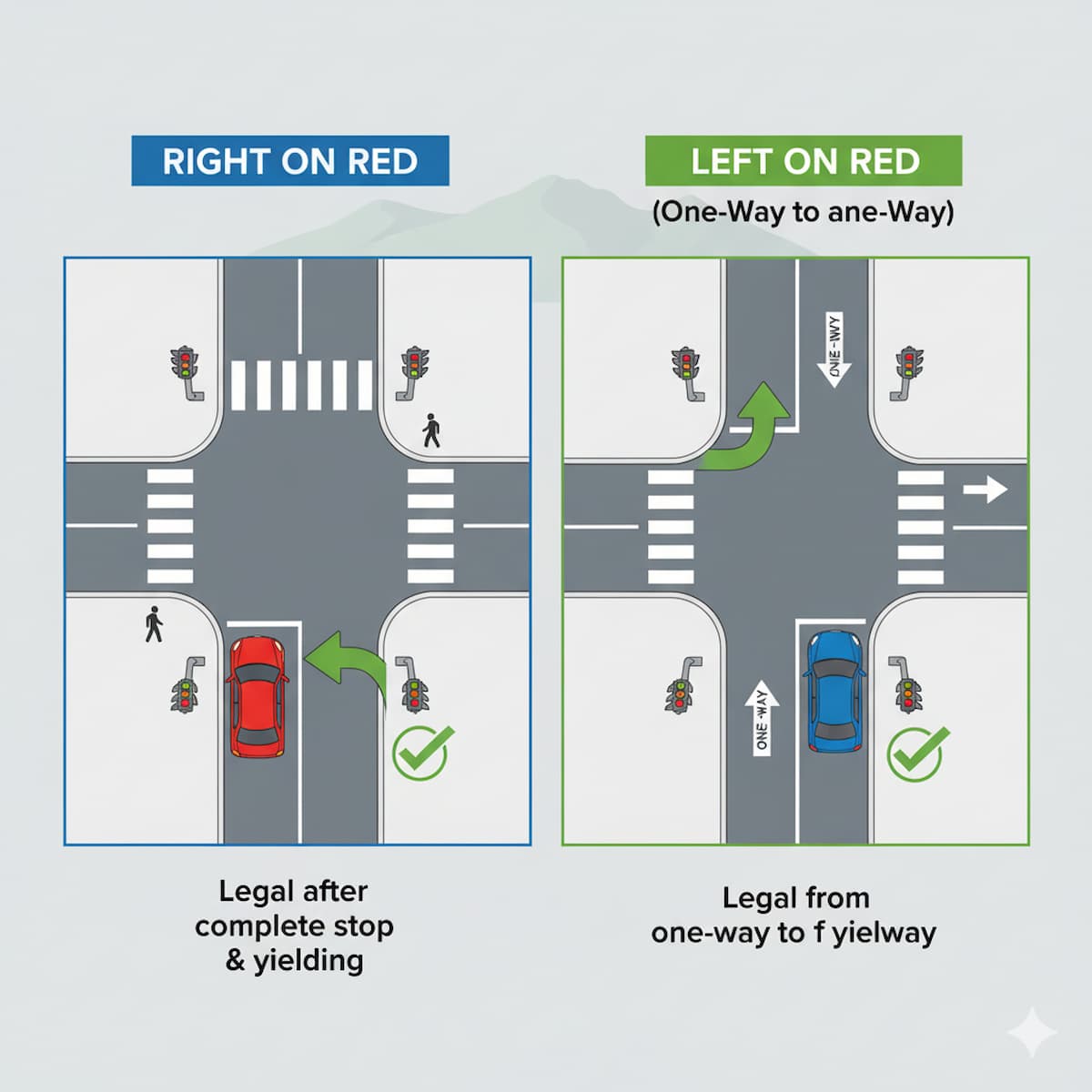
Vermont law allows right turns on red after coming to a complete stop at the limit line, crosswalk, or point where you have a clear view of approaching traffic under 23 VSA §1072. You must yield the right-of-way to pedestrians and vehicles lawfully proceeding through the intersection before making your turn. This is one of the most tested rules on the Vermont driver's exam. Vermont's law is consistent with most New England states and applies statewide, though some municipalities restrict the practice in busy downtown areas and college campus zones.
"NO TURN ON RED" signs and posted restrictions at Burlington and ski town intersections
Vermont municipalities can prohibit right turns on red at specific intersections by posting "NO TURN ON RED" signs. These restrictions are common in busy areas like downtown Burlington (especially Church Street Marketplace area), Montpelier (near the State House), Stowe village (ski resort traffic), Manchester Center (outlet shopping district), and Brattleboro. Time-based restrictions (e.g., "No Turn on Red 7-9 AM, 4-6 PM") apply only during posted hours and are often used near schools like the University of Vermont campus and busy ski resort access roads during winter weekends. Always check for signage before turning, especially in college towns and tourist areas.
Pedestrian right-of-way and crosswalk safety in Vermont college towns and village centers
Before executing a right turn on red, you must scan the crosswalk for pedestrians who have started crossing or are about to enter. Vermont law requires drivers to yield to pedestrians in crosswalks at all times under 23 VSA §1052. College towns like Burlington (UVM), Middlebury (Middlebury College), and Hanover border area (Dartmouth College) have particularly strict enforcement due to high pedestrian traffic. Historic village centers with designated crosswalks require extra caution. Failing to yield can result in fines up to $250 and 5 points on your license.
Red light enforcement: Vermont State Police traffic safety patrols and local monitoring
Vermont does not use automated red light cameras for enforcement, consistent with the state's privacy-focused legislation. However, law enforcement actively patrols high-traffic intersections, particularly in Chittenden County (Burlington metro), Rutland County, and Washington County (Montpelier-Barre). You must come to a complete stop before the stop line when making a legal right turn on red to avoid citations from police officers. Vermont State Police increase patrols during peak tourist seasons and winter ski weekends.
Left Turn on Red in Vermont: One-Way Street Rules & Intersection Requirements
When left on red is legal: 23 VSA §1072 one-way to one-way explained for Vermont drivers
Vermont permits left turns on red from a one-way street onto another one-way street after coming to a complete stop, unless prohibited by signage under 23 VSA §1072(b). This rule is less well-known but equally important and is particularly useful in downtown Burlington's grid system, which features several one-way streets including Cherry Street, College Street, and portions of Main Street. You must yield to all pedestrians and vehicles with the right-of-way before proceeding. Check our guide on left on red from one-way to one-way for detailed scenarios applicable to Vermont's small city layouts.
Signal compliance and yielding requirements for left turns on red signals in downtown areas
Just like right on red, you must make a complete stop at the stop line or crosswalk before turning left on red. Scan for oncoming traffic from all directions, watch for pedestrians (especially during fall foliage season when tourist foot traffic peaks), and only proceed when the intersection is clear. Protected-turn signals (green arrows) and "No Turn on Red" signs override the default permission. Burlington's one-way street system during weekday commute hours and UVM class change times requires extra caution.
Burlington downtown grid system and one-way street navigation for Vermont visitors
Burlington's downtown features a logical grid system with several one-way streets running north-south and east-west. Understanding the left-on-red rule helps you navigate efficiently during peak hours. Major one-way streets include portions of College Street (eastbound), Cherry Street (westbound), and Main Street sections. Always look for posted signs, especially during Lake Champlain waterfront events, Church Street Marketplace activities, and UVM sports events at Patrick Gym or Virtue Field.
Both right and left turns on red in Vermont require a complete stop and yielding to all traffic and pedestrians.
Vermont U-Turn Laws: When and Where U-Turns Are Legal Under 23 VSA §1065
23 VSA §1065: U-turn prohibitions at traffic signals, business districts, and limited visibility areas
U-turns are generally legal in Vermont when they can be made safely without interfering with other traffic under 23 VSA §1065. However, Vermont law specifically prohibits U-turns in business districts (unless made at an intersection where traffic is controlled by police or signals), at any location where your vehicle cannot be seen by approaching drivers within 500 feet due to curves or hills, and upon any curve or upon the approach to or near the crest of a grade. U-turns are also prohibited where posted "No U-Turn" signs exist. For more details, see our guide on U-turns across double yellow lines and Vermont-specific applications.
Safe U-turn execution on Vermont mountain highways: visibility and gap selection for Route 100 and scenic byways
When making a legal U-turn in Vermont, especially on mountain highways, ensure you have adequate sight distance in both directions—typically at least 500 feet per statute. Signal your intention, check mirrors and blind spots, and yield to all approaching vehicles and pedestrians. Execute the turn in a single, smooth motion without stopping in the opposing lane. On narrow mountain roads like Route 100 (Vermont's most scenic highway), Route 17 (Appalachian Gap), and Route 125 (Middlebury Gap), choose wide areas with good visibility or designated turnaround points. Never attempt U-turns on blind curves or near the crest of hills—Vermont's mountain passes have numerous curves and elevation changes that limit visibility.
Posted "No U-Turn" signs at Vermont ski resort intersections, covered bridges, and tourist attractions
Vermont municipalities and VTrans post "No U-Turn" signs at specific locations where U-turns would create hazards. These restrictions are common at ski resort access intersections (Stowe Mountain, Killington, Sugarbush, Stratton, Mount Snow), busy tourist areas near covered bridges (especially during fall foliage season), and high-traffic areas in Burlington, Rutland, and Brattleboro. These restrictions are enforceable by law, and violations can result in fines starting at $150 and 4 points on your license. Popular fall foliage viewing areas have increased enforcement during September and October.
U-turn citations and defensive driving in Vermont fall foliage traffic and ski season conditions
Illegal U-turns in Vermont can result in fines and points on your license if deemed an unsafe movement. During fall foliage season (late September through mid-October) and winter ski season (December through March), tourist routes experience heavy traffic, and illegal U-turns can cause serious accidents. To avoid citations, only make U-turns where visibility is excellent, traffic is light, and no signs prohibit the maneuver. When in doubt, continue to the next legal turning opportunity or designated scenic overlook with safe turnaround space. Vermont Route 100 has numerous scenic pullouts designed for safe stops and turns.
Vermont School Bus Stop Laws: 23 VSA §1101 Requirements & Penalties
When you must stop for school buses with flashing red lights in Vermont's rural and suburban areas
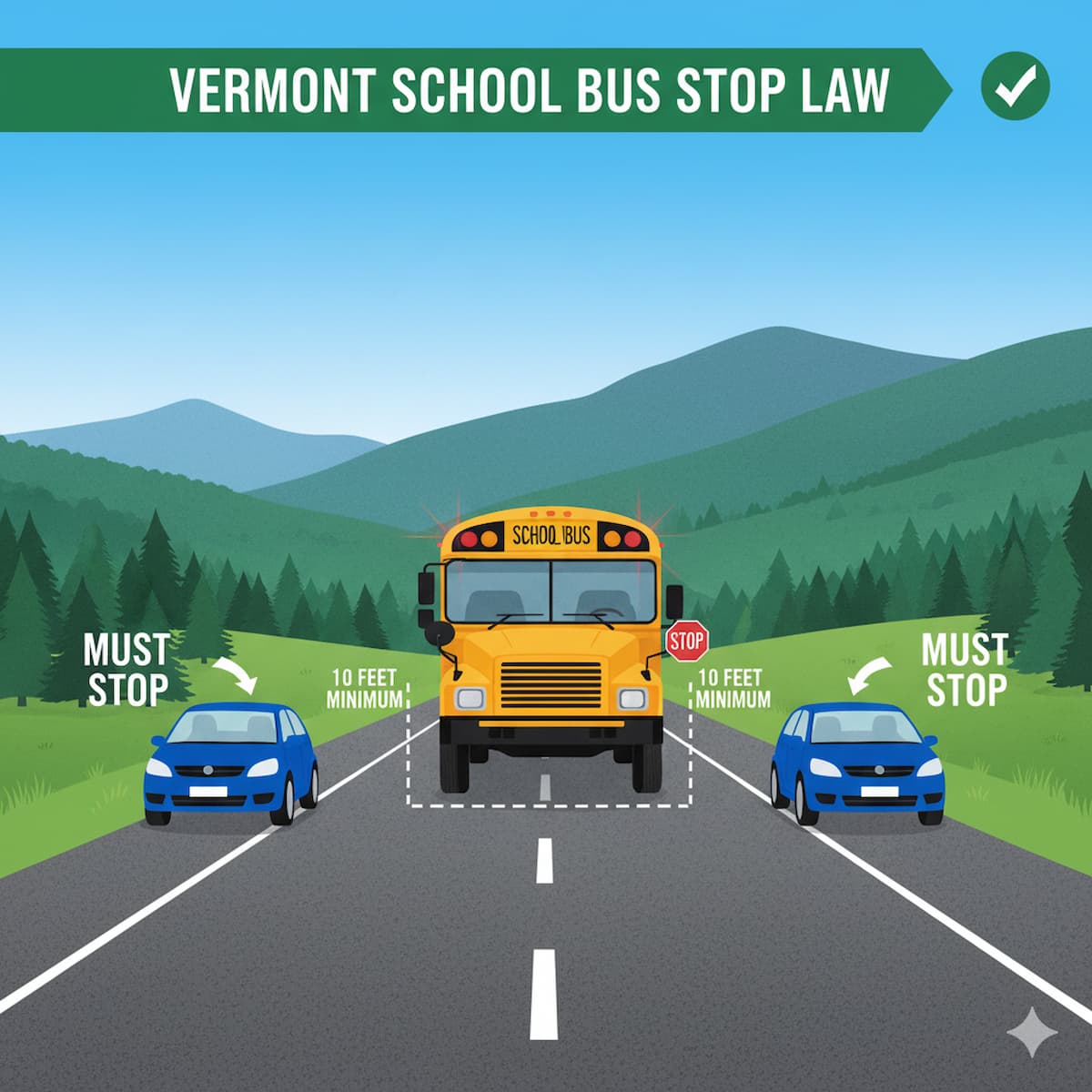
Vermont has strict school bus stop laws designed to protect children. Under23 VSA §1101, when a school bus displays flashing red lights and extends its stop arm, all traffic traveling in both directions must stop. You may not proceed until the red lights stop flashing, the stop arm is retracted, and the bus begins moving—or until the bus driver signals you to proceed. Unlike some states, Vermont requires stopping at least 10 feet away from the bus to allow children to cross safely. Vermont's rural character means school bus stops are common on narrow two-lane roads.
Both-direction stopping rule on undivided Vermont roads and rural highways
On two-lane roads and multi-lane undivided highways, traffic in both directions must stop for a school bus with activated signals. This includes highways with center turn lanes or painted medians that are not physically divided. The only exception is when you are traveling in the opposite direction on a divided highway with a physical barrier such as a concrete median, guardrail, cable barrier, or grassy divider at least five feet wide. Vermont's rural nature means most roads are undivided two-lane highways where both-direction stopping applies.
Divided highway exception: physical barriers and median requirements on I-89, I-91, and Route 7 expressway sections
On physically divided highways with a barrier separating opposing traffic (such as I-89, I-91, portions of US Route 7 expressway, and limited sections of Route 4 near Rutland), drivers traveling in the opposite direction of the school bus are not required to stop under 23 VSA §1101(a)(2). However, if you are traveling in the same direction as the bus or on a road divided only by pavement markings (painted median), you must stop. When in doubt on Vermont highways, always stop—enforcement is strict and penalties are severe.
Penalties for illegal school bus passing: fines up to $1,000, license suspension, and mandatory driver retraining
Illegally passing a stopped school bus in Vermont carries severe penalties. First-time offenders face fines up to$1,000, license suspension for a minimum of one month, and 5 points on your license. The Vermont DMV may require completion of a driver retraining program before license reinstatement. If you cause injury while illegally passing a school bus, charges can escalate to reckless endangerment with potential jail time. Vermont school districts increasingly use bus-mounted cameras to identify violators, and footage is admissible as evidence in traffic court. Vermont's tight-knit communities take school bus safety very seriously.
On undivided Vermont roads, all traffic in both directions must stop at least 10 feet from school buses with flashing red lights.
Winter tire tread requirements and seasonal driving preparedness for Green Mountain passes
Vermont enforces specific winter driving requirements through 23 VSA §1039 and VTrans recommendations. While Vermont does not mandate winter tires by law, VTrans strongly recommends snow tires with a minimum tread depth of 4/32 inch for winter driving safety. All-season tires must have at least 4/32 inch tread during winter months (November through April). Vermont State Police can issue citations for inadequate tires under the "negligent operation" statute if your vehicle's tires contribute to a crash or traffic hazard. Mountain passes like Smugglers' Notch (Route 108—closed in winter), Appalachian Gap (Route 17), and Lincoln Gap (closed in winter) have particularly demanding conditions.
Smugglers' Notch closure and seasonal road restrictions for Vermont mountain passes
Vermont seasonally closes several mountain pass roads due to severe winter conditions and avalanche danger. Route 108 through Smugglers' Notch is closed annually from approximately late October through late May, making it illegal to drive even with 4WD and snow tires. Lincoln Gap Road and Appalachian Gap have seasonal closures or restrictions. VTrans posts closure gates and signs—driving around closure barriers is illegal and can result in fines up to $500 plus rescue costs if you become stranded. Always check Vermont 511 or VTrans road condition reports before attempting mountain pass crossings during winter months.
Snow removal parking bans and overnight winter parking restrictions in Vermont towns and ski areas
Vermont municipalities enforce strict winter parking bans to allow snow removal operations. Most towns prohibit street parking during overnight hours (typically 12 AM to 6 AM) from November 1 through April 1, though exact dates vary by municipality. Burlington, Montpelier, Rutland, and ski towns like Stowe and Killington have aggressive towing policies for vehicles blocking snow removal. Fines range from $50-$100 plus towing fees ($150-$300). Check local ordinances before parking overnight. Ski resort parking areas have specific overnight policies—most prohibit overnight parking except in designated areas.
Vermont's "Move Over" law for emergency vehicles and snow plows on highways and mountain roads
Vermont's Move Over Law (23 VSA §1062) requires drivers to move over one lane (or slow down if moving over is impossible) when passing emergency vehicles, tow trucks, and highway maintenance vehicles including snow plows with activated warning lights. This is critical during winter snow removal operations on Vermont's highways and mountain roads. Violating the Move Over Law carries fines up to $500 and 5 points on your license. If a violation results in injury or property damage, penalties increase significantly. Vermont snow plow operators face dangerous conditions and deserve safe clearance.
Vermont DUI Laws, Speed Limits, Wildlife Crossing Safety & Point System Overview
Vermont DUI laws: 0.08% BAC limit, criminal penalties, and ignition interlock requirements for impaired driving
Vermont has strict DUI laws under 23 VSA §1201 with a legal blood alcohol concentration (BAC) limit of 0.08% for drivers 21 and over. The limit is 0.02% for drivers under 21 (zero tolerance enforcement), and 0.04% for commercial drivers. First-time DUI convictions carry fines from $750 to $1,500, license suspension for 90 days (or up to 18 months for high BAC), mandatory alcohol screening and education, and potential jail time up to 2 years. Vermont requires ignition interlock devices for all DUI convictions, even first-time offenders. Refusal to submit to chemical testing results in automatic license suspension for 6 months (first offense) or longer for repeat refusals.
Vermont speed limits: urban, rural, interstate, and posted school zone and village center regulations
Vermont speed limits vary by road type and area under 23 VSA §1081. Unless otherwise posted, speed limits are 25 mph in villages and residential districts, 35 mph in densely settled areas, 40 mph on town highways outside settled areas, 50 mph on Vermont state highways, and 65 mph on interstate highways (I-89 and I-91—Vermont does not have 70+ mph speed limits). School zones have reduced speed limits of 20-25 mph when children are present or during posted hours. Vermont enforces the "Basic Rule"—drivers must travel at speeds safe for current conditions, even if below the posted limit, which is critical during fog, rain, snow, and icy conditions common in Vermont.
Vermont demerit point system: accumulation thresholds, suspensions, and driver improvement requirements
Vermont uses a demerit point system under 23 VSA §2406 to track traffic violations. Points range from 2 points (minor violations like speeding 1-10 mph over) to 8 points (reckless driving, school bus passing). Accumulating 10 or more points within 2 years triggers a license suspension warning, and additional points lead to suspension. Suspensions range from 1-90 days depending on point total and history. You can attend a driver improvement course to reduce points once every 2 years. Drivers under 21 face stricter rules—any violation can trigger license suspension or restrictions. Vermont DMV sends warning letters at 6 points.
Moose and deer crossing safety: Vermont wildlife collision prevention and reporting requirements for rural highways
Vermont has one of the highest moose collision rates in the nation, with peak danger periods during May-July (mating season) and October-November (pre-winter movement). Moose are most active at dawn and dusk on rural highways, especially in the Northeast Kingdom, northern Green Mountains, and areas near wetlands. If you see one moose, slow down immediately— others are likely nearby. Never swerve to avoid moose or deer on high-speed roads; braking hard in a straight line is safer than swerving into oncoming traffic or trees. If you hit a moose or deer causing property damage over $3,000 or any injury, you must report the crash to law enforcement under 23 VSA §1128. Route 105, Route 114, Route 100, and I-91 through the Northeast Kingdom have particularly high moose crossing frequencies. Use high beams when no oncoming traffic is present to spot wildlife eye-shine earlier.
This guide summarizes Vermont driving laws for educational purposes only and is not legal advice. Always consult the official Vermont Statutes Annotated, VTrans guidance, and posted traffic signs for authoritative information. Traffic laws are subject to change—verify current regulations with official sources. Vermont's rural character and seasonal conditions require extra caution and preparation year-round.