Washington Driving Laws & Traffic Rules (2025 Complete Guide)
This comprehensive guide covers Washington State's essential driving laws and traffic regulations under the Revised Code of Washington (RCW) Title 46. Whether you're a new driver preparing for your Washington driver's license exam, a resident needing to understand state-specific rules, or a visitor navigating Washington's rainy highways and mountain passes, this guide provides clear explanations of double yellow line rules, turn regulations, school bus stop laws, rain safety requirements, DUI penalties, and mountain pass chain laws. All information references official WSDOT guidance and Washington statutes.
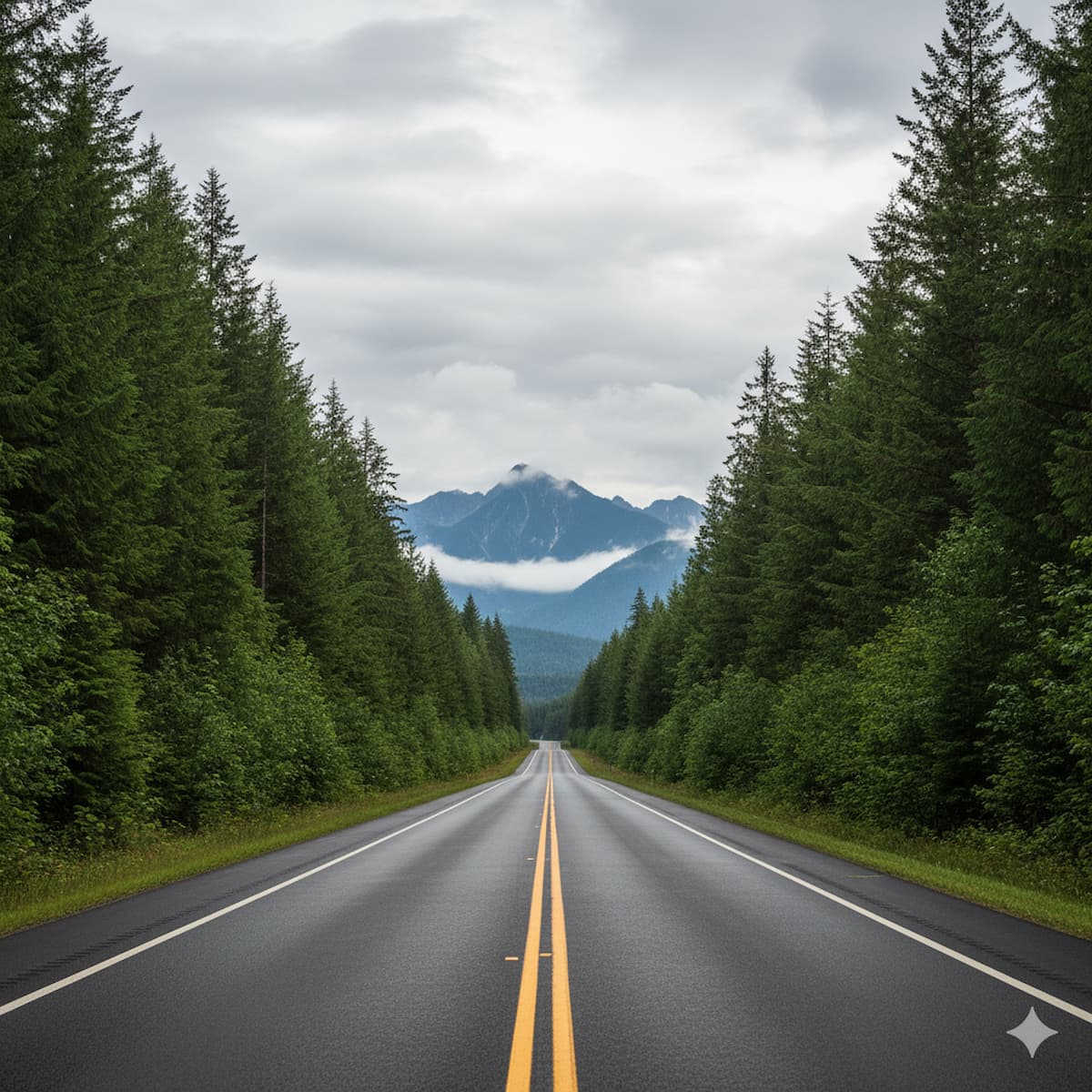
Washington's scenic highways require drivers to follow specific state traffic laws and road marking regulations.
Washington Double Yellow Line Laws: No-Passing Zones & Legal Crossing Rules
RCW §46.61.130: When you can and cannot cross double yellow centerlines in Washington
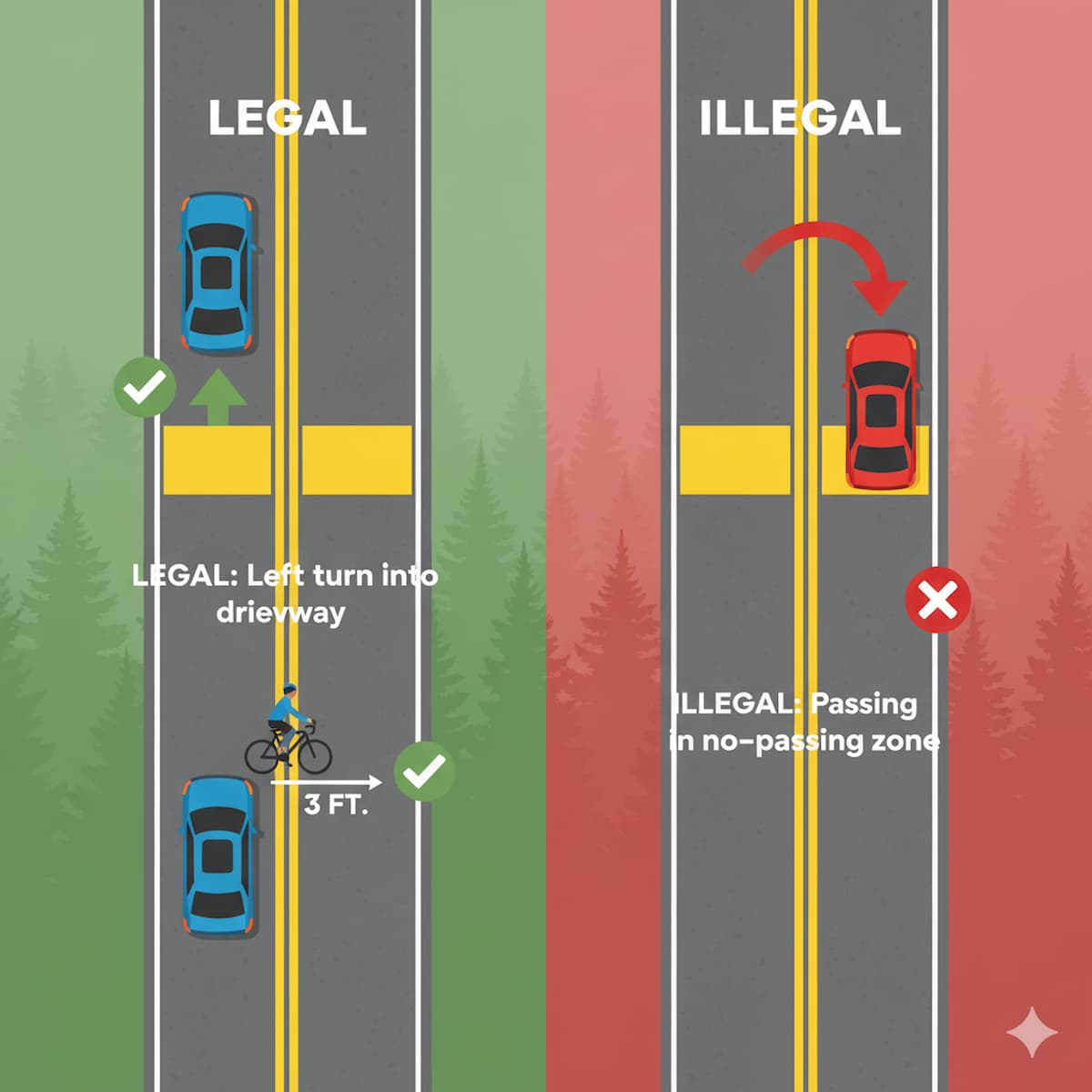
Washington's double yellow centerline regulations are governed by RCW §46.61.130, which establishes no-passing zones throughout the state. In Washington, double solid yellow lines indicate that passing is prohibited for traffic traveling in both directions. These markings typically appear on Washington's winding highways, I-90 through the Cascades, North Cascades Highway (SR-20), curves, hills, and other areas where passing would be dangerous due to limited sight distance or high traffic volume. Washington's mountainous terrain and frequent rain make these restrictions especially critical for safety.
Legal exceptions for left turns: driveways, private roads, and parking lots
Washington law permits drivers to cross double yellow lines to make left turns into driveways, alleys, private roads, and parking lots when it is safe to do so. This is one of the most common exceptions to the no-passing rule and is particularly important for accessing Washington's many mountain properties, ferry terminals, and recreational areas. When making such turns, you must yield to oncoming traffic, use your turn signal at least 100 feet in advance, and complete the maneuver safely without impeding other vehicles. Review our detailed guide on left turns across double yellow lines for best practices.
Crossing double yellow to avoid obstructions: cyclists, debris, and road hazards
Washington drivers may briefly cross the centerline—even in a no-passing zone—to avoid an obstruction in the roadway, such as a disabled vehicle, fallen trees (common in Pacific Northwest weather), construction debris, or a road hazard. The key requirement is that the maneuver must be necessary for safety and performed only when it can be done without endangering oncoming traffic. You must return to your lane as soon as it is safe. Washington is known for being bike-friendly, and drivers are explicitly allowed to cross centerlines to pass cyclists when safe and visibility permits, maintaining at least 3 feet of clearance.
Common violations and penalties for illegal passing on Washington highways
Illegally passing across double yellow lines in Washington can result in fines up to $250 plus court costs. Courts view passing in no-passing zones seriously, especially on dangerous highways like US-2 through Stevens Pass, SR-20 North Cascades Highway, or Highway 101 along the Olympic Peninsula. If the violation results in a crash or near-miss, penalties increase significantly and may include license suspension and mandatory traffic school.
Yellow centerline pavement markings and painted median barriers in Washington
In Washington, when you encounter closely spaced yellow pavement markings forming a barrier area between opposing traffic lanes (similar to two sets of double yellow lines), you must treat this area as a physical divider. You may not drive on, across, or within this painted median except at designated openings marked for left turns. These painted medians are common on Washington's urban arterials like Aurora Avenue (SR-99) in Seattle and Pacific Highway corridors. Learn more about painted median barriers and how they function.
Center left-turn lanes (TWLTL) vs painted medians in Washington cities
Washington also uses center left-turn lanes (two-way left-turn lanes), which have a different marking pattern. These lanes feature a solid yellow line on the outside and a broken yellow line on the inside, with yellow diagonal markings or arrows inside the lane. These are shared by traffic traveling in both directions to make left turns. Do not confuse these with painted medians—center turn lanes are designed for shared use (maximum 300 feet before your turn), while painted median barriers prohibit all crossing.
Washington allows crossing double yellow lines for left turns but prohibits passing in no-passing zones.
Right Turn on Red in Washington: RCW §46.61.055 Requirements & Restrictions
Complete stop requirement before turning right on red at Washington intersections
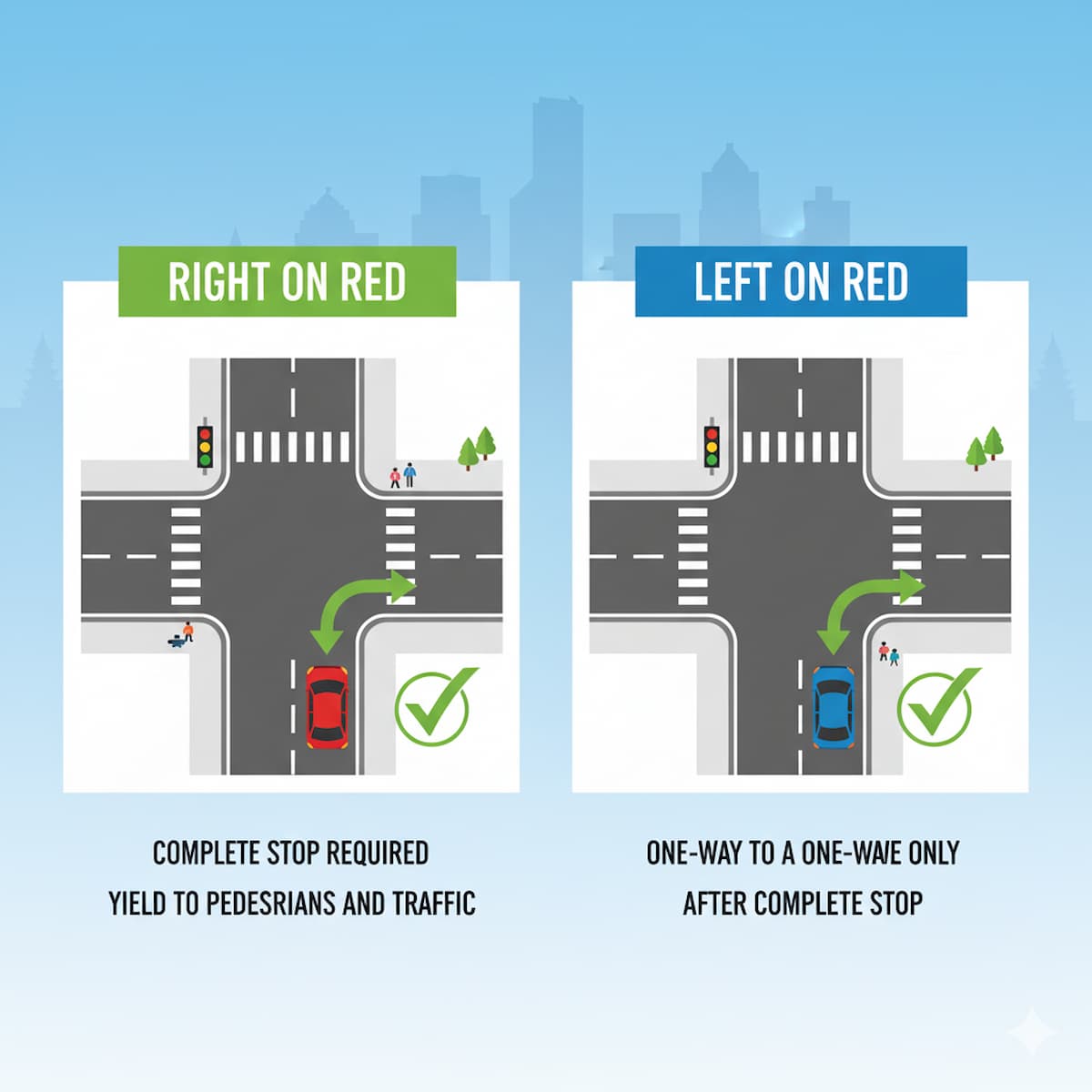
Washington law allows right turns on red after coming to a complete stop at the limit line, crosswalk, or point where you have a clear view of approaching traffic. Under RCW §46.61.055, you must yield the right-of-way to pedestrians and vehicles lawfully proceeding through the intersection before making your turn. This is one of the most tested rules on the Washington driver's exam. Washington's law applies statewide but with specific urban restrictions in downtown areas.
"NO TURN ON RED" signs and posted restrictions in Seattle and urban areas
Washington municipalities can prohibit right turns on red at specific intersections by posting "NO TURN ON RED" signs. These restrictions are extremely common in downtown Seattle, Bellevue, Tacoma, and Spokane to protect high pedestrian traffic. Many Seattle intersections also have time-based restrictions (e.g., "No Turn on Red 7-9 AM, 4-7 PM") during rush hours. Pike Place Market area and University District have numerous no-turn-on-red intersections. Always check for signage before turning, especially in urban cores.
Pedestrian right-of-way and crosswalk safety in Seattle downtown core
Before executing a right turn on red, you must scan the crosswalk for pedestrians who have started crossing or are about to enter. Washington law requires drivers to yield to pedestrians in crosswalks at all times under RCW §46.61.235. Downtown Seattle, Bellevue, and other urban areas have particularly strict enforcement due to high pedestrian traffic and "Vision Zero" safety initiatives. Failing to yield can result in fines up to $250 and points on your license.
Red light camera enforcement in Washington cities and ticket procedures
Washington does use red light cameras in certain jurisdictions including Seattle, Tacoma, and Spokane. If you are photographed making an illegal right turn on red (rolling stop, no stop, or turning when prohibited), you will receive a civil infraction notice by mail. Fines typically range from $124 to $250. You must come to a complete stop before the stop line when making a legal right turn on red. Red light camera violations do not add points to your license but must be paid or contested within the specified timeframe.
Left Turn on Red in Washington: One-Way Street Rules & Intersection Requirements
When left on red is legal: RCW §46.61.055 one-way to one-way explained
Washington permits left turns on red from a one-way street onto another one-way street after coming to a complete stop, unless prohibited by signage. This rule is particularly useful in downtown Seattle's grid system, Spokane's downtown core, and Tacoma's urban streets, which feature several one-way configurations. You must yield to all pedestrians and vehicles with the right-of-way before proceeding. Check our guide on left on red from one-way to one-way for detailed scenarios and safe execution.
Signal compliance and yielding requirements for left turns on red signals
Just like right on red, you must make a complete stop at the stop line or crosswalk before turning left on red. Scan for oncoming traffic from all directions, watch for pedestrians (especially during Pike Place Market hours when tourist foot traffic is high), and only proceed when the intersection is clear. Protected-turn signals (green arrows) and "No Turn on Red" signs override the default permission. Seattle's downtown has many complex intersections where both pedestrians and light rail must be considered.
Seattle downtown grid system and one-way street navigation for drivers
Seattle's downtown features a grid system with several one-way streets. Major one-way arterials include portions of 2nd Avenue, 4th Avenue, and various numbered avenues. Understanding the left-on-red rule helps you navigate efficiently during peak hours. Always look for posted signs, especially during Seahawks/Mariners game days at T-Mobile Park and Lumen Field when traffic patterns change. Spokane's downtown also features extensive one-way streets where this rule applies frequently.
Both right and left turns on red in Washington require a complete stop and yielding to all traffic and pedestrians.
Washington U-Turn Laws: When and Where U-Turns Are Legal Under RCW §46.61.295
RCW §46.61.295: U-turn prohibitions at traffic signals and business districts
U-turns are generally legal in Washington when they can be made safely without interfering with other traffic under RCW §46.61.295. However, Washington law specifically prohibits U-turns in business districts (unless made at an intersection where permitted), at any location where your vehicle cannot be seen by approaching drivers within 500 feet due to curves or hills, and at intersections controlled by traffic signals unless a sign specifically permits U-turns. For more details, see our guide on U-turns across double yellow lines.
Safe U-turn execution on Washington highways: visibility and gap selection
When making a legal U-turn in Washington, especially on highways, ensure you have adequate sight distance in both directions—typically at least 500 feet. Signal your intention, check mirrors and blind spots, and yield to all approaching vehicles and pedestrians. Execute the turn in a single, smooth motion without stopping in the opposing lane. On narrow highways, choose wide areas with good visibility or designated turnaround points. Never attempt U-turns on blind curves or near the crest of hills on highways like US-2, SR-20, or Highway 101. Rain and fog common in Washington reduce visibility, making safe U-turns even more critical.
Posted "No U-Turn" signs at Washington intersections and highway locations
Washington municipalities and WSDOT post "No U-Turn" signs at specific locations where U-turns would create hazards. These restrictions are common at busy Seattle intersections (especially Aurora Avenue/SR-99), I-5 on-ramps, highway median breaks, and congested areas in Bellevue and Tacoma. Ferry terminal approaches and bridge approaches (like approaches to I-90 floating bridges) often prohibit U-turns. These restrictions are enforceable by law, and violations can result in fines starting at $139.
U-turn citations and defensive driving in Washington rain and fog conditions
Illegal U-turns in Washington can result in fines and points on your license if deemed an unsafe movement. During Washington's rainy season (October through May), reduced visibility from rain and fog makes illegal U-turns especially dangerous. To avoid citations and crashes, only make U-turns where visibility is excellent, traffic is light, and no signs prohibit the maneuver. When in doubt, continue to the next intersection or designated turnaround area. Highway Patrol actively enforces unsafe U-turn violations on state routes.
Washington School Bus Stop Laws: RCW §46.61.370 Requirements & Penalties
When you must stop for school buses with flashing red lights in Washington
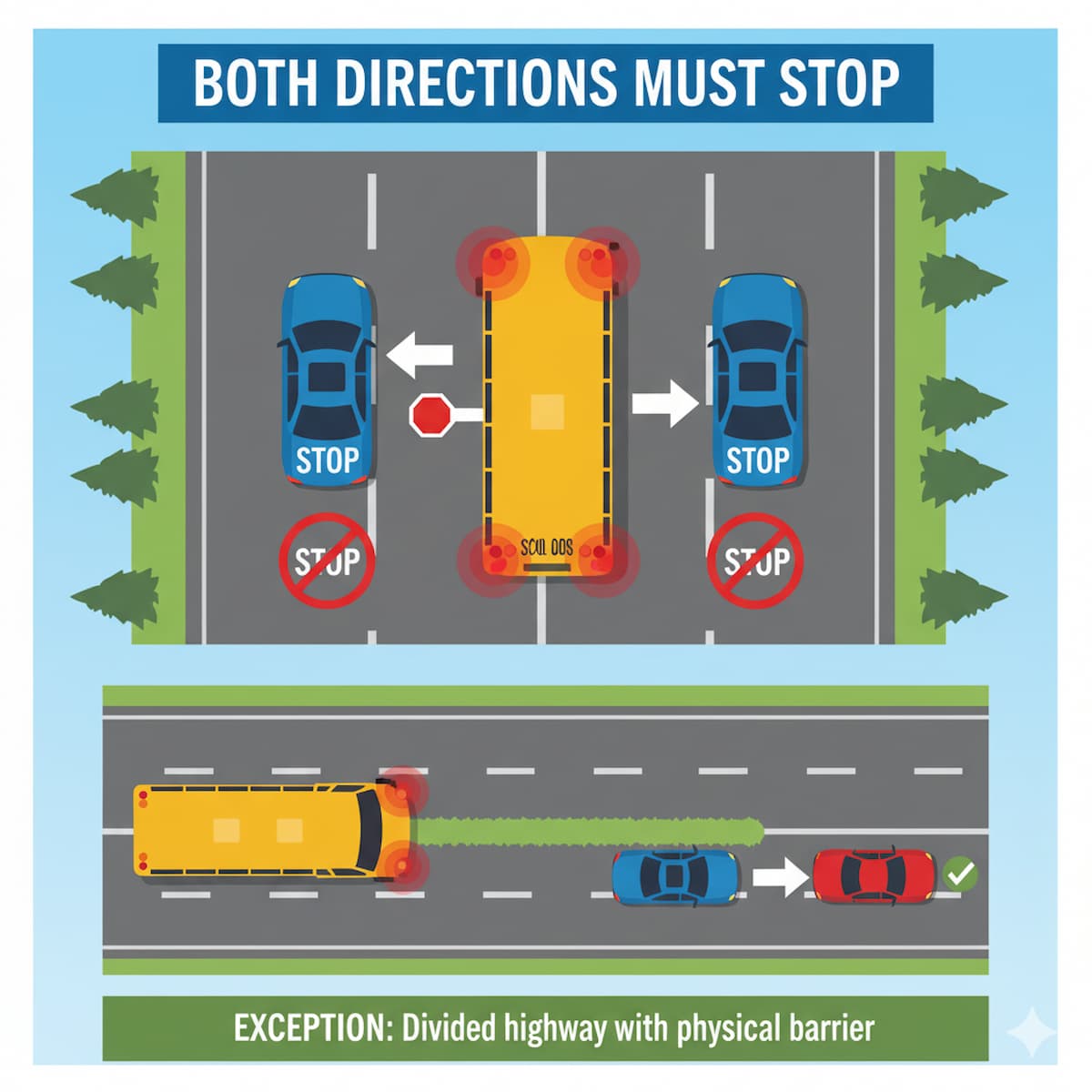
Washington has strict school bus stop laws designed to protect children. UnderRCW §46.61.370, when a school bus displays flashing red lights and extends its stop arm, all traffic traveling in both directions must stop. You may not proceed until the red lights stop flashing, the stop arm is retracted, and the bus begins moving—or until the bus driver signals you to proceed. You must stop at a safe distance that allows children to cross safely, and remain stopped even if the bus is on the opposite side of the road.
Both-direction stopping rule on undivided Washington roads and highways
On two-lane roads and multi-lane undivided highways, traffic in both directions must stop for a school bus with activated signals. This includes highways with center turn lanes or painted medians that are not physically divided. The only exception is when you are traveling in the opposite direction on a divided highway with a physical barrier such as a concrete median, guardrail, cable barrier, or raised divider. This applies on highways like I-5, I-90, and I-405 where physical barriers separate opposing traffic.
Divided highway exception: physical barriers and median requirements in Washington
On physically divided highways with a barrier separating opposing traffic (such as I-5, I-90, I-405, or portions of SR-520), drivers traveling in the opposite direction of the school bus are not required to stop. However, if you are traveling in the same direction as the bus or on a road divided only by pavement markings (painted median), you must stop. When in doubt on Washington highways, always stop—enforcement is strict, and school safety is paramount.
Penalties for illegal school bus passing: fines, license suspension, and camera enforcement
Illegally passing a stopped school bus in Washington carries severe penalties. First-time offenders face fines up to$419 and mandatory traffic school. The Washington DOL may suspend your license for repeat violations. Many Washington school districts now equip buses with stop-arm cameras that photograph violators' license plates. If you are caught on camera illegally passing a school bus, you will receive a citation by mail. These violations are taken very seriously—if you cause injury while illegally passing a school bus, criminal charges including reckless endangerment may apply.
On undivided Washington roads, all traffic in both directions must stop for school buses with flashing red lights.
Washington Mountain Pass Driving Laws & Winter Chain Requirements
Traction tire and chain requirements on Snoqualmie Pass and Stevens Pass
Washington enforces specific winter driving requirements on mountain passes during winter storms. When "Chains Required" signs are posted, all vehicles—including AWD and 4WD—must carry chains in the vehicle. WSDOT and Washington State Patrol require approved traction tires (M+S or mountain/snowflake symbol) or chains installed on Snoqualmie Pass (I-90), Stevens Pass (US-2), White Pass (US-12), Blewett Pass (US-97), and Chinook Pass (SR-410). Law enforcement can turn away vehicles without proper equipment. Fines for non-compliance start at $500, and if your inadequate vehicle causes a road closure or accident, you may face additional liability.
Three-tier traction advisory system: chains advised, required, and essential
Washington uses a three-tier traction advisory system. "Chains Advised" means winter conditions exist and chains are recommended. "Chains Required" means all vehicles except AWD/4WD with approved traction tires must have chains installed on drive wheels. "Chains Required on All Vehicles" (rare) means even AWD/4WD must install chains. Commercial vehicles have additional requirements. Check WSDOT's mountain pass reports before traveling during winter months.
Safe following distances and runaway truck ramps on Washington mountain highways
Washington's steep mountain passes feature runaway truck ramps designed for vehicles experiencing brake failure on long descents. Drivers should maintain extended following distances (5+ seconds minimum) on downgrades and avoid riding brakes. Use lower gears to control speed on descents of Snoqualmie Pass (I-90 westbound from summit to North Bend), Stevens Pass, and other mountain routes. Never park or stop in runaway truck ramp areas—they are for emergencies only, and blocking them carries severe penalties and endangers commercial vehicle drivers.
Washington wipers-on headlights-on law and rain safety requirements
Washington law requires drivers to use headlights whenever windshield wipers are in continuous use due to rain, snow, sleet, or fog. This "wipers on, headlights on" rule under RCW §46.37.020 is critical for visibility during Washington's frequent rain. Daytime running lights do NOT satisfy this requirement—you must activate your full headlight system (which illuminates tail lights). Violating this law results in fines around $136 and is frequently enforced during rainy months on I-5, I-405, and other major highways.
Washington DUI Laws, Speed Limits, Distracted Driving & Point System
Washington DUI laws: 0.08% BAC limit and strict penalties for impaired driving
Washington enforces a 0.08% blood alcohol concentration (BAC) limit for drivers 21 and over. The limit is 0.02% for drivers under 21 (zero tolerance), and 0.04% for commercial drivers. First-time DUI convictions carry mandatory jail time (minimum 1 day), fines starting at $941.50 (can exceed $5,000), license suspension for 90 days (longer for refusal), mandatory alcohol assessment and treatment, ignition interlock device for at least one year, and SR-22 high-risk insurance. Washington's DUI penalties escalate sharply for repeat offenses and high BAC levels (0.15% or higher).
Washington speed limits: urban, rural, interstate, and school zone regulations
Washington speed limits vary by road type and area. Unless otherwise posted, speed limits are 25 mph in residential areas, 50 mph on county roads, 60 mph on state highways, and60-70 mph on interstate highways (I-5, I-90, I-405 have 60 mph limits in urban areas; 70 mph in rural areas). School zones have reduced speed limits of 20 mph when children are present or during posted hours. Washington enforces the "Basic Rule"—drivers must travel at speeds safe for current conditions, even if below the posted limit, which is critical during rain, fog, and winter weather.
Washington distracted driving law: E-DUI and hands-free cell phone requirements
Washington has one of the strictest distracted driving laws in the nation. Under the Driving Under the Influence of Electronics Act (E-DUI), you may not hold a phone or electronic device while driving—even while stopped at a red light. This includes texting, browsing, taking photos, or using apps. You may use voice-activated/hands-free functions with minimal touch (single tap). First offense fines are $136, second offense within 5 years is $234 plus the violation is reported to insurance. The law applies statewide and is actively enforced.
High-risk violations: reckless driving, aggressive driving, and street racing penalties
Washington treats certain violations as high-risk offenses with enhanced penalties. Reckless driving (RCW §46.61.500) is a gross misdemeanor carrying up to 364 days in jail and fines up to $5,000. Racing(street racing or exhibition of speed) carries similar penalties plus vehicle impound. Negligent driving in the first degree (driving dangerously while exhibiting effects of substances or distractions) is a misdemeanor. All of these significantly increase insurance rates, add points to your license, and can lead to license suspension.
Official Washington Driving Resources & WSDOT Links
This guide summarizes Washington driving laws for educational purposes only and is not legal advice. Always consult the official Revised Code of Washington, WSDOT guidance, and posted traffic signs for authoritative information. Traffic laws are subject to change—verify current regulations with official sources.
Washington Driving Laws & Traffic Rules 2025 Complete Guide