This comprehensive guide covers West Virginia's essential driving laws and traffic regulations under the West Virginia Code. Whether you're navigating the winding mountain roads of the Appalachians, driving through Charleston or Morgantown, or traveling scenic highways like the Highland Scenic Byway, understanding state-specific traffic rules is crucial. This guide provides clear explanations of double yellow line rules, turn regulations, school bus stop laws, mountain driving requirements, speed limits, and DUI penalties. All information references official West Virginia Division of Motor Vehicles guidance and WV Code statutes to ensure accuracy for residents, new drivers, and visitors alike.
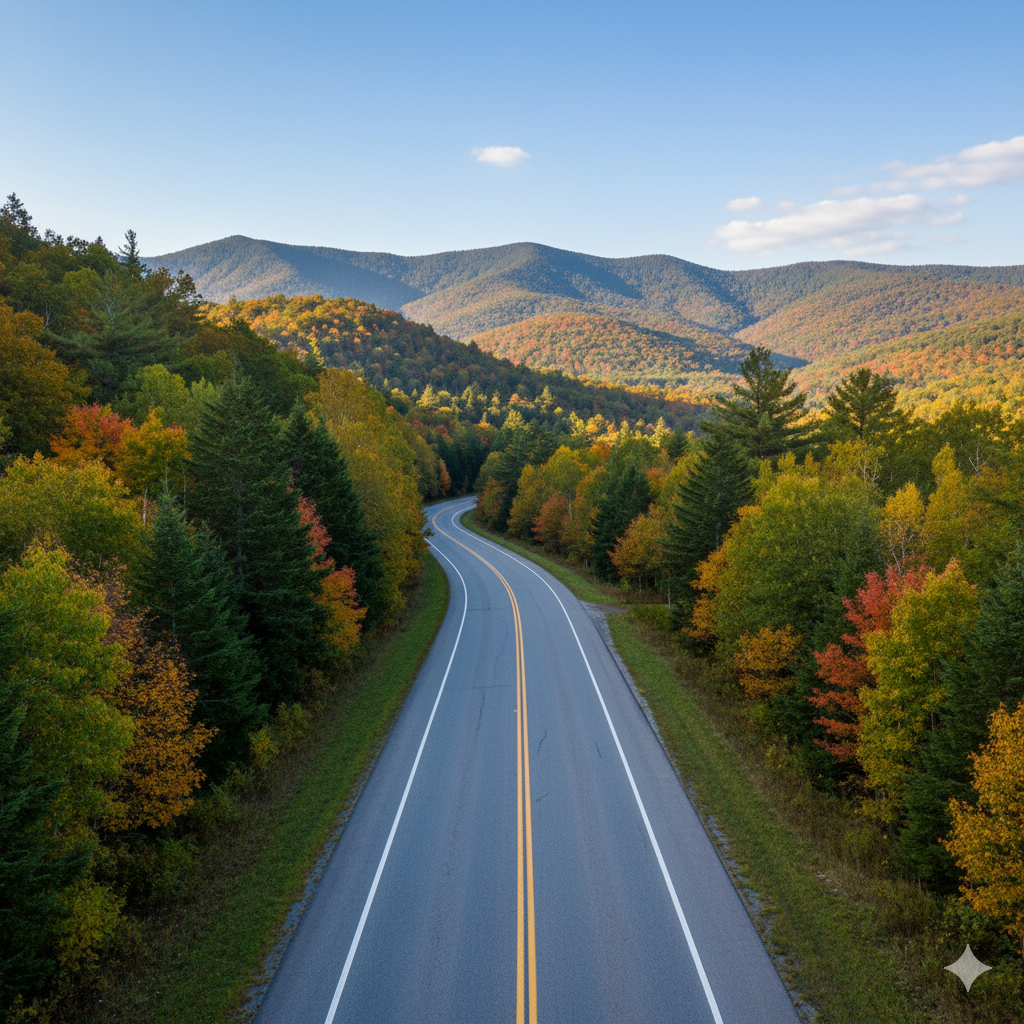
West Virginia's mountainous terrain requires strict adherence to traffic laws, especially on winding roads with steep grades.
West Virginia Double Yellow Line Laws: No-Passing Zones and Legal Crossings (WV Code §17C-7-3)
Understanding West Virginia no-passing zones and centerline markings
West Virginia's no-passing regulations are governed by WV Code §17C-7-3, which establishes clear rules for double solid yellow centerlines. In West Virginia, double solid yellow lines indicate that passing is prohibited for traffic traveling in both directions. These markings typically appear on mountain curves, steep grades, narrow bridges, and other locations where passing would create a safety hazard due to limited sight distance or oncoming traffic visibility. Given West Virginia's mountainous terrain and winding Appalachian highways, these no-passing zones are especially common and strictly enforced.
When you may legally cross double yellow lines in West Virginia mountain roads
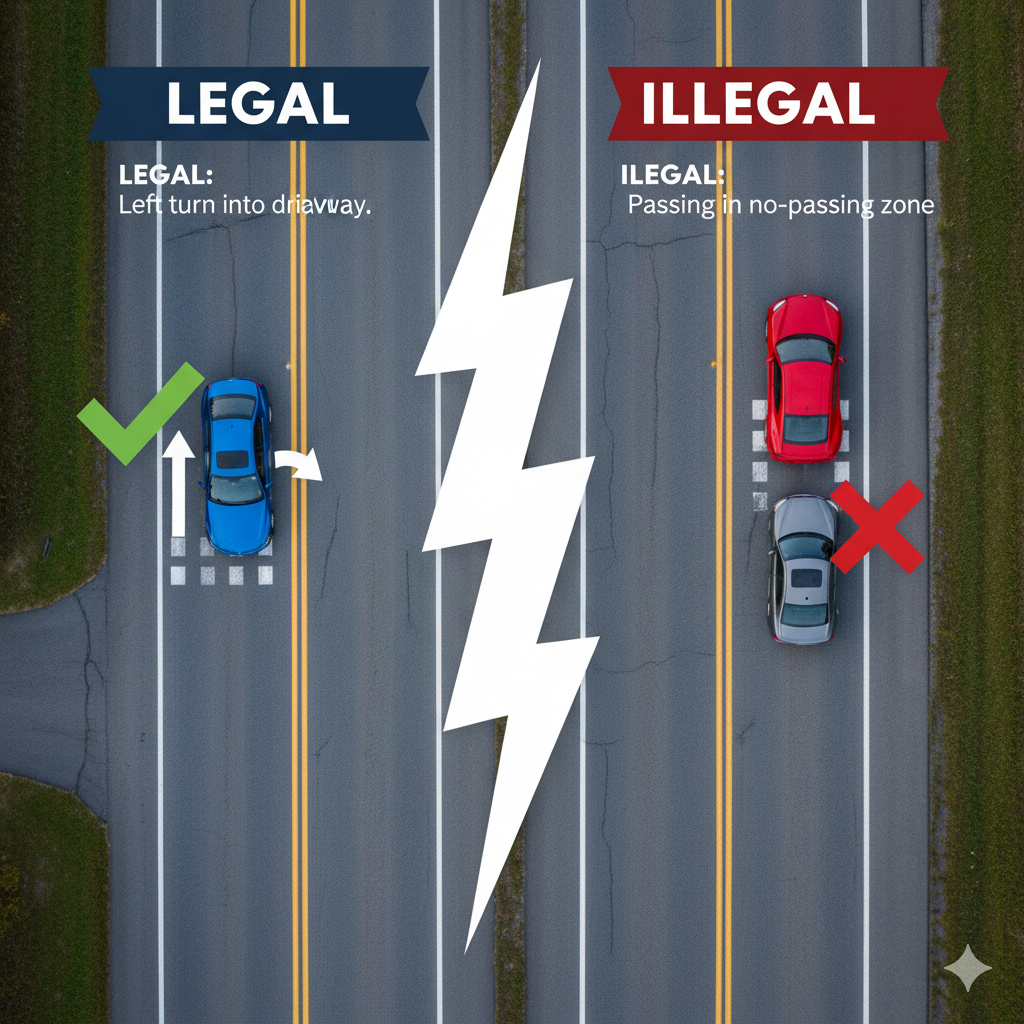
West Virginia law permits drivers to cross double yellow lines in specific situations when it can be done safely and does not endanger other road users. The primary legal exceptions include: (1) making a left turn into a driveway, alley, or private road when safe and no signs prohibit the movement; (2) executing a U-turn where legal and sight distance requirements are met; and (3) briefly avoiding an obstruction in the roadway such as debris, a disabled vehicle, fallen rocks, or road damage when necessary for safety. On West Virginia's narrow mountain roads like US-219 through the Allegheny Mountains or WV-39 through the Cranberry Wilderness, exercising extreme caution when crossing centerlines is essential.
Left turns across double yellow into driveways and private roads in rural WV
Making a left turn across double yellow lines is one of the most common legal exceptions in West Virginia. When executing this maneuver, drivers must signal their intention at least 100 feet in advance, yield to all oncoming traffic and pedestrians, and complete the turn in a single, continuous movement without lingering in the opposing lane. This exception applies to both urban areas like Charleston and rural highways throughout Appalachia. Given the prevalence of steep driveways and private roads leading off mountain highways, this maneuver requires extra attention to ensure adequate sight distance around curves.
Avoiding obstructions: rockslides, fallen trees, and coal truck hazards in West Virginia
West Virginia's mountain highways often present unique hazards including rockslides, fallen trees, coal and timber trucks, and weather-related debris. State law permits drivers to briefly cross the centerline to avoid these obstructions when it can be done safely and no oncoming traffic is present. However, this exception does not permit passing slower-moving vehicles in no-passing zones. On highways like US-60 through the New River Gorge or WV-2 along the Ohio River, drivers should be especially vigilant for road hazards that may suddenly appear, particularly during heavy rains or winter weather when landslides and flooding are common.
Penalties for illegal passing across double yellow lines in West Virginia
Illegally passing across double yellow lines in West Virginia can result in significant penalties. Violations typically carry fines ranging from $100 to $200 plus court costs, and 3 to 5 points added to your driving record under West Virginia's point system. Accumulating 12 or more points within a 24-month period can lead to license suspension, mandatory driver improvement courses, and increased insurance premiums. Courts treat passing violations seriously, particularly if they result in a collision or near-miss with oncoming traffic on narrow mountain roads where head-on crashes can be fatal.
Common violations on West Virginia scenic highways and mountainous terrain
Law enforcement in West Virginia actively patrols popular scenic routes where illegal passing is common and dangerous, including the Highland Scenic Byway (WV-150/US-219), Midland Trail (US-60), Coal Heritage Trail, and the winding sections of US-33 through the Monongahela National Forest. These mountain roads feature numerous sharp curves, steep grades, and hills with limited sight distance, making passing extremely dangerous. Drivers should exercise patience and wait for designated legal passing zones marked by dashed yellow lines before attempting to overtake slower vehicles, coal trucks, or recreational vehicles.
West Virginia permits crossing double yellow lines for left turns into driveways but prohibits passing in no-passing zones.
Right Turn on Red Rules in West Virginia: Complete Stop Requirements (WV Code §17C-6-3)
West Virginia right on red law: stop, yield, and proceed when clear
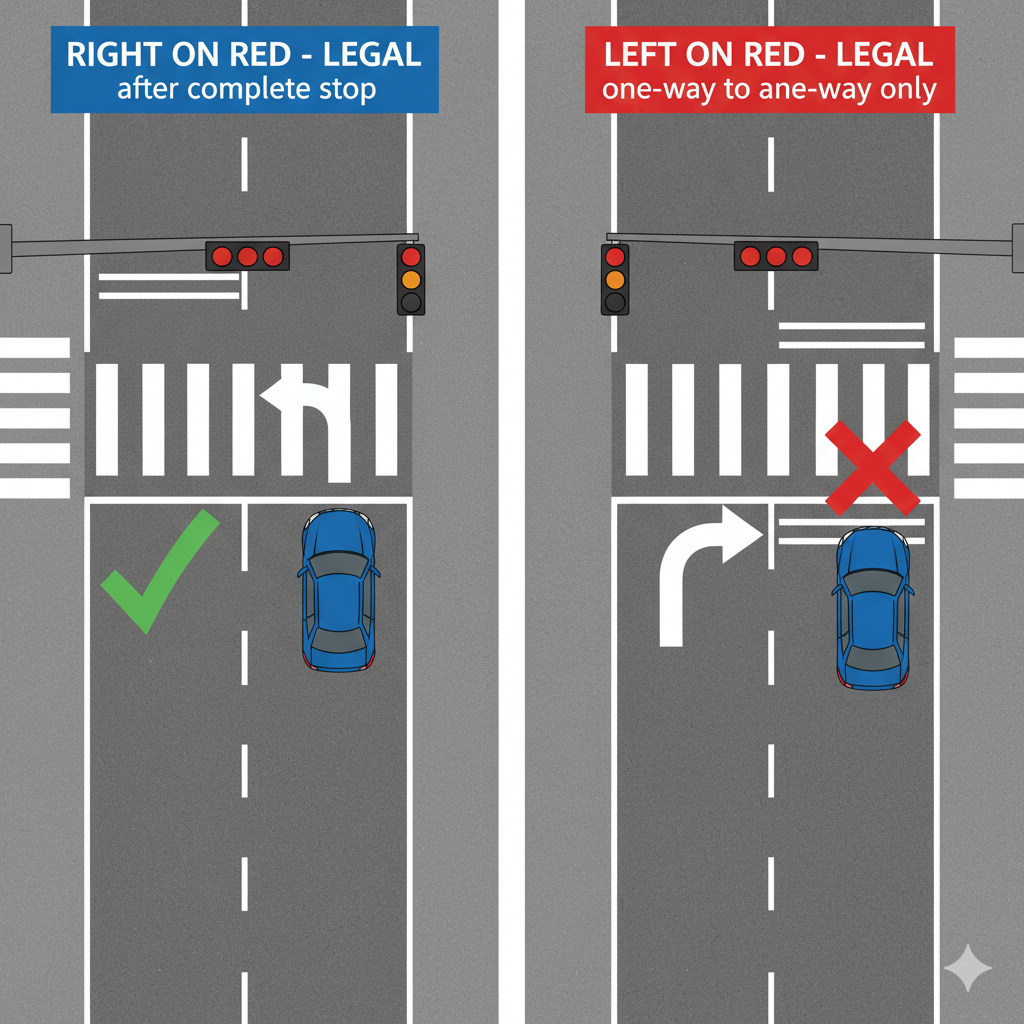
West Virginia law allows right turns on red after coming to a complete stop at the limit line, crosswalk, or point where you have a clear view of approaching traffic. Under WV Code §17C-6-3, drivers must yield the right-of-way to pedestrians and vehicles lawfully proceeding through the intersection before making their turn. This rule is tested frequently on the West Virginia driver's license exam and is a fundamental skill all drivers must master. The complete stop requirement is especially important in hilly areas where intersections may have limited visibility.
Complete stop requirement: no rolling stops allowed in WV cities
A complete stop means bringing your vehicle to a full halt with wheels motionless. "Rolling stops"—where the vehicle slows but never completely stops—are illegal and frequently cited by law enforcement, especially at intersections with heavy pedestrian traffic or automated enforcement. In cities like Charleston, Huntington, and Morgantown, officers often monitor busy intersections for rolling stop violations during right turns on red, particularly near West Virginia University campus, shopping districts, and downtown business areas.
NO TURN ON RED signs and posted restrictions in West Virginia municipalities
West Virginia municipalities can prohibit right turns on red at specific intersections by posting "NO TURN ON RED" signs. These restrictions are common in downtown areas, school zones, and intersections with complex signal phasing or heavy pedestrian traffic. Some intersections may have time-based restrictions (e.g., "No Turn on Red 7-9 AM, 4-6 PM") that apply only during posted hours. Always check for signage before turning, especially in busy urban areas and college towns.
Pedestrian right-of-way and crosswalk safety when making right turns
Before executing a right turn on red, drivers must scan the crosswalk for pedestrians who have started crossing or are about to enter. West Virginia law requires drivers to yield to pedestrians in crosswalks at all times. Failing to yield can result in fines, points on your license, and significantly increased penalties if a pedestrian is struck. This is especially critical in downtown areas and near college campuses such as West Virginia University in Morgantown and Marshall University in Huntington, where pedestrian traffic is heavy throughout the day.
Left Turn on Red in West Virginia: One-Way Street Exception
When left on red is permitted: one-way to one-way street rules
West Virginia permits left turns on red from a one-way street onto another one-way street after coming to a complete stop, unless prohibited by signage. This lesser-known rule can improve traffic flow in urban grid systems but requires the same caution as right turns on red. Drivers must yield to all pedestrians and vehicles with the right-of-way before proceeding. Check our detailed guide on left on red from one-way to one-way for specific scenarios and best practices. This rule is most applicable in downtown Charleston and Wheeling where one-way street systems are common.
Signal compliance and safe execution of left turns on red
Just like right on red, you must make a complete stop at the stop line or crosswalk before turning left on red. Scan for oncoming traffic from all directions, watch for pedestrians in the crosswalk, and only proceed when the intersection is completely clear. Protected-turn signals (green arrows) and "No Turn on Red" signs override the default permission to turn left on red.
Urban area restrictions and downtown signage in Charleston and Wheeling
In downtown Charleston, Wheeling, Huntington, and Morgantown, be especially alert for posted restrictions on left turns on red. High-traffic intersections and areas with heavy pedestrian activity may prohibit the maneuver entirely. When in doubt, wait for a green signal or green arrow before proceeding. Historic districts with narrow streets and limited visibility often have additional turn restrictions.
Both right and left turns on red in West Virginia require a complete stop and yielding to all traffic and pedestrians.
West Virginia U-Turn Laws: When and Where U-Turns Are Legal (WV Code §17C-7-8)
Legal U-turns in West Virginia: safety requirements and mountain road restrictions
U-turns are generally legal in West Virginia when they can be made safely and do not interfere with other traffic. However, West Virginia law prohibits U-turns in certain locations under WV Code §17C-7-8. You may not make a U-turn on any curve or near the crest of a hill where your vehicle cannot be seen by other drivers approaching from either direction within 500 feet. U-turns are also prohibited in business districts unless made at an intersection or where permitted by traffic control devices. For comprehensive guidance, see our article on U-turns across double yellow lines. Given West Virginia's mountainous terrain, sight distance limitations make U-turns particularly dangerous on many highways.
Sight distance requirements for safe U-turn execution on mountain highways
When making a legal U-turn in West Virginia, ensure you have adequate sight distance in both directions—typically at least 500 feet on rural highways. Signal your intention, check mirrors and blind spots, yield to all approaching vehicles and pedestrians, and execute the turn in a single, smooth motion without stopping in the opposing lane. Choose wide intersections, areas with center turn lanes, or designated U-turn locations when possible. On mountain roads with curves and grades, finding adequate sight distance for safe U-turns is often challenging, making it safer to continue to the next intersection or designated turning area.
Posted NO U-TURN signs and business district restrictions
West Virginia municipalities can post "NO U-TURN" signs at specific locations, typically in business districts, school zones, and high-traffic areas. These restrictions are enforceable by law, and violations can result in fines and points on your license. In downtown areas like Capitol Street in Charleston or High Street in Morgantown, watch carefully for U-turn prohibitions before attempting the maneuver. Many historic downtown districts with narrow streets prohibit U-turns entirely for safety reasons.
U-turn citations and defensive driving best practices in Appalachian terrain
Illegal or unsafe U-turns in West Virginia can result in fines ranging from $50 to $200 and 3 points on your license. To avoid citations, only make U-turns where visibility is excellent, traffic is light, and no signs prohibit the maneuver. On highways through the mountains like US-219, WV-2, or the Highland Scenic Byway, where sight distance may be limited by terrain and curves, it's often safer to continue to the next legal turning opportunity rather than risk an illegal U-turn that could result in a head-on collision with vehicles coming around blind curves.
West Virginia School Bus Stop Laws: Protecting Children (WV Code §17C-12-7)
When you must stop for school buses with flashing red lights and stop arms
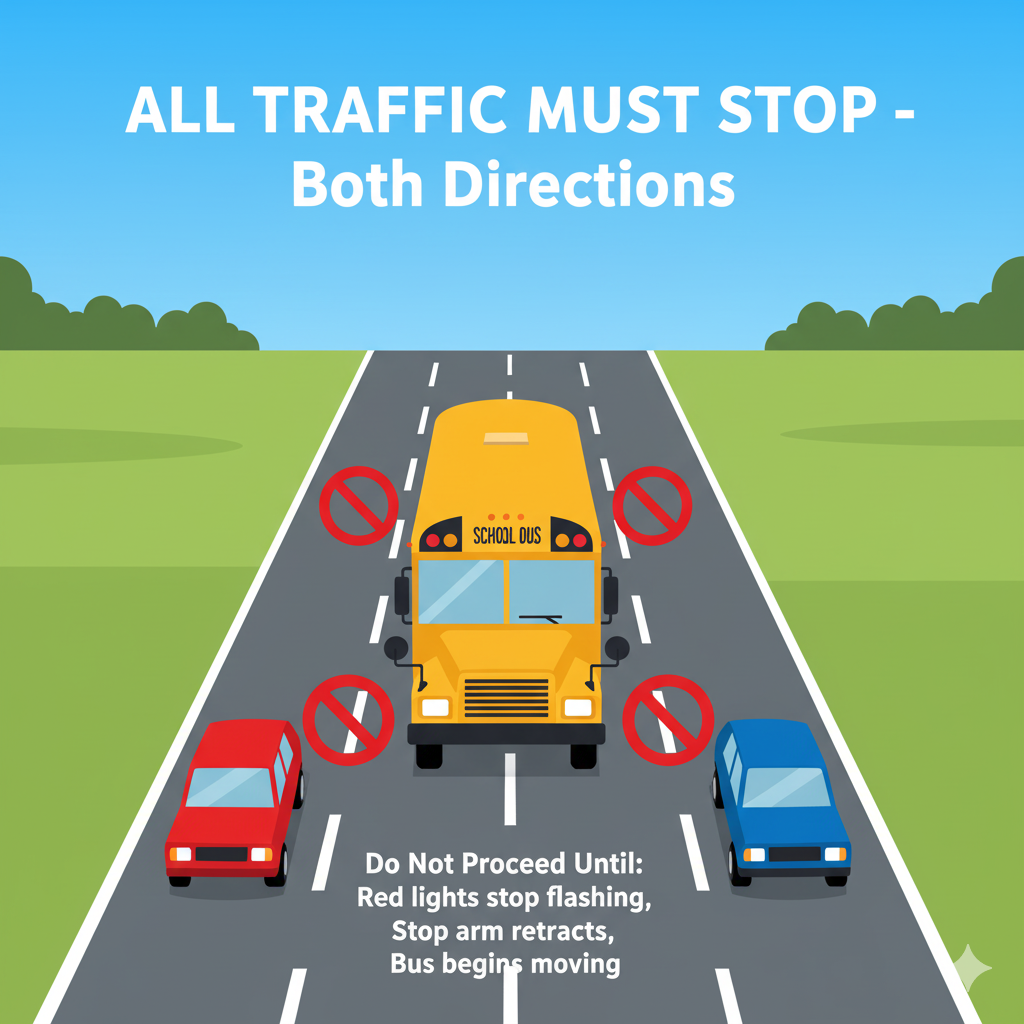
West Virginia has strict school bus stop laws designed to protect children boarding and exiting buses. Under WV Code §17C-12-7, when a school bus displays flashing red lights and extends its stop arm, all traffic traveling in both directions must stop. You may not proceed until the red lights stop flashing, the stop arm is retracted, and the bus begins moving—or until the bus driver signals you to proceed. West Virginia takes school bus safety extremely seriously and has enhanced penalties for violations.
Both-direction stopping rule on undivided West Virginia roads
On two-lane roads and multi-lane undivided highways, traffic in both directions must stop for a school bus with activated signals. This includes highways with center turn lanes or painted medians that are not physically divided. The requirement applies throughout West Virginia's rural areas, small towns, and suburban communities. Given that many children in rural West Virginia must board buses along narrow mountain roads without sidewalks, strict compliance with school bus stop laws is essential for child safety.
Divided highway exception: physical barriers and wide medians
The only exception to the both-direction stopping rule is when you are traveling in the opposite direction on adivided highway with a physical barrier or median at least 20 feet wide. This includes highways with concrete medians, guardrails, or wide grassy dividers. However, if you are traveling in the same direction as the bus or on a road divided only by pavement markings (painted median), you must stop. This exception applies to limited-access highways like I-64, I-77, and I-79, but drivers must still stop when traveling in the same direction as the bus.
Penalties for illegally passing a stopped school bus in West Virginia
Illegally passing a stopped school bus in West Virginia is a serious traffic violation with escalating penalties. First offense carries a fine of up to $500 and suspension of driving privileges for at least30 days. Second offense within five years results in fines up to $1,000 and suspension for 60 days. Third and subsequent offenses carry fines up to $1,500 and suspension for 90 days. If you cause injury or death while illegally passing a school bus, you may face criminal charges including felony vehicular assault or manslaughter. West Virginia school districts increasingly use bus-mounted cameras to identify and cite violators, and citations based on camera evidence are legally enforceable.
On undivided West Virginia roads, all traffic in both directions must stop for school buses with flashing red lights and extended stop arms.
West Virginia Mountain Driving Laws and Safety Requirements
Mountain road regulations and equipment requirements for Appalachian terrain
West Virginia's mountainous terrain presents unique driving challenges including steep grades, sharp curves, narrow roads, and rapidly changing weather conditions. While the state does not require snow tires or chains for most passenger vehicles under normal conditions, drivers are legally obligated to maintain safe speeds for current conditions under WV Code §17C-6-1. Downhill vehicles must yield to uphill vehicles when roads are too narrow for both to pass safely. This rule is especially important on narrow mountain roads and forest service roads throughout the Appalachians where turnouts are limited.
Brake inspection and runaway truck ramp requirements
West Virginia requires all vehicles to have fully functioning brakes before operating on public roads. Brake fade on long mountain descents is a serious safety hazard. Commercial vehicles must use lower gears and engine braking on steep downgrades rather than riding brakes continuously. Emergency runaway truck ramps are provided on major mountain descents like I-77 through the Big Walker Mountain tunnel and US-19 near Beckley. These ramps are designed for emergency use only when brakes fail on steep grades—unauthorized use can result in citations and recovery costs.
Snow chain and traction device requirements during winter weather
During severe winter weather, West Virginia may require vehicles to use chains or approved traction devices on certain mountain passes and highways. The West Virginia Division of Highways posts chain requirements and road closures through their 511 traveler information system and highway advisory radio. Commercial vehicles may face mandatory chain-up requirements during winter storms, especially on I-79 through the mountains, US-33 over the Allegheny Front, and other high-elevation routes. Passenger vehicles should carry emergency equipment including blankets, food, water, flashlight, and traction aids when traveling mountain roads in winter.
Steep grade safety and engine braking best practices
When descending steep mountain grades in West Virginia, use lower gears to provide engine braking and avoid overheating brakes. Never coast in neutral or with the clutch disengaged. Watch for warning signs indicating steep grades (often 6% to 10% or steeper) and slow to a safe speed before beginning the descent. On long downgrades like those on US-219 south of Elkins or WV-16 through the Cranberry Backcountry, pull into designated brake check areas if you smell burning brakes or feel brake fade. Allow brakes to cool before proceeding.
West Virginia Speed Limits, DUI Laws, and Point System Overview
West Virginia speed limits: interstate, highway, and residential regulations
West Virginia speed limits vary by road type and location. Unless otherwise posted, speed limits are 25 mph in residential districts, 15 mph in school zones when children are present or during posted hours, 55 mph on most rural highways, and 70 mph on Interstate highways. West Virginia enforces these limits strictly, especially in work zones where fines are doubled and in school zones where violations carry enhanced penalties. The state's mountainous terrain means that safe speeds are often lower than posted limits due to curves, grades, and weather conditions.
DUI laws in West Virginia: BAC limits and strict penalties
West Virginia enforces strict DUI (driving under the influence) laws. The legal blood alcohol concentration (BAC) limit is 0.08% for drivers 21 and over, 0.02% for drivers under 21, and0.04% for commercial drivers. First-offense DUI penalties include fines of $100 to $500, jail time of 24 hours to six months (or community service), license revocation for at least 15 days followed by occupational license eligibility, and possible ignition interlock device installation. Penalties increase significantly for repeat offenses or BAC levels above 0.15%, including mandatory jail time and longer license revocation periods.
West Virginia point system: accumulation and license suspension
West Virginia uses a point system to track traffic violations. Points range from 2 to 8 depending on the severity of the offense. Accumulating 12 or more points within a 24-month period results in license suspension. Points remain on your record for 2 years from the date of conviction. Completing a defensive driving course may reduce points in some cases. Major violations like reckless driving, DUI, leaving the scene of an accident, and driving on a suspended license carry the highest point penalties and mandatory license suspensions.
Reckless driving and aggressive driving penalties in mountain conditions
Reckless driving in West Virginia involves willful disregard for the safety of persons or property and can result in up to 30 days in jail, fines of $25 to $500, and 6 points on your license. Aggressive driving—which may include speeding combined with unsafe lane changes, tailgating, or running red lights on mountain roads—also carries enhanced penalties. Both offenses significantly increase insurance rates and may lead to license suspension for repeat violations. Reckless driving on narrow mountain roads with blind curves and steep drop-offs is particularly dangerous and is prosecuted aggressively by local courts.
Official West Virginia Driving Resources and DMV Links
This guide summarizes West Virginia driving laws for educational purposes only and is not legal advice. Always consult the official West Virginia Code, Division of Motor Vehicles guidance, and posted traffic signs for authoritative information. Traffic laws are subject to change—verify current regulations with official sources.