This comprehensive guide covers Wyoming's essential driving laws and traffic regulations under Wyoming Statutes Title 31 (Motor Vehicles). Whether you're navigating the scenic routes through Grand Teton and Yellowstone National Parks, driving I-80 across the state, exploring the Bighorn Mountains, or traveling through Cheyenne, Casper, or Jackson Hole, understanding state-specific traffic rules is crucial for safety. This guide provides detailed explanations of double yellow line rules, turn regulations, school bus stop laws, wildlife safety requirements, winter driving regulations, speed limits, and DUI penalties. All information references official Wyoming Department of Transportation (WYDOT) guidance and Wyoming Statutes to ensure accuracy for residents, new drivers, tourists, and outdoor enthusiasts.
Ad not loaded or not displayed
Ad not loaded or not displayed
Wyoming's scenic mountain highways require strict adherence to traffic laws, especially regarding wildlife hazards and weather conditions.
Wyoming Double Yellow Line Laws: No-Passing Zones and Legal Crossing Rules (W.S. §31-5-204)
Understanding Wyoming no-passing zones with double solid yellow centerlines
Wyoming's no-passing regulations are governed by Wyoming Statute §31-5-204, which establishes clear rules for double solid yellow centerlines. In Wyoming, double solid yellow lines indicate that passing is prohibited for traffic traveling in both directions. These markings typically appear on mountain passes, steep grades, winding canyon roads, curves, hills, and other locations where passing would create a serious safety hazard due to limited sight distance or high elevation. Wyoming's challenging terrain and frequent wildlife crossings make strict adherence to these rules especially critical for preventing head-on collisions.
When you may legally cross double yellow lines in Wyoming: left turns and driveways
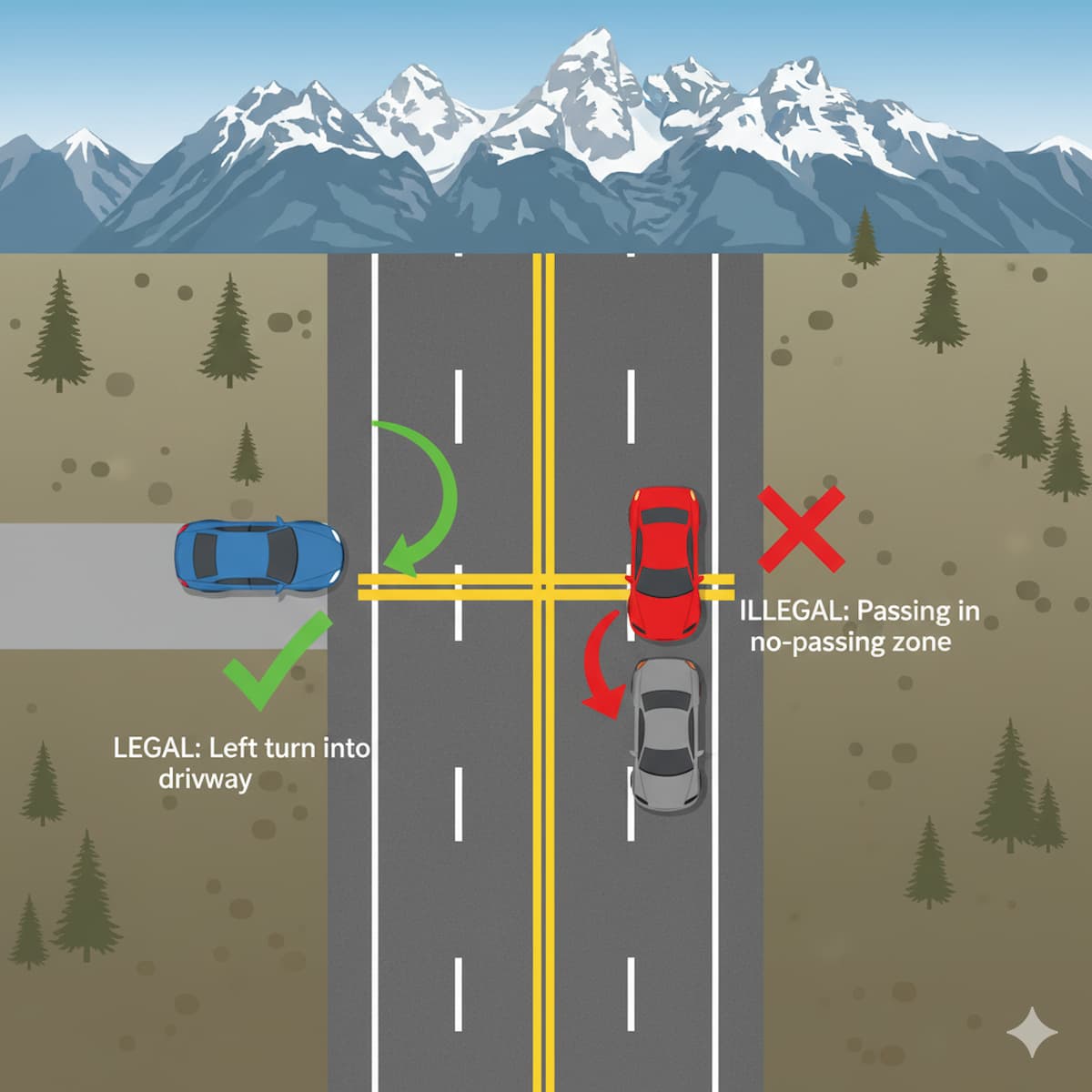
Wyoming law permits drivers to cross double yellow lines in specific situations when it can be done safely without endangering other road users. The primary legal exceptions include: (1) making a left turn into a driveway, alley, side street, or private road when safe and no signs prohibit the movement; (2) executing a U-turn where legal and sight distance requirements are met; and (3) briefly avoiding an obstruction in the roadway such as fallen rocks, debris, disabled vehicles, or wildlife when necessary for safety. These exceptions are particularly important for accessing Wyoming's numerous ranch properties, national park entrances, and scenic pullouts.
Left turn exceptions for driveways and side roads: proper execution
Making a left turn across double yellow lines is one of the most common legal exceptions in Wyoming. When executing this maneuver, drivers must signal their intention at least 100 feet in advance (Wyoming Statute §31-5-217), yield to all oncoming traffic and pedestrians, and complete the turn in a single, continuous movement without lingering in the opposing lane. This exception applies throughout Wyoming, from urban areas like Cheyenne and Casper to remote mountain highways accessing Grand Teton and Yellowstone National Parks. On highways like US-26/287 through the Tetons or US-14/16/20 through the Bighorns, proper turn execution is critical due to high tourist traffic and limited passing opportunities.
Avoiding obstructions: wildlife, rockslides, and roadway hazards unique to Wyoming
Wyoming's highways present unique challenges including frequent wildlife crossings (elk, moose, deer, antelope, bison), rockslides in mountain areas, severe weather debris, and agricultural equipment. State law permits drivers to briefly cross the centerline to avoid these obstructions when it can be done safely and no oncoming traffic is present. However, this exception does not permit passing slower-moving vehicles in no-passing zones. On highways like US-191 through Jackson Hole, Highway 296 (Teton Park Road), or WY-120 through the Bighorn Basin, drivers should be especially vigilant for wildlife that may suddenly enter the roadway, particularly at dawn and dusk. Wyoming law requires reporting wildlife collisions that result in animal injury or vehicle damage exceeding $1,000.
Penalties for illegal passing across double yellow lines on Wyoming highways
Illegally passing across double yellow lines in Wyoming can result in significant penalties. Violations typically carry fines ranging from $200 to $400 plus court costs, and 3 points added to your driving recordunder Wyoming's point system. Accumulating 12 or more points within 12 months can lead to license suspension, mandatory defensive driving courses, and substantially increased insurance premiums. Wyoming courts treat passing violations very seriously, particularly if they result in a collision or near-miss with oncoming traffic on dangerous mountain roads.
Common violation hotspots on Wyoming scenic byways and mountain passes
Law enforcement in Wyoming actively patrols popular scenic routes where illegal passing is common and especially dangerous. High-enforcement areas include Teton Pass (WY-22), Togwotee Pass (US-26/287), Beartooth Highway (US-212), Snowy Range Scenic Byway (WY-130), and Medicine Bow-Routt National Forest routes. These winding mountain roads feature numerous curves, steep grades, and elevation changes with severely limited sight distance, making passing extremely hazardous. Drivers should exercise patience and wait for designated legal passing zones marked by dashed yellow lines before attempting to overtake slower vehicles or RVs.
Ad not loaded or not displayed
Ad not loaded or not displayed
Wyoming permits crossing double yellow lines for left turns into driveways but strictly prohibits passing in no-passing zones.
Ad not loaded or not displayed
Ad not loaded or not displayed
Right Turn on Red Rules in Wyoming: Complete Stop Requirements (W.S. §31-5-214)
Wyoming right on red law: mandatory stop, yield, and proceed safely
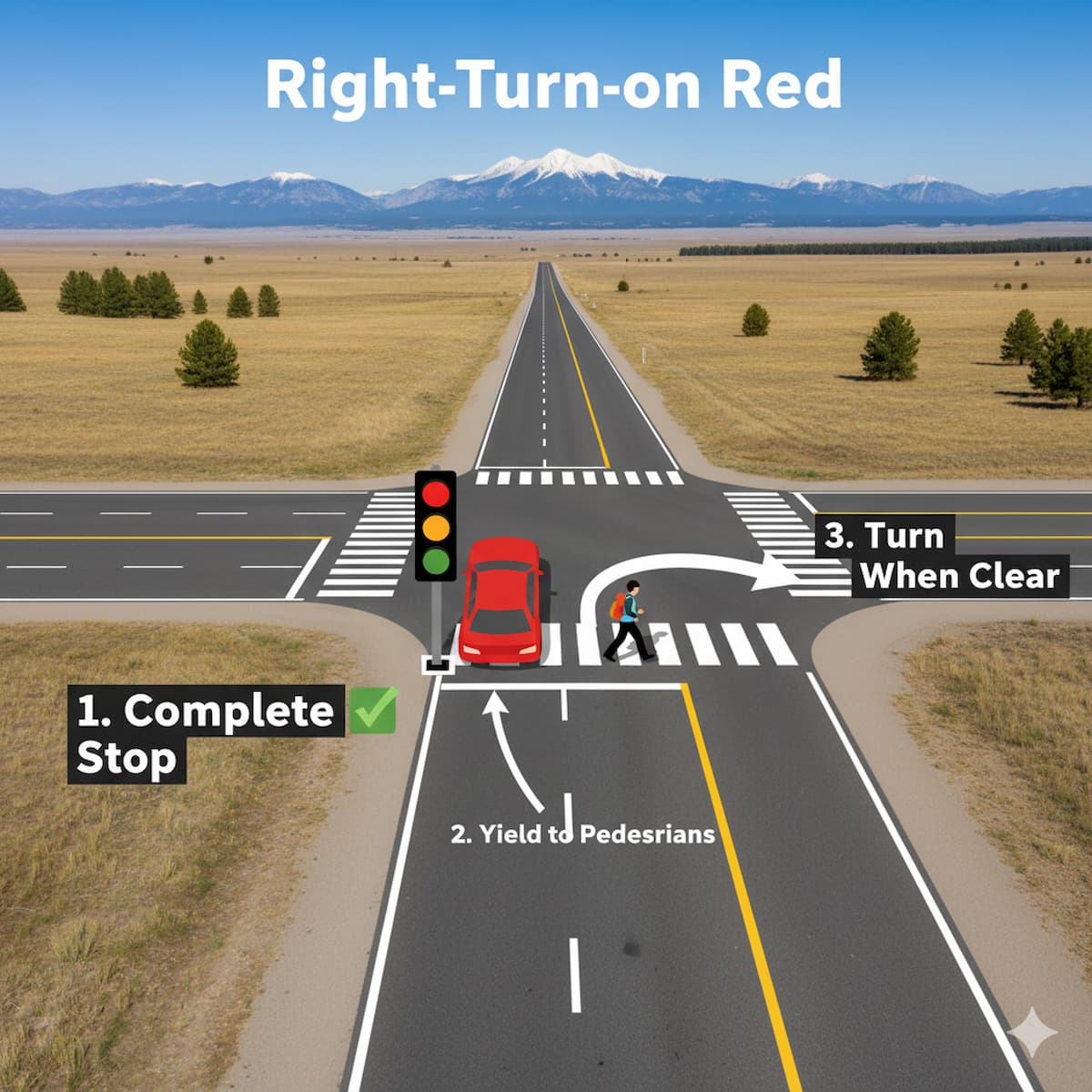
Wyoming law allows right turns on red after coming to a complete stop at the limit line, crosswalk, or point where you have a clear view of approaching traffic. Under Wyoming Statute §31-5-214, drivers must yield the right-of-way to pedestrians and vehicles lawfully proceeding through the intersection before making their turn. This fundamental rule is tested frequently on the Wyoming driver's license exam and is a critical skill for all drivers, especially in tourist-heavy areas like Jackson Hole and near national park entrances.
Complete stop requirement: no rolling stops permitted under Wyoming law
A complete stop means bringing your vehicle to a full halt with wheels completely motionless. "Rolling stops"—where the vehicle slows but never completely stops—are illegal and frequently cited by law enforcement throughout Wyoming, especially at intersections near schools, downtown areas, and tourist destinations. In cities like Cheyenne, Casper, Laramie, and Jackson, Wyoming Highway Patrol and local police actively monitor busy intersections for rolling stop violations during right turns on red. The fine for a rolling stop can reach $100-$200 plus court costs.
NO TURN ON RED signs and posted restrictions in Wyoming cities and tourist areas
Wyoming municipalities can prohibit right turns on red at specific intersections by posting "NO TURN ON RED" signs. These restrictions are common in downtown areas of Cheyenne and Casper, near the University of Wyoming in Laramie, in Jackson Hole's town square area, and at intersections with complex signal phasing or heavy pedestrian traffic near national park visitor centers. Some intersections may have time-based restrictions (e.g., "No Turn on Red 7-9 AM, 4-6 PM") that apply only during posted hours, particularly near schools. Always check for signage before turning.
Pedestrian right-of-way and crosswalk safety in national park gateway communities
Before executing a right turn on red, drivers must thoroughly scan the crosswalk for pedestrians who have started crossing or are about to enter. Wyoming law requires drivers to yield to pedestrians in crosswalks at all times under Wyoming Statute §31-5-703. This is especially critical in gateway communities like Jackson (Grand Teton), Cody (Yellowstone East), and Moose (Grand Teton South Entrance), where tourist pedestrian traffic is heavy during summer months. Failing to yield can result in fines up to $235, points on your license, and significantly increased penalties if a pedestrian is struck.
Left Turn on Red in Wyoming: One-Way Street Exception Rules
When left on red is permitted: one-way to one-way street regulations
Wyoming permits left turns on red from a one-way street onto another one-way street after coming to a complete stop, unless prohibited by signage. This lesser-known rule can improve traffic flow in urban grid systems but requires the same extreme caution as right turns on red. Drivers must yield to all pedestrians and vehicles with the right-of-way before proceeding. Check our detailed guide on left on red from one-way to one-way for specific scenarios and best practices applicable to Wyoming cities.
Signal compliance and safe execution of left turns on red lights
Just like right on red, you must make a complete stop at the stop line or crosswalk before turning left on red. Scan for oncoming traffic from all directions, watch carefully for pedestrians in the crosswalk (especially outdoor recreationists carrying equipment), and only proceed when the intersection is completely clear. Protected-turn signals (green arrows) and "No Turn on Red" signs override the default permission to turn left on red.
Downtown restrictions and urban area signage in Wyoming cities
In downtown Cheyenne, Casper, and Jackson, be especially alert for posted restrictions on left turns on red. High-traffic intersections and areas with heavy pedestrian activity may prohibit the maneuver entirely during peak tourist seasons (June-September). When in doubt, wait for a green signal or green arrow before proceeding. This is particularly important in Jackson's town square area where tourist foot traffic is constant during summer and winter ski season.
Ad not loaded or not displayed
Ad not loaded or not displayed
Both right and left turns on red in Wyoming require a complete stop and yielding to all traffic and pedestrians.
Ad not loaded or not displayed
Ad not loaded or not displayed
Wyoming U-Turn Laws: When and Where U-Turns Are Legal (W.S. §31-5-208)
Legal U-turns in Wyoming: safety requirements and location restrictions
U-turns are generally legal in Wyoming when they can be made safely and do not interfere with other traffic. However, Wyoming law prohibits U-turns in certain locations under Wyoming Statute §31-5-208. You may not make a U-turn on any curve or near the crest of a hill where your vehicle cannot be seen by other drivers approaching from either direction within 500 feet. U-turns are also prohibited in business districts unless made at an intersection or where permitted by traffic control devices. For comprehensive guidance on U-turn regulations, see our detailed article on U-turns across double yellow lines.
Sight distance requirements for safe U-turn execution on Wyoming highways
When making a legal U-turn in Wyoming, ensure you have adequate sight distance in both directions—typically at least 500 feet on rural highways and mountain roads. Signal your intention clearly, check mirrors and blind spots thoroughly, yield to all approaching vehicles and pedestrians, and execute the turn in a single, smooth motion without stopping in the opposing lane. Choose wide intersections, areas with center turn lanes, or designated U-turn locations when possible. On narrow mountain highways like Teton Pass or the Beartooth Highway, designated pullouts and turnarounds are the safest option rather than attempting U-turns in traffic.
Posted NO U-TURN signs near national parks and business districts
Wyoming municipalities and the National Park Service post "NO U-TURN" signs at specific locations where U-turns would create hazards or disrupt traffic flow. These restrictions are common in business districts of Cheyenne and Casper, at national park entrance gates (Grand Teton, Yellowstone), in school zones, near popular trailheads and overlooks, and at high-traffic tourist areas. These restrictions are enforceable by law, and violations can result in fines starting at $100-$200 and points on your license. In busy tourist areas like Jackson's town square or near Old Faithful in Yellowstone, watch carefully for U-turn prohibitions before attempting the maneuver.
U-turn citations and defensive driving best practices in mountain terrain
Illegal or unsafe U-turns in Wyoming can result in fines and 3 points on your license under the state's point system. To avoid citations and potential accidents, only make U-turns where visibility is excellent, traffic is light, and no signs prohibit the maneuver. On highways through the Tetons, Bighorns, or Wind River Range, where sight distance may be severely limited by terrain and curves, it's often much safer to continue to the next legal turning opportunity, designated pullout, or intersection rather than risk an illegal or dangerous U-turn in traffic. Remember that mountain highways often have limited shoulders and steep drop-offs, making U-turn mistakes potentially catastrophic.
Wyoming School Bus Stop Laws: Protecting Children (W.S. §31-5-1301)
When you must stop for school buses with flashing red lights and stop arms
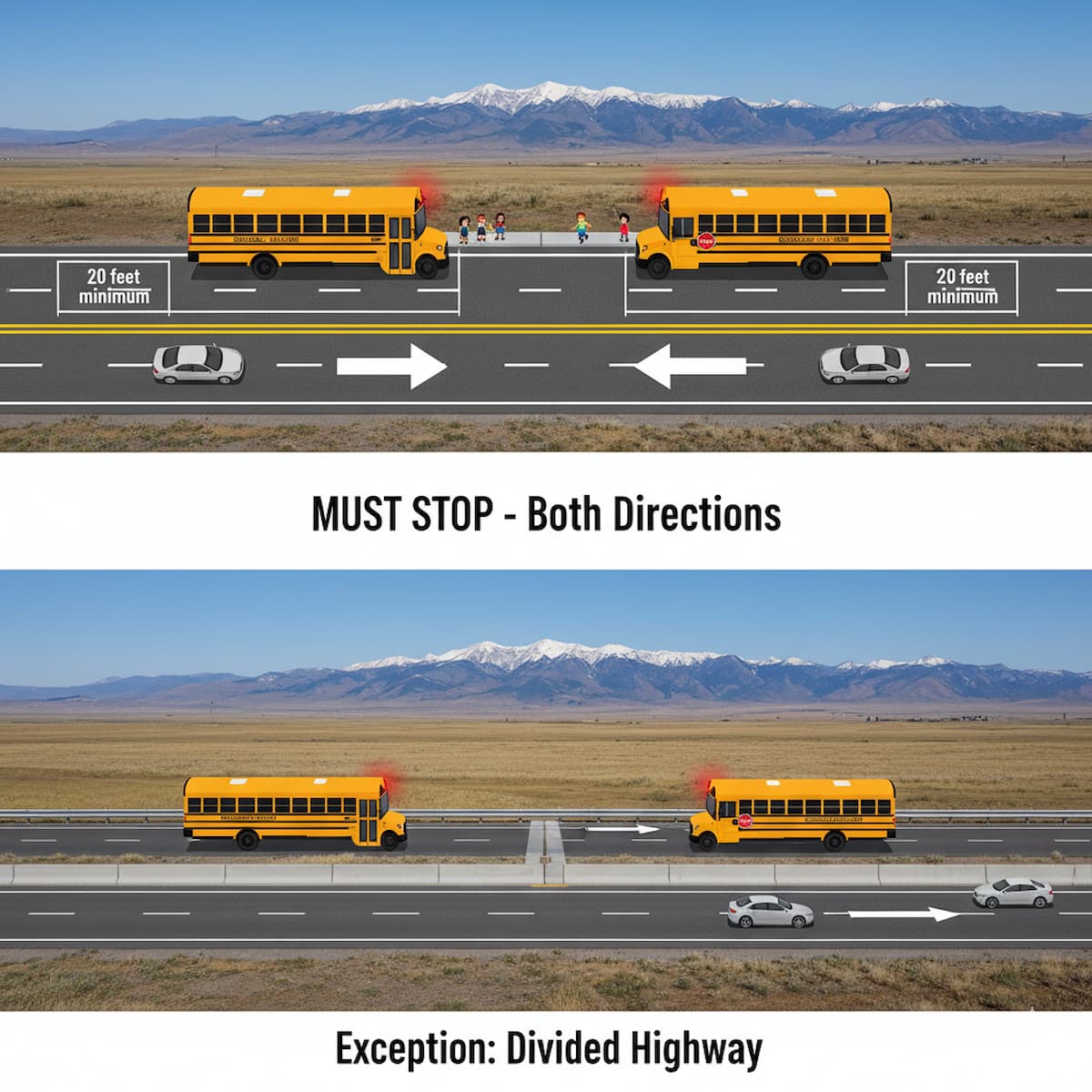
Wyoming has strict school bus stop laws designed to protect children boarding and exiting buses in rural areas and towns. Under Wyoming Statute §31-5-1301, when a school bus displays flashing red lights and extends its stop arm, all traffic traveling in both directions must stop at least 20 feet from the bus. You may not proceed until the red lights stop flashing, the stop arm is retracted, and the bus begins moving—or until the bus driver signals you to proceed. Wyoming's law specifies the 20-foot minimum distance requirement, which is critical on narrow rural roads.
Both-direction stopping rule on undivided Wyoming roads and highways
On two-lane roads and multi-lane undivided highways, traffic in both directions must stop for a school bus with activated signals. This includes highways with center turn lanes or painted medians that are not physically divided. The requirement applies throughout Wyoming's rural areas, small towns like Lander, Sheridan, Gillette, and Rock Springs, and suburban communities. Given Wyoming's vast rural landscape, many school bus stops occur on highways and county roads where high-speed traffic must slow and stop.
Divided highway exception: physical barriers and median requirements
The only exception to the both-direction stopping rule is when you are traveling in the opposite direction on adivided highway with a physical barrier or raised median separating the directions of travel. This includes highways with concrete medians, guardrails, cable barriers, or substantial grassy dividers. On I-80, I-25, and other Wyoming interstate highways, drivers in the opposite direction are not required to stop. However, if you are traveling in the same direction as the bus or on a road divided only by pavement markings (painted median), you must stop.
Penalties for illegally passing a stopped school bus in Wyoming
Illegally passing a stopped school bus in Wyoming is a serious traffic violation with severe consequences. First-time offenders face fines of up to $500, 4 points on your driving record, and potential license suspension. Wyoming Statute §31-5-1301 authorizes school districts to install cameras on buses to record violations, and video evidence is admissible in court. Repeat violations carry mandatory license suspension and higher fines. If you cause injury or death while illegally passing a school bus, you may face criminal charges including vehicular homicide, which carries prison time. Wyoming takes school bus safety extremely seriously due to the state's rural character and long bus routes.
On undivided Wyoming roads, all traffic in both directions must stop at least 20 feet from school buses with flashing red lights.
Ad not loaded or not displayed
Ad not loaded or not displayed
Wyoming Winter Driving Laws and Mountain Pass Safety Requirements
Winter weather driving regulations and traction device requirements
Wyoming winters bring some of the nation's most challenging driving conditions including heavy snow, severe ice, high winds exceeding 60 mph, blizzards, and sudden whiteout conditions. While Wyoming does not mandate snow tires for passenger vehicles statewide, WYDOT can require chains or adequate traction devices on specific mountain passes during winter storms. Common chain requirement areas include I-80 over the Continental Divide (between Laramie and Rawlins), US-26/287 over Togwotee Pass, WY-22 over Teton Pass, and sections of I-25 south of Casper.Studded tires are permitted from October 1 through May 31 each year in Wyoming.
I-80 closures, high wind warnings, and WYDOT road condition alerts
Wyoming's I-80 corridor is notorious for frequent closures during winter due to high winds and blizzard conditions. WYDOT closely monitors conditions and can close stretches of I-80 for hours or days when wind speeds exceed safe limits or visibility drops to zero. Drivers must check wyoroad.info or call 511 before traveling during winter months. Violating road closure barricades is illegal and carries fines up to $750. All vehicles must have fully functioning headlights, taillights, brake lights, and windshield wipers before operating on public roads during winter conditions.
Reduced speed requirements for weather conditions on mountain passes
Even when posted speed limits are higher, Wyoming's "basic rule" requires drivers to travel at speeds safe for current weather, visibility, and road conditions under Wyoming Statute §31-5-301. During winter storms, blizzards, or when roads are icy, driving at the posted speed limit can still be considered "too fast for conditions" and result in a citation. This is particularly critical on high-altitude mountain passes like Togwotee Pass (US-26/287, elevation 9,658 feet), Teton Pass (WY-22, elevation 8,431 feet), and the Snowy Range Pass (WY-130, elevation 10,847 feet), where weather can change rapidly and conditions deteriorate quickly.
Snow removal requirements and ice sheet hazards from vehicles
Wyoming law requires drivers to clear ice and snow from all windows, mirrors, headlights, taillights, license plates, and the vehicle roof before driving. Failure to remove snow and ice can result in citations for impaired visibility or creating road hazards when ice sheets fly off at highway speeds and strike other vehicles. This is a particular concern on I-80 and I-25 where trucks and RVs traveling at 70+ mph can shed dangerous ice chunks. Drivers should use a snow brush and scraper to thoroughly clear their vehicles before entering traffic.
Wyoming Speed Limits, DUI Laws, and Point System Overview
Wyoming speed limits: interstate, highway, and urban area regulations
Wyoming speed limits vary by road type and location. Unless otherwise posted, speed limits are 30 mph in urban districts, 20 mph in school zones (when children are present or during posted hours),65 mph on most rural two-lane highways, and 75-80 mph on interstate highways. I-80 and I-25 have 80 mph speed limits in many rural sections, making Wyoming one of the highest speed limit states in the nation. However, these high limits apply only in good weather conditions—the "basic rule" requires reducing speed for weather, visibility, and traffic conditions.
DUI laws in Wyoming: BAC limits and strict penalties
Wyoming enforces strict DUI (driving under the influence) laws. The legal blood alcohol concentration (BAC) limit is 0.08% for drivers 21 and over, 0.02% for drivers under 21, and 0.04% for commercial drivers. First-offense DUI penalties include fines up to $750, jail time up to 6 months, license suspension for 90 days, and possible ignition interlock device installation for 6 months. Wyoming also has an "aggravated DUI" offense for BAC of 0.15% or higher, which carries enhanced penalties including mandatory jail time and longer license suspension. Penalties increase dramatically for repeat offenses or DUI causing injury.
Wyoming point system: accumulation thresholds and license suspension rules
Wyoming uses a point system to track traffic violations. Points range from 3 to 8 depending on the severity of the offense. Accumulating 12 or more points within 12 months results in license suspension for 90 days. Points remain on your record for 1 year from the conviction date. Major violations like reckless driving (8 points), DUI (8 points), and leaving the scene of an accident (12 points) carry the highest penalties. Completing a defensive driving course may prevent suspension in some cases, but only once every 3 years.
Reckless driving, aggressive driving, and excessive speed penalties
Reckless driving in Wyoming involves willful or wanton disregard for the safety of persons or property and can result in up to 6 months in jail, fines up to $750, and 8 points on your license. Excessive speeding— typically defined as exceeding the posted limit by 20 mph or more—carries enhanced penalties including possible jail time and mandatory court appearance. Both offenses significantly increase insurance rates and can lead to license suspension for repeat violations. Given Wyoming's high speed limits, even brief lapses in attention can result in excessive speed violations.
Ad not loaded or not displayed
Ad not loaded or not displayed
Official Wyoming Driving Resources and WYDOT Links
This guide summarizes Wyoming driving laws for educational purposes only and is not legal advice. Always consult the official Wyoming Statutes, WYDOT guidance, and posted traffic signs for authoritative information. Traffic laws are subject to change—verify current regulations with official sources. Pay special attention to winter road conditions, wildlife crossing zones, and mountain pass safety requirements when traveling in Wyoming.