Road Markings
Yellow vs White Lines Explained
A concise guide to U.S. pavement markings: what yellow and white lines mean, how single/double and solid/broken patterns work, and when you may cross them. For deep detail, see Double Solid Yellow Line Rules.
Quick Reference: What Do Yellow and White Lines Mean?
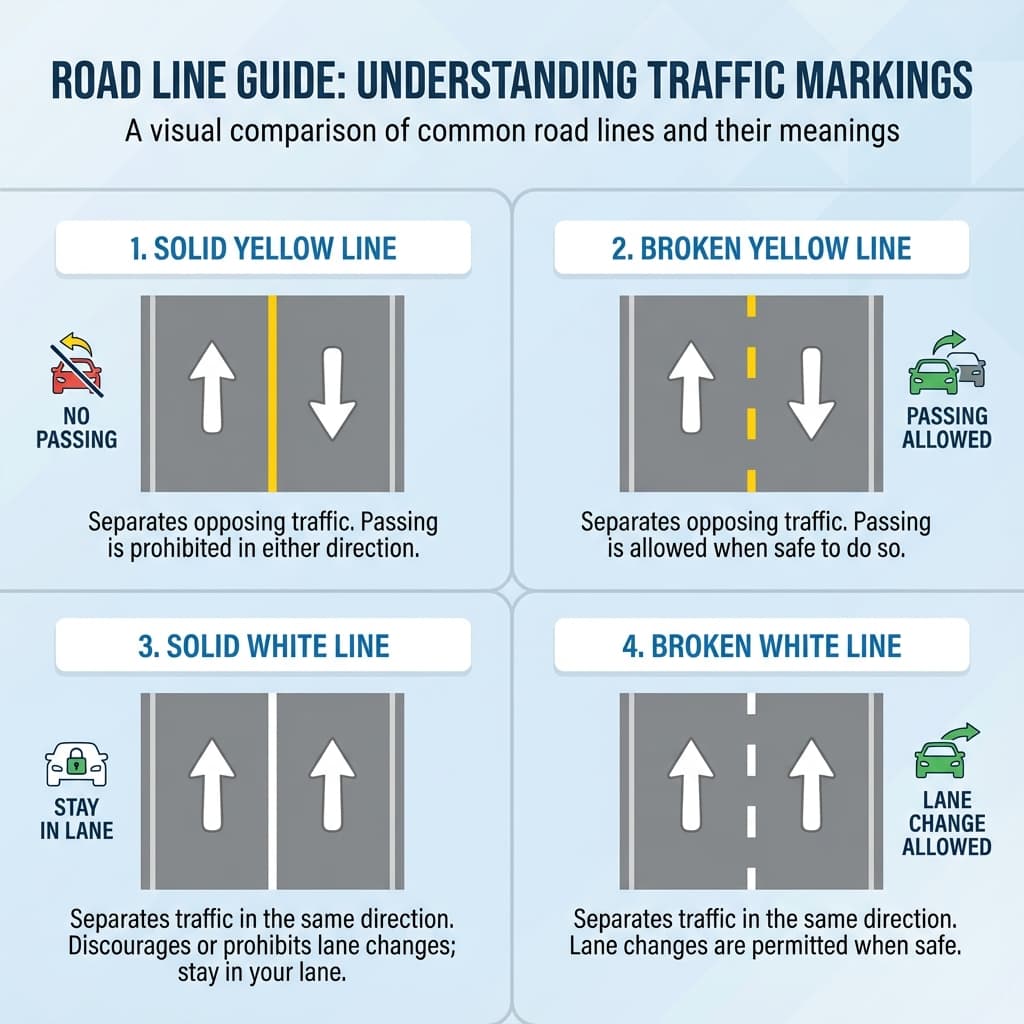
Key Differences at a Glance:
- Yellow Lines: Separate traffic flowing in opposite directions
- White Lines: Separate traffic in the same direction or mark the right edge
- Solid: Stay in lane (crossing discouraged or prohibited)
- Broken/Dashed: You may change lanes or pass when safe
- Double Lines: Stricter than single lines (Double Yellow = No Passing)
- Yellow lines on road (solid yellow road line) mark opposing traffic separation and usually signal no passing unless paired with a broken segment on your side.
- Edge lines: right edge is a solid white line; divided-highway left edge may be a solid yellow line.
- Drivers edu traffic lines explained: this guide gives pavement markings and provides the description/name and its meaning.
Yellow Lines: Centerlines and Passing Rules
Yellow = Opposing Traffic
Yellow lines always indicate that traffic on the other side is moving in the opposite direction. Never drive to the left of a yellow line unless you are passing (where allowed) or turning.
- Yellow line vs white line: yellow = opposing traffic; white = same direction.
- Single yellow line (solid): warning not to pass from your side; check local law before crossing.
- Double solid yellow lines: two-way no-passing. Full rules in Pillar A.
- Solid + broken yellow combinations: the side with the broken line may pass when safe; the solid side may not.
- Broken yellow line alone: passing allowed when safe and clear.
- Yellow center line shows traffic flowing in opposite directions; a double yellow line in the center of a highway means no passing.
- A double yellow line on road / double yellow lines on road both mark opposing traffic separation; wait for a broken line on your side before passing.
- A yellow center line shows traffic flowing in _____ directions: two (opposite) directions.
- Double vs single road lines: double = stricter barrier; single = warning for your side.
White Lines: Same-Direction Separation and Edges
White = Same Direction
White lines separate lanes moving in the same direction. They also mark the right edge of the roadway.
- Single broken white line: you may change lanes when safe.
- Single solid white line: same-direction lanes—avoid crossing unless necessary.
- Double solid white line: do not cross (HOV/express/toll boundaries).
- Which line is used to mark the right edge of a road? A solid white line on the right edge of the highway.
- White lines indicate traffic flowing in one direction or the right edge of a road.
- You may cross a single solid white line in the highway? Usually discouraged but not always illegal; double white is a hard do-not-cross.
Solid vs Broken: How to Read the Pattern
- Solid = stay put; crossing discouraged or prohibited.
- Broken/dashed = movement allowed when safe.
- Mixed centerlines (solid/broken) tell you which side may pass.
- Double double yellow lines vs double yellow lines: the “double-double” (two sets separated by a gap) acts as a painted barrier—do not cross.
- Solid yellow with broken line driving lto: the broken side may pass; the solid side may not—watch which side you are on.
Single vs Double: Strength of the Message
Tip
Double lines are stricter than single lines.
- Single Solid: Warning / Discouraged
- Double Solid: Prohibited / Barrier
- Single solid yellow or white: advisory/soft restriction.
- Double solid yellow: two-way no-passing (see Pillar A).
- Double solid white: same-direction no-crossing.
- Single white lines vs double: double is a hard do-not-cross.
- Single solid yellow line vs double solid yellow line: double is stricter; both signal no-passing from your side.
Edge Lines and Where They Appear
- Right edge: solid white line on road; stay to its left.
- Left edge of divided highways: solid yellow line may appear by itself to mark the median side.
- Yellow line on the side of the road indicates the left edge of a divided roadway; white marks the right edge.
- Lines parallel to road meaning: parallel edge lines define the travel way; do not drive in the buffer beyond them.
Diagonal, Horizontal, and Channelizing Markings
Warning
Do not drive on diagonal stripes.
Diagonal yellow stripes or horizontal lines mark neutral areas (gore zones) or channelization. These are not travel lanes.
- Diagonal yellow stripes on streets and highways: channelizing or neutral areas—do not drive or stop in them.
- Horizontal yellow lines or chevrons: gore areas near ramps; stay out.
- Painted medians with double solid yellow lines on both sides: treated as a painted barrier; cross only at marked openings.
- Two sets of solid double yellow lines spaced two or more feet apart are considered a barrier—do not cross.
- Horizontal yellow lines on road: gore or neutral zones—remain out of these areas.
- Distance between dotted yellow lines on a single road: often 10-foot stripes with 30-foot gaps unless a local standard specifies otherwise.
Passing Zones and Turn Lanes
- A solid yellow line on your side indicates a no-passing zone.
- A broken yellow line next to your lane indicates you may pass when safe.
- Two-way left-turn lanes (often bordered by double yellow or double-double): use only for turning, not for passing or queueing long distances.
- Reversible or managed lanes may use double broken yellow lines; obey signals and time-of-day rules.
- What is a broken yellow line? A passing-permitted centerline when safe.
- What does a broken yellow line mean? Passing is allowed when safe. What does a broken yellow line next to your driving lane indicate? You may pass after yielding to oncoming traffic.
- What do broken line (dotted line) pavement markings indicate? Lane changes or passing permitted when safe (not a travel zone for lingering).
- Solid yellow with broken line driving lto: the broken side may pass; the solid side may not.
- What dloes a broken yellow l / brokeb yellow line: common misspellings of “broken yellow line,” meaning passing permitted when safe.
- Single yellow lines can you do a left turn? Yes, where not prohibited and safe; treat it like a limited exception similar to double yellow rules.
Common Questions (Drivers-Ed Style)
- What do yellow lines mean on the road? Opposing traffic separation; solid vs broken governs passing.
- What do yellow and white solid lines mean? Yellow = opposing separation; white = same-direction separation/edge; both discourage or prohibit crossing.
- Road markings / pavement markings meaning? They communicate lane use, passing permission, and edges; do not enter striped buffers.
- Pavement markings and provide the description/ name and its meaning. This guide and its companion pillars spell out the naming and rules.
- Which type of line indicates that you may change lanes when safe to do so? A dashed/broken white line.
- What colour lines separate traffic travelling in opposite directions? Yellow.
- Road lines meaning Philippines: standards may differ; always follow local rules.
- Pavement markings and provide the description/ name and its meaning: this guide and its companion pillars spell out the terminology and rules.
FAQ
Frequently Asked Questions
What is the difference between yellow and white lines?
Yellow separates opposing traffic; white separates same-direction traffic or marks edges. Crossing rules depend on solid vs broken and single vs double.
When can you change lanes across a white line?
Across a broken white line when safe. A single solid white is discouraged to cross; double solid white is typically prohibited.
What do diagonal yellow stripes mean?
They mark channelizing or neutral areas—do not drive or stop there; use only marked openings.
Where can I learn the full double yellow rules?
See Double Solid Yellow Line: Meaning, Rules, and When You Can Cross It for crossing, passing, and exception details.